
Inbound Call Handling
Every inbound call answered. Every lead captured. No hold.
Workforce Wave handles every inbound call simultaneously — qualifying the lead, capturing structured intake data, and routing by priority. Predictable monthly pricing. No queue.
Inbound Call — Real-Time Processing
How It's Different
AI inbound handling vs a traditional answering service.
The output of a traditional answering service is a voicemail transcript. The output of Workforce Wave is a filed lead record with structured intake data in your CRM.
Natural Conversation
Callers describe what they need in plain language. The AI understands and responds — no numbered menus, no 'say or press 1.' Completion rates for AI-native conversations are significantly higher than traditional IVR flows.
Structured Output
Every call produces structured data: caller name, contact info, intent category, urgency level, and whatever intake fields your business requires. This data syncs to your CRM automatically — not as a voicemail transcript, but as a properly filed lead record.
Concurrent Capacity
A human call center agent handles one call at a time. WFW handles every simultaneous call with the same quality. A call spike at 8am Monday does not create a queue.
Consistent Quality
Every caller gets the same carefully designed conversation. No off-script days, no missed questions, no tired-Friday quality dips. The agent follows your intake protocol exactly, every time.
Inbound call handling questions.
What is an inbound call handling service?
An inbound call handling service answers incoming calls on behalf of your business, qualifies callers, routes them appropriately, and captures their information. Traditional services use human agents at a call center. Workforce Wave uses AI — which means every call is answered simultaneously, structured data is captured automatically, and your cost is flat monthly rather than per-minute or per-agent.
How is AI inbound call handling different from a traditional answering service?
Traditional answering services use human operators who take down caller information and relay it to you by voicemail or email. The output is unstructured. AI inbound call handling conducts a real conversation, extracts specific intake data (service type, urgency, contact info, appointment preference), and pushes that data as a structured record directly into your CRM or scheduling system. With a traditional answering service, someone still has to call the lead back and re-collect the information. With WFW, the intake is done during the call.
Can an AI handle complex inbound call flows?
Yes. WFW supports multi-branch conversation flows — if a caller is asking about an emergency, the flow goes one direction; if they are asking about pricing, it goes another. You define the logic during onboarding, and the AI follows it on every call. For situations outside the agent's configured scope, WFW escalates: live transfer, SMS alert to on-call staff, or callback scheduling.
What happens if the call volume spikes unexpectedly?
Unlike a call center where a spike creates hold times, WFW handles every concurrent call simultaneously. There is no queue and no hold music. Each caller gets the same first-ring response regardless of how many other calls are happening at the same moment.
Does inbound call handling work for after-hours calls?
Yes — and after-hours is where the value is most visible. When a potential customer calls at 9pm or on Saturday morning and reaches a thoughtful AI receptionist instead of voicemail, they are far more likely to complete the intake and book. WFW operates 24/7/365 with no staffing changes required.
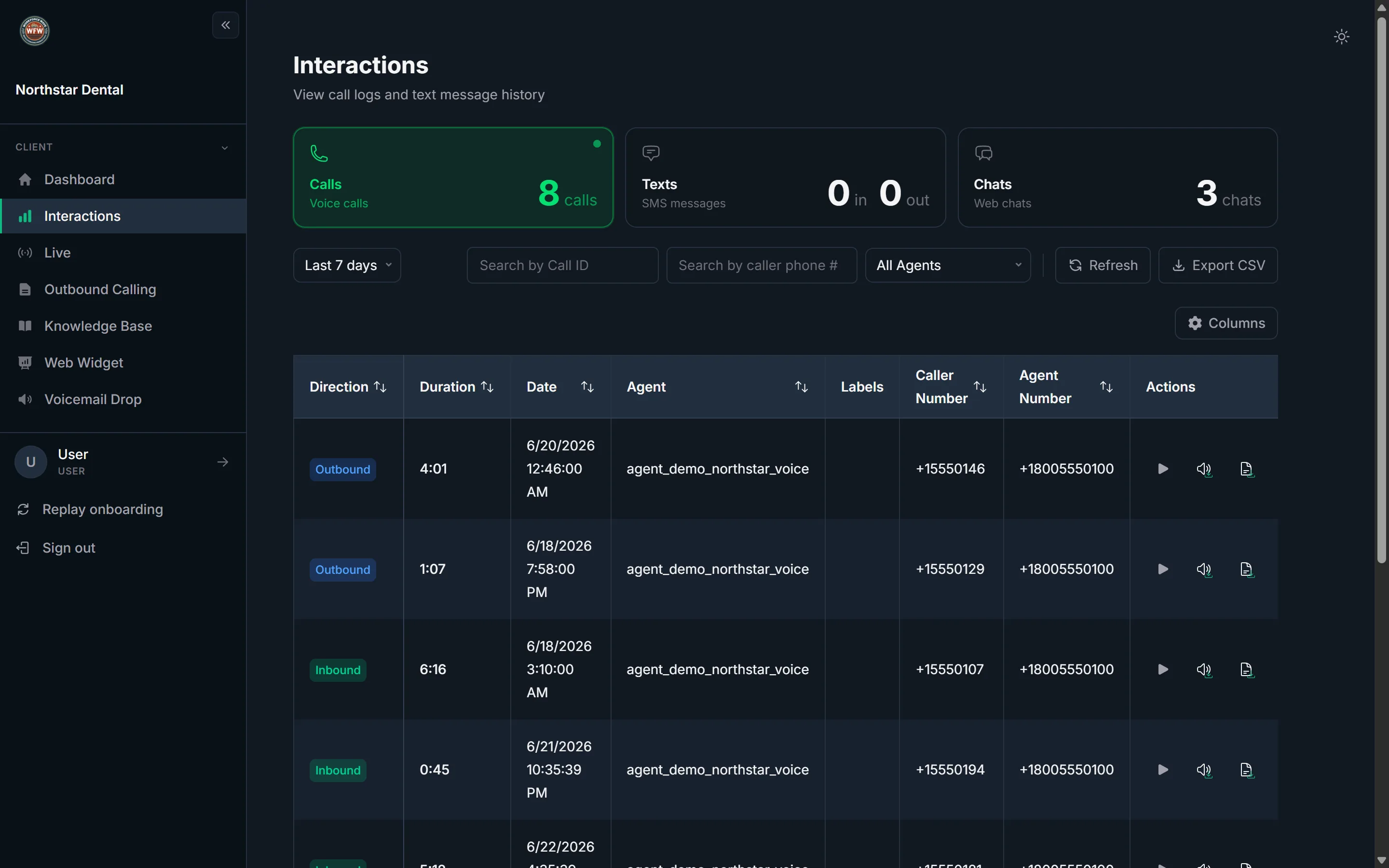
Live Dashboard
Every interaction, one inbox.
Handle every inbound call — without adding headcount.
Workforce Wave manages your inbound calls so your team can focus on work that actually requires human attention.
Start free today