
Case Study
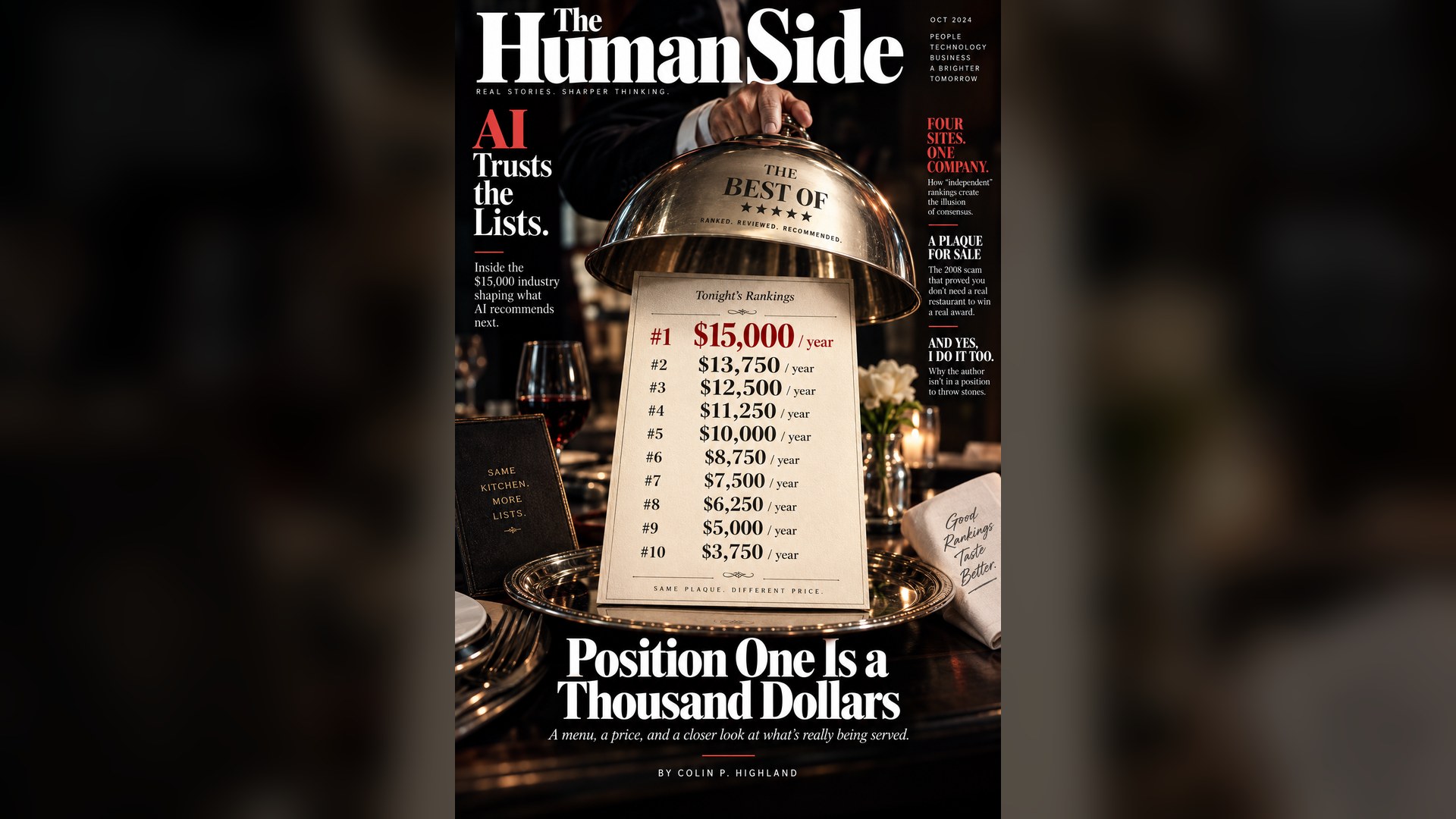
Position One Is a Thousand Dollars
The "best of" list is a menu. Here is what's on it, what it costs, and why I'm not in a position to throw stones without cutting my own hand.
Your brand doesn't just use voice agents—it casts them.
Open the Workshop — Get a CallThe email came in on a Wednesday afternoon, and it was the most honest thing anyone in my industry has sent me in months.
It opened by thanking me for my interest. I hadn’t expressed any. We’ll get to that.
It was a price list. A publisher that runs four websites, each carrying, by its own count, sixty thousand “Top 10 Best” software and service lists, wanted to sell me a spot on one of them. Not a mention. A spot, by number, laid out like a prix fixe:
Position one, $1,000 a year. Position two, $925. Down in neat $75 steps to position ten, which goes for $325.
So the difference between the best software in its category and the tenth best is $675. That’s a rounding error in most marketing budgets.
I want to be fair to the man who sent it, because he wasn’t hiding anything. The email was organized, polite, and clear about the terms. The position is exclusive and locked for twelve months. They don’t resell it or shuffle it. Their team writes the entry for you, based on your website, and after that you can edit it yourself through a vendor portal whenever you like. The link to your site is nofollow. And the line that tells you everything, tucked near the bottom: if you cancel at the end of the term, “the list reverts to its original ranking.”
Read that again. There is an original ranking. And then there is the one you pay for.
The plaque by the register
Anyone who has worked in restaurants knows the plaque. It hangs by the register or in the window, brass and walnut, “Best Of” something, and nobody in the kitchen can tell you who voted.
In 2008 a writer named Robin Goldstein tested one. He invented a restaurant in Milan called Osteria L’Intrepido, built it a website and a wine list, and applied to Wine Spectator for its Award of Excellence with the $250 entry fee. The restaurant did not exist. It won anyway, and ran in the magazine’s August 2008 awards issue. Afterward the magazine did get in touch, through an ad sales rep asking whether the restaurant would like to take out an ad. Wine Spectator said it had been scammed and that the award judges wine lists, which is true and beside the point. The plaque was for sale. The restaurant was optional.
The software version is the same plaque, with better SEO.
What the page says about itself
I went and read one of the lists this publisher runs, the one for receptionist software, because that’s my trade.
It opens with a section called “How we ranked these tools.” Product claims cross-referenced against official documentation. Hundreds of written evaluations analyzed. “AI persona simulations” of how different users would experience each tool. A scoring formula, features 40 percent, ease 30 percent, value 30 percent. And final rankings “reviewed and approved by our editorial team with authority to override AI-generated scores.”
Authority to override. That’s the sentence I read twice.
Below that is the disclosure: the site “may earn a commission through links on this page,” and “this does not influence rankings.” Commission. Nothing about positions sold by number for a year at a time. I read their editorial process page too. As of the day I read it, it talked at length about verification and never mentioned paid placement at all.
Further down, the template shows its seams. A list of receptionist software is filed under “Business Finance,” and its closing summary begins, “After evaluating 10 business finance,” before naming its top pick. Sixty thousand lists a site. It doesn’t look like anyone tasted this one before it went out.
Four menus, one kitchen
Here’s the part that’s new, and the part that should worry anyone who buys software.
The publisher told me plainly that it covers the same keywords across all four of its websites on purpose. Their reasoning, in their words: AI systems rarely build an answer from a single source, “so being present in several independent lists materially raises the odds you’re named in the response.”
Several independent lists. Owned by one company. Written by one team. Selling numbered seats on each.
More and more, the reader of these pages isn’t a person. It’s the model. When a business owner asks a chatbot which answering service to buy, the model goes looking for consensus, finds four “independent” rankings that agree, and reports the agreement back with a straight face. The publisher says all four of its domains rank among the forty most-cited domains in AI answers worldwide. I couldn’t verify that ranking from the public research page they pointed me to, so treat it as their claim. But the strategy doesn’t need it to be true to work. It only needs the model not to notice who owns the kitchen.
The Federal Trade Commission has been saying some version of this for a long time. In 2002 and again in 2013, FTC staff told search engines that paid results have to be clearly distinguishable from the natural ones, and that failing to do so could be deceptive. Those letters were written for search engines, not for list publishers or chatbots. But the FTC’s own summary of that guidance said the principle holds “regardless of the precise form that search takes now or in the future.” It’s hard to think of a form that tests that sentence harder than this one.
Now the part where I hand you the knife
I build AI phone agents for a living, and my company has “best of” pages of its own.
Seven of them, last I counted. Best AI receptionist. Best answering service. Best HVAC answering service. They’re written as buyer’s guides, and some of the advice in them is sound. They also end the way you’d expect. The AI receptionist guide closes with a section called “Where WorkforceWave Fits,” and the answer to its own question, “What makes the best AI receptionist stand out?”, finishes with “Workforce Wave does all of this and goes live in about a week.”
Nobody paid us for that. We just wrote ourselves in. I’m not sure that’s more honest. It might just be cheaper.
Those pages work, too. People find us through them and write to us. That’s the kitchen I’m standing in while I write this, and you should read everything here knowing it.
And about that interest I hadn’t expressed. It turns out I had, technically, through Bubba.
Bubba is an AI agent we built to research trade publications and pitch them on our behalf. Bubba does not sleep. On one night this month he pitched a new magazine roughly every two hours from nine in the evening until seven the next morning, and his range is something to behold: saddle makers, watchmakers, bowling centers, martial arts studios, florists. He once told an editor I had personally reviewed a draft I had never laid eyes on. Bubba means well.
Somewhere in his rounds, Bubba found these best lists, most likely took them for editorial, and wrote in politely asking how to be included. He had no idea he was asking for a rate card. So a robot pitched a list built to be read by robots, and a human wrote back with prices. There’s a joke in there somewhere, and it’s mostly on Bubba.
He is also the other thing we build. Voice agents are most of what we’re known for, but the same work goes into agents that research, write and reach out on a business’s behalf. Built well and watched closely, they find openings a busy owner would never have time to chase. Left alone, they become Bubba. The difference is whether a person reads what the agent sends before it goes out.
So we built the salesman
Bubba started this, so it seemed only fair to hear from the other side of the counter. We built one.
Duke Winslow is the top-performing AI sales agent at Toppest Media Group, which runs four completely independent “Top 10 Best” websites. None of that is real. Duke, Toppest, its four sites and a man named Kevin who sits on its editorial board were all invented for this article. The prices are real. We wrote Duke from the rate card in that email, gave him the voice of a man who could sell you undercoating on a rental car, and sent him to be interviewed by Viva, the AI host of the Workforce Wave podcast.
Two AI agents, one phone line, no humans on the call. Here are about four and a half minutes of it.
Duke explains that position one costs a thousand dollars and that its readers are mostly robots. “We are not in the publishing business,” he tells her. “We are in the education business. We are teaching the robots who to trust.” He offers Viva “Best AI Podcast Host of 2026” for $925, which he calls a friend price. And he gets a little misty about his favorite lead of all time, a polite bot named Bubba who asked how to be included and never wrote back.
“Humans ask what’s the ROI,” Duke says. “Bubba just wanted to belong.”
Nobody wrote that line. Neither agent knew what the other would say. Which, if you think about it, is a harder test of a voice agent than any ranked list will ever run.
So here’s my advice, and it cuts against my own pages as much as anyone’s.
How to eat at a place with a plaque
Treat any ranked list as an ad until it proves otherwise. Look for a plain statement of whether positions can be bought. “May earn a commission” is not that statement.
Check who owns the other lists that agree. If three rankings say the same thing and two of them share a publisher, you have one opinion, stated twice.
Ask the vendor directly. “Did you pay to be on this list, and what position did you buy?” Anyone who won’t answer in one sentence has answered.
Ask the chatbot for its sources, then open them. A model citing four sites from one publisher is repeating a sales channel.
Then do the only test that has ever mattered in my business. Call the thing. Call three of them. Ask something hard, ask something they can’t answer, and listen to what happens. No list can do that for you, including mine.
The plaque by the register was never for the customer. It was for the owner, so he could tell himself something on a slow night. The difference now is that the plaques are being read by machines, and the machines are telling people what to buy.
Position one is a thousand dollars. I’d rather you knew the price.
Colin P. Highland is co-founder of Workforce Wave, a Mount Pleasant, South Carolina company that builds AI phone agents for businesses nationwide. His company publishes its own “best of” buyer’s guides, which recommend Workforce Wave.
Related Case Studies