
Case Study
One Voice, Twelve Front Desks: Voice AI for Underserved Languages
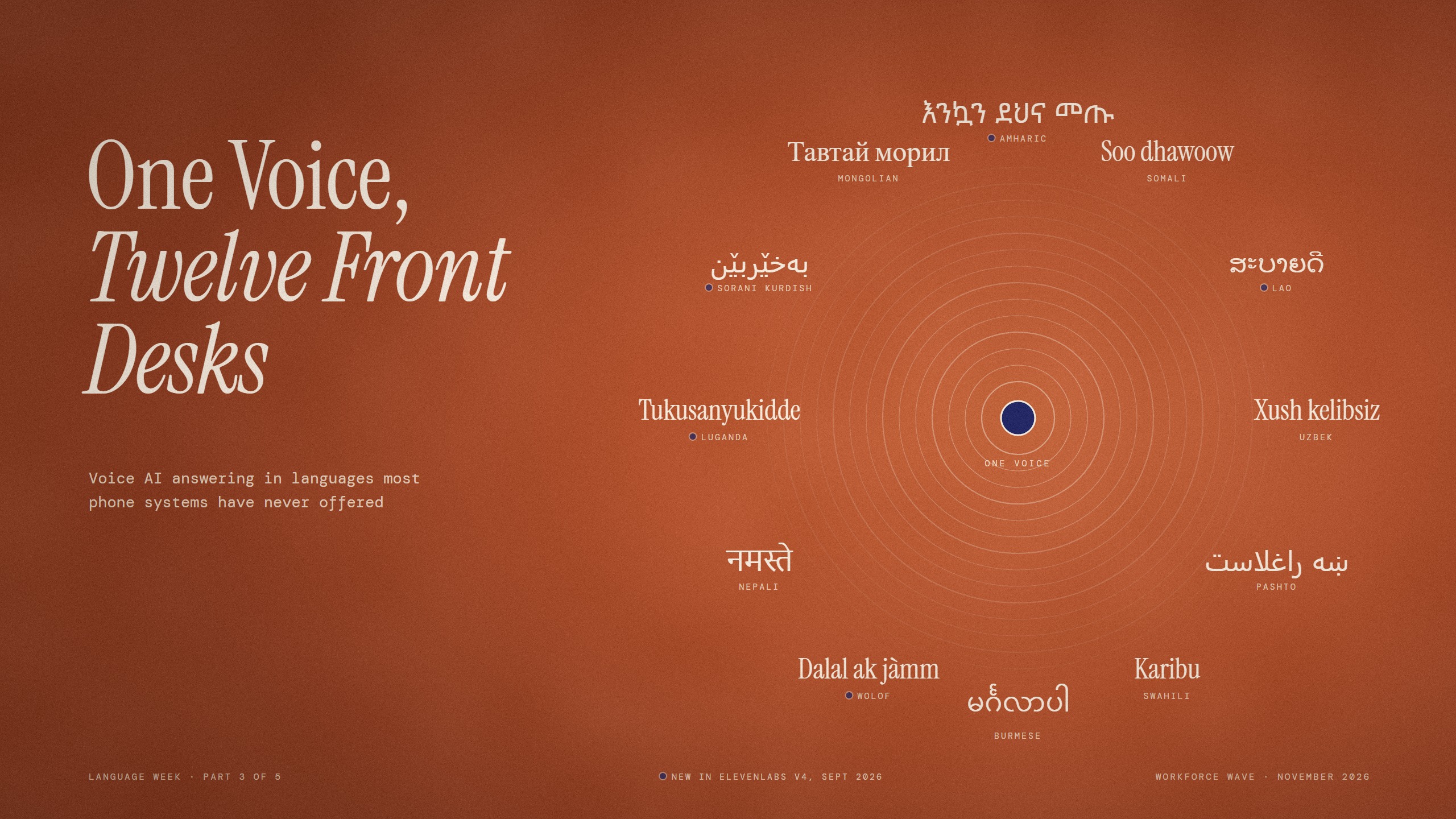
Voice AI can now answer a city's phone line in Amharic, Lao, Wolof, Somali and eight more languages. Listen to all twelve and meet the communities they reach.
Your brand doesn't just use voice agents—it casts them.
Open the Workshop — Get a CallListen first
Every clip on this page is the same voice. It belongs to the digital assistant for Port Alder, a fictional city we use to demonstrate our agents, and here it greets a caller in twelve languages that most American phone systems have never offered.
Five of these twelve (Amharic, Lao, Wolof, Sorani Kurdish and Luganda) could not be spoken by any voice we use until the end of September 2026, when ElevenLabs released its v4 speech model. The other seven were already supported, and most phone lines in the country still do not offer them. As of this week, we have confirmed that all twelve work end to end on the platform our agents run on, both in the voice and in the settings that let an agent switch into the language on a live call.
The greetings were machine translated. Native speakers will hear things we cannot, and we would like to hear from them (more on that at the end).
Why these twelve
Language access sounds like a nice-to-have until you are the one on hold. The Census Bureau counts a resident as having limited English when they speak it less than "very well," and for most of these communities that describes somewhere between a fifth and two thirds of speakers.
Taken together, the twelve languages below are spoken at home by roughly 1.1 million US residents age five and older, and close to half a million of them have limited English, according to the Census Bureau's most recent detailed language tables (American Community Survey, 2017 to 2021). Those tables predate the Afghan resettlement, so for Pashto in particular the real numbers today are higher.
These communities have always been the hardest to serve by phone for a simple reason. Interpreters for their languages are scarce, so a call that needs one waits for a callback, a relative, or a bilingual neighbor. A voice agent does not get tired, does not need to be scheduled, and does not put the caller on hold to find someone. Much of the decision about which languages to offer now rests with cities and counties themselves, and a city that wants to answer in Amharic or Lao can now simply decide to.
Twelve languages, twelve communities
Amharic. The working language of Ethiopia, written in the Ge'ez script, one of the oldest writing systems still in daily use. About 220,000 US residents speak it at home, with a large community in the Washington, DC area, where it is one of six languages named in the District's Language Access Act of 2004. About 39% of speakers have limited English.
Lao. A tonal language with six tones, written in a script that does not put spaces between words, which makes it one of the harder languages for speech technology to segment. Many Lao-speaking residents came to the United States as refugees after the war in Laos, and nearly half of speakers (48.8%) have limited English.
Wolof. The most widely spoken language of Senegal, carried by a long oral tradition, with a well-known community in Harlem's Little Senegal. About 24,000 US residents speak it at home.
Sorani Kurdish. One of the two major Kurdish languages, written in an Arabic-based script, and spoken by a community concentrated around Nashville, Tennessee. About 25,000 US residents speak it at home, and close to two in five have limited English.
Luganda. The most widely spoken language of Uganda, a tonal Bantu language, with a close-knit community in Waltham, Massachusetts. It is the smallest community on this list, about 12,000 speakers, and it is here on purpose. The long tail of small communities is exactly where human interpreter coverage has always been thinnest.
Somali. A language with a deep oral and poetic tradition that has been written in the Latin alphabet only since 1972. Minnesota is home to the best-known Somali community in the country. About 156,000 US residents speak it at home, and 42% have limited English.
Burmese. About 95,000 speakers, many of them refugees from Myanmar who resettled in places like Indianapolis. At 64.6%, Burmese has the highest share of speakers with limited English of any language on this list.
Nepali. About 198,000 speakers at home, including Bhutanese refugees of Nepali heritage who rebuilt their communities in central Ohio after being expelled from Bhutan in the 1990s. Half of speakers have limited English.
Pashto. One of the two main languages of Afghanistan, written in an Arabic-based script. More than 76,000 Afghans resettled in the United States after the 2021 evacuation, according to the Department of Homeland Security, so the Census count of about 46,000 speakers is already well out of date.
Swahili. A language of East and Central Africa, spoken by many of the Congolese refugee families who have resettled across the US. About 147,000 US residents speak it at home. The Swahili of eastern Congo differs from the coastal Swahili of Kenya and Tanzania, which matters for how a voice should sound to the people it serves.
Mongolian. The only language on this list from the Mongolic family, written in Cyrillic in modern Mongolia, with communities in Chicago and the Washington area. Nearly half of speakers (48.2%) have limited English.
Uzbek. A Turkic language of Central Asia, written in the Latin alphabet. About 17,600 US residents speak it at home, and 63.1% have limited English, the second-highest share on this list.
How we make a new language ready
Turning a language on is a setting. Making it work for a resident takes more than that, and this is how we approach it.
One voice, a native accent in every language. The speech model we use now gives a voice a native accent in each language it speaks, rather than carrying the accent of the person it was recorded from. A city keeps one recognizable voice, and a Somali-speaking resident hears Somali spoken the way a Somali speaker would say it. Part 1 of this series covers how that works.
Ask before switching. Our agents offer to change languages, in both languages at once, and switch only when the caller says yes. Part 2 covers the rules in detail, with recordings.
Design around the recognizer. Speech recognition for newer languages is less mature than for English or Spanish. In our own testing, the recognizer sometimes transcribed a language correctly and then labeled it as a different language, Somali as Finnish and Lao as Thai. That is one more reason our agents never switch languages on a label alone. They listen to what the caller actually asks for.
Native-speaker review. Before a language goes live on a client line, the greeting and the most common answers should be heard by people who speak it. That is the step we are asking for help with below.
The phone line is only the front door
Answering in a resident's language solves the first ten seconds of the call. What happens after that depends on what the city has actually written down.
Most municipal and county voice agents and chatbots in the country are built on surface material, largely what is already on the city website. That usually means office hours, addresses, a list of departments, and a handful of fee pages. Real resident questions go further. A resident wants to know what a notice means for their street, what to bring to an appointment, or what happens if they miss a deadline. When the knowledge behind the agent stops at the website, the agent stops there too, and it ends up saying some version of "please check the City website" or "let me connect you with someone."
That limit has nothing to do with language. It applies to English and Spanish callers just as much as to Amharic or Lao callers, and it is the single biggest gap we see between what voice agents could do for residents and what they do today. A Lao-speaking resident who is greeted perfectly and then sent to a website written in English has been served in name only.
The encouraging part is that multilingual service multiplies the value of good knowledge. A clear, detailed answer written once can be delivered in every language the agent speaks, so each improvement to the knowledge base reaches every community at the same time. How a city builds that kind of usable, resident-grade knowledge for an AI agent is the subject of a coming Workforce Wave article.
Talk with us
We would like to hear from linguists, anthropologists, interpreters and native speakers of these twelve languages, and of the languages that are still waiting for support. Tell us how our greetings sound, what we got wrong, and what a resident in your community would actually call a city to ask. We are also inviting guests to the Workforce Wave podcast to talk about who gets served next and how to do it well. If that is you, we would love to have you on the show.
About this series
This is Part 3 of Language Week, five pieces on language and voice AI published November 9 to 13, 2026. Part 1, Speaking Languages It Was Never Taught, reviews two years of multilingual speech synthesis research. Part 2, When to Switch, shows how our agents decide when to change languages on a live call.
Related Case Studies
When to Switch: How We Prompt Voice Agents to Change Languages
How to prompt a multilingual voice agent to switch languages at the right moment, with recorded calls showing each rule, from explicit requests to place names.
Speaking Languages It Was Never Taught: Multilingual Voice AI, 2024 to 2026
How AI voices learned to speak 90+ languages: two years of multilingual speech synthesis research, a platform comparison, and our 20-language test.
The Voicemail That Doesn't Ring
Two county council races, one election-eve deadline, and 5,306 voters reached in their candidate's own voice. A case study and field guide to ringless voicemail: how it works, what the law requires, where it beats texting, and what to honestly expect.