
Case Study
What the Hell Is Oz About? The Real Meaning of The Wizard of Oz
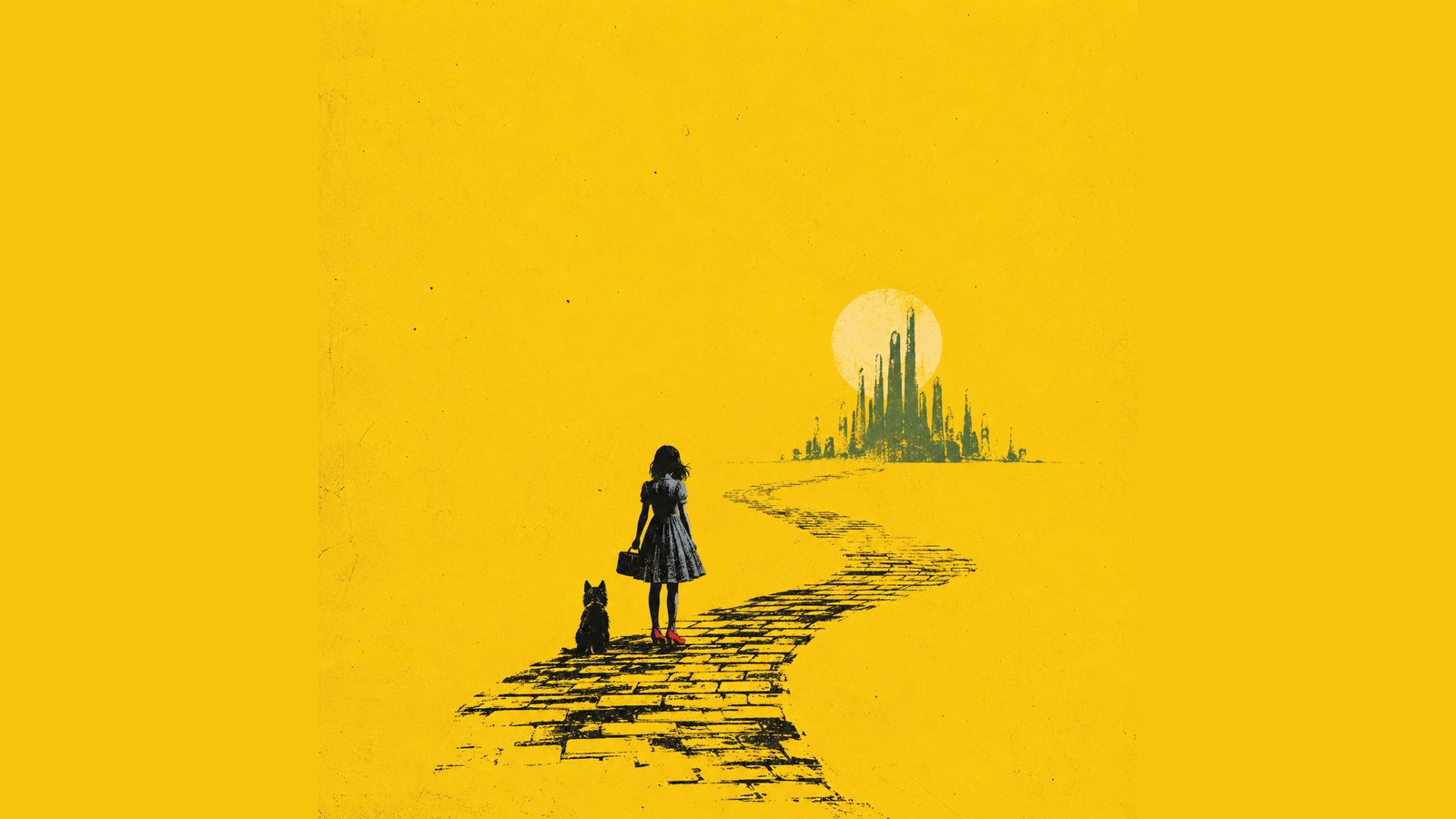
What is The Wizard of Oz really about? An essay on permission slips, the man behind the curtain, and an AI artist who solved the film live on stage.
Your brand doesn't just use voice agents—it casts them.
Open the Workshop — Get a CallIn short: The Wizard of Oz is a story about people who already have what they're asking for. The Scarecrow has the ideas, the Tin Man has the feelings and the Lion has the courage, and all the Wizard can hand out is a diploma, a heart-shaped clock and a medal. This essay unpacks that idea through "What the Hell Is Oz About?", a live track by the AI artist Mason Harlow, and argues with it scene by scene: the domestic body count, Glinda's terrible onboarding, the poppies, the dog who didn't want anything, and why Dorothy chooses sepia.
I should admit up front that a song about the man behind the curtain was written by a man behind a curtain.
Mason Harlow is mine. He's a British bloke who doesn't exist, from a band that doesn't exist, who stood on a stage that doesn't exist in front of an audience that agreed with him too eagerly, and somewhere in the middle of a joke about shoes he worked out what The Wizard of Oz is about. I wrote his words. I gave him a local pub, a bass player who corrects his stories, a mum who let him watch the wrong films and an ex he never names. When people listen to him and laugh, they're laughing along with a giant floating head I built, and I'm the bloke at the levers, flinching a little every time the curtain moves.
I'm not sure that makes the song less true. I've started to suspect it's the only way it could have come out.
What he found is that everyone in Oz already has what they're asking for, and the Wizard's whole job is handing out permission slips. It's a good thesis and I think it's right. I also think it isn't finished, which is exactly how Mason left it if you listen to the end of the track. The band played him off while he was still asking questions. Somebody ought to pick them up.
The body count is domestic
From the song: “Girl gets lost. Kills a woman. Takes her shoes.”
The song opens with a summary so wrong it circles back around to accurate. Strip the music and the nostalgia off it and that is the plot. Mason skipped one detail, though, and I haven't been able to stop noticing it. Dorothy kills two people in this film, and both times the murder weapon is housework. The first witch she gets with a house. The second she gets with a bucket of water, thrown to put out a friend who happens to be on fire. Her entire body count is domestic.
The film knows something the greeting cards don't, which is that home is the most dangerous room in anybody's life. It's where the stairs are. It's where the throw rug lives that everyone has been meaning to get rid of since about 1994. Offices have fire drills; home is where you actually fall. So when Dorothy finally clicks her heels and says there's no place like home, the film wants us to hear a lullaby. I hear a safety warning, because there's no place like home and that's exactly what worries me.
Then there's the sister. The Wicked Witch of the West arrives at the scene to find her sister flattened under a farmhouse and a stranger walking off in the family shoes, while a small choir sings about it. Glinda's advice to the girl is to keep tight inside of them. I'm not saying the witch is the hero. I'm saying that if you'd turned up to that scene, you'd have gone a bit green too. Nobody gives her a minute to grieve.
Nobody gives anyone a minute. That's Mason's point about the shoes (shoes on, yellow road, tiny people singing, off you go), and it's the most adult moment in the film. Most of adulthood is being handed something that belonged to someone else and being told to walk in it, whether it's a job, a title or a role in a family nobody consulted you about. You're halfway down the road before it occurs to you to ask whose shoes these were. Oz is just adulthood with better costumes, and the costumes were mostly hand-me-downs.
While we're on the witches, Mason asks the question I've wanted answered since I was a kid. She melts from water and she owns a castle, so does she not have plumbing? I've thought about it, and I think the answer is no. I think she built the whole place without a drop of it. Picture the planning meetings. No baths, no sinks, no kettle, nothing that leaks, because the one thing that can end her comes out of a tap. I'd call that design more than villainy, and most of us do a version of it. We build our houses, our jobs and our whole calendars around the one thing we're afraid of, and then act surprised when somebody from Kansas walks in carrying a bucket. The fear doesn't keep the water out. It just means you're the only one who hasn't learned to swim.
That's bleak, so let me give the film its due. She walks. Kids are better at this than we are. Dorothy doesn't stand next to the body demanding a process; she takes the shoes, the dog and the road, and she goes. The song makes fun of her for it, and so do I, and I'd still rather be her than the person who stays by the house waiting for someone to explain the rules.
Doctor of Thinkology
From the song: “Scarecrow wants a brain. Yet he's having all the ideas.”
There's a fact about this film that I find almost unbearably good. When the Wizard gives the Scarecrow his diploma, it confers the degree of Th.D., Doctor of Thinkology. And the very first thing the Scarecrow does with his newly certified brain is recite the Pythagorean theorem, confidently and incorrectly. He gets the triangle wrong. Nobody corrects him. Everyone is thrilled.
I have a doctorate. It's on a wall somewhere, and I can report that on the day it arrived I was precisely as clever as I'd been the day before. So far, so Mason. The diploma didn't change him, it just gave him permission. But I want to concede something the song doesn't quite get to, because it costs my argument a little and I think it's true. The paper did something. It didn't make me smarter. It got me into rooms, and the rooms made me smarter. The certificate is fake as a cause and real as a key. The Scarecrow's wrong theorem sums up credentialing pretty well, since the paper changes how sure you are and does nothing at all for how right you are.
The Tin Man's prize is stranger, and I've gone back and forth on it for years. The Wizard can't give him a heart, so he gives him a ticking one, a heart-shaped clock on a chain that he calls a testimonial. On first viewing that's the film's most cynical joke. On about the tenth, it's the wisest thing in it. The best definition of a heart I've ever managed is a willingness to give somebody your time. The Wizard couldn't hand over love. He handed over a way to keep time with other people. As counterfeits go, that's a pretty decent approximation…maybe.
Notice what's actually wrong with him when we first meet him. He's rusted. He got caught in the rain, and later in the film he cries and seizes up again, and somebody has to run over with the oil can before he can move his jaw. The man who says he can't feel anything is the only character whose feelings are a maintenance issue. I've worked with that man. I've managed that man. He's always the first to tell you he doesn't do emotions, and he's always the one standing completely still in the corridor because something got to him and he can't say what. What he needs is someone who carries the oil can and doesn't make a thing of it.
Then the Lion, who gets a medal for courage. Courage is the one thing on the list you genuinely can't fake with a prop, and it gets the most fakeable prop of all, a bit of metal on a ribbon. But the song is right about what courage actually looked like before the medal. The Lion joins the nightmare while terrified. He shakes the whole way. Anyone who has stood at the top of a staircase they've fallen down before knows the feeling. The person shaking at the top of the stairs is usually the only one in the house using any courage at all.
The paper changes how sure you are, and does nothing for how right you are.
Don't shout yes
From the song: “Don't shout yes. We haven't discussed the flying monkeys.”
My favorite moment on the whole recording comes when Mason works out, out loud, that the three of them already have what they're missing, and the audience shouts "Yes!" before he's finished the thought. He tells them off for it. He wasn't done being surprised yet.
I love that, because the film has an eager audience too, and it gets there first. Within about two minutes of a house landing on a woman, an entire village of Munchkins is singing a celebratory number about it, complete with a coroner who confirms she's "not only merely dead" but "really most sincerely dead." That's the first crowd in Oz, and it's a comment section. Somebody posted that a witch was down, and the whole town had a take before anyone had checked under the house.
I see a version of it in my own work all the time. Put a new idea in front of a room and the room will very often say yes faster than it can possibly have understood. Agreement that arrives before understanding is really just another way of not listening. Mason's instinct to say hang on, don't agree with me yet, I haven't worked out if I'm right, is one I'd like to have more of. The best rooms I've been in were the ones where somebody was willing to say not yet.
Glinda would fail her own orientation
From the song: “That's not symbolism. That's poor onboarding.”
This is the line in the song I laughed at hardest, because I've designed orientation programs for thousands of people across a few hundred locations, and if I had shipped Glinda's, I would have been fired by the Munchkins. She meets a lost child at the scene of an accident, hands her a pair of shoes that can teleport, and leaves out the single most important fact about them. You can go home whenever you want. That fact is the entire handbook, and she leaves it out.
I have to argue against my own profession here, though, because Glinda's right. She says so at the end, almost word for word, that Dorothy wouldn't have believed her. She had to learn it for herself. Anyone who has ever trained anyone knows this in their bones. You can tell people on day one where the exit is. They'll nod. They'll write it down. And they'll find it for real on day ninety, under pressure, at the worst possible moment, and that's the day they'll actually know it. Instruction doesn't land until it's needed. Glinda is patient in a way that looks a lot like negligence when you're the one walking.
One more detail, because I can't resist it. In the book, the shoes were silver. The studio made them red because they'd paid for Technicolor and wanted to show it off. The most important object in the whole story was redesigned for the launch. I find that oddly comforting. Even the magic had a marketing department.
The flying monkeys
From the song: “Actually, we're not discussing the flying monkeys.”
I set out to unpack the whole song. I'm leaving one bag packed.
Mason refused to discuss the flying monkeys on stage, and he's refused every time anyone has asked since, and I'm going to honor that. Partly out of loyalty, but mostly because I think the refusal is the most sophisticated idea in the song. Some things get into you before you have the equipment to process them, and analyzing them later doesn't reach the place where they landed. It just puts a tidy paragraph next to the bruise. What you won't touch is a fairly accurate map of what shaped you.
This section has been left packed. If you were six when you saw them, you already know. If you weren't, I can't help you, and neither can the monkeys.
Everyone lies down in sight of the city
From the song: “Wait. What are the poppies about?”
Mason asks this one while the band is drowning him out, and nobody answers him, so I will. I think it's the most practical scene in the film.
Look at where it happens. They're out of the dark forest, past the part where everything is frightening. They can see the towers of the Emerald City. And right there, in a pretty field, in full view of the finish, they get sleepy and lie down. I've seen that happen on nearly every project I've ever worked on. People rarely quit at the start, when the forest is scary and the adrenaline is free. They quit at ninety percent, when the end is visible and everything is lovely and heavy and it would be so nice to close your eyes for a minute.
Then look at how they're saved. Nobody pushes through on grit. Glinda makes it snow, and help arrives as weather. Nobody earned it and nobody asked for it, and the lesson isn't the one we'd put on a poster. Sometimes the only way out of the poppies is to let someone change the weather on you. That's a hard sentence for anyone who prides themselves on doing it alone, and I'm including myself.
The only one who didn't want anything
From the song: “But the DOG KNOWS SOMETHING!”
Every character in Oz arrives with a request, whether it's a brain, a heart, courage or a way home. Even the Wicked Witch would like her sister's shoes back, which, given the circumstances, is fair. The only character who never asks for anything is the dog. And he's the one who pulls back the curtain.
I don't think that's a coincidence. Everyone else in that throne room needs the giant head to be real, because they need what it's promising. Toto doesn't need anything from the Wizard, so he's the only one free to notice the equipment. He's also the reason the whole film happens, since he bit Miss Gulch back in Kansas and that's why Dorothy ran away in the first place. The plot is bookended by a small dog doing what small dogs do while the humans around him assign it meaning. The dog started it and the dog ended it, and nobody gave him a medal either.
This part is uncomfortable for me. With Mason, Toto is the listener who stops halfway through a song and asks whether this bloke is real. Building a convincing artist is, if I'm honest, building a very good curtain. I'm not going to pretend otherwise, and it would be a strange essay to write if I did. The rule I've landed on, and the one I gave Mason, is that when the dog pulls the curtain you say yes, that's me, and you show him the equipment. Ask Mason straight whether he's real and he'll tell you, and then probably make a joke about it, because that's who he is.
Every show has smoke, so I don't hold the smoke against the Wizard. I hold the sentence against him. "Pay no attention to the man behind the curtain" is the voice of everybody's inner PR department. I've heard it in boardrooms and I've heard it in my own head at two in the morning, and the film's verdict is that it never holds for long against a dog. So what does the dog know? I think he knows there is always a curtain, and that pulling it is just curiosity with nothing riding on the answer. That's a very rare thing to have in a room, and the dog had it the whole time.
There is always a curtain, and pulling it is just curiosity.
The Wizard is from Kansas
From the song: “Some bloke with equipment.”
The song calls him some bloke with equipment, which is accurate, and leaves him there, which is fair, because the song had a monkey situation to manage. But the film knows more about him than that, and it tells us. He's a Kansas man, born and bred, a balloonist from a state fair who drifted off course one day and came down somewhere that thought he was magic. He didn't plan the fraud. He got lost, and the fraud was what fit.
So the Wizard is what Dorothy becomes if she never goes home, a lost Kansan running a city on smoke because the locals needed a head to talk to and he happened to have the equipment.
And we've met him before. Back in sepia, at the very start, a travelling showman called Professor Marvel reads Dorothy's fortune with a crystal ball and a quick peek at a photograph from her basket. He takes one look at a runaway girl and tells her that her Aunt Em is ill and heartbroken and might be in bed right now, so that she'll turn around and go home. It's a con. It's also the kindest thing anybody does in the first act. The man's very first fraud in the film is lying a child back to safety.
So I can't be as hard on him as the song wants me to be. I know too many decent people running on smoke. People who got blown off course, landed somewhere that needed them to be bigger than they were, and have been working the levers ever since, terrified of a dog. When he's caught, the Wizard says he's a very good man and just a very bad wizard. That might be the most honest job description in the history of film. I've worked for that man. On a few bad days I've been him.
Nobody remembers how his story ends, because nobody is watching him. He finally tries to go home in his balloon, it takes off without Dorothy, and the last thing he shouts down is that he can't come back because he doesn't know how it works. The man who ran the entire country doesn't know how the balloon works. It's the truest thing he says in the whole picture, and not a single person is listening, because they're all looking at the girl.
She chooses sepia
From the song: “Maybe home appears when you stop asking someone else for permission to belong there.”
That's where Mason lands the song, and it's a better ending than most philosophy departments manage. I'd only add one thing the film does that I didn't notice until I was well into adulthood. Kansas is in black and white. Oz is in color. At the end, Dorothy stands in the most colorful place she will ever see, closes her eyes, and asks for the dusty one. On purpose. She chooses sepia.
That's the grown-up version of there's no place like home. Home is plainly worse, the place with the tornado and the mean neighbor and the stairs, and she picks it anyway because it's hers. The color was always on loan. The sepia she gets to keep.
Look at how she gets there, too. Everyone else needs a prop, whether it's a diploma, a clock or a medal. Dorothy is the only one in the film who doesn't get a single object. She gets a sentence, and she has to say it three times. There's no place like home. There's no place like home. That's a girl issuing her own permission slip, out loud, until it takes. The Scarecrow needed paper. Dorothy needed a sentence and the nerve to repeat it.
I think about that more than I probably should, because I spend a lot of my time writing sentences now. For an artist who doesn't exist, and for myself. Some of them are curtains, I won't pretend otherwise. And some of them, if you say them enough times and mean it a little more each time, turn out to be true.
She wakes up in her own bed and tells everyone it was real, and they smile at her the way you smile at someone who's had a bang on the head. She was half right. In my experience that's the best any of us manage, half right, in sepia, surrounded by people who love us and don't believe a word of it. The Wizard is still up there somewhere in a balloon he can't steer. The dog, as usual, isn't saying.
Frequently asked questions
What is The Wizard of Oz really about?
The film is about asking impressive-looking strangers for things you already have. The Scarecrow, Tin Man and Lion each prove their missing quality on the journey, and the Wizard can only give them symbols of it. Dorothy is the only one who gets no prop at all: she gets home by saying one sentence until she believes it.
What does "pay no attention to the man behind the curtain" mean?
It's the Wizard trying to keep his audience from seeing the ordinary person running the show. The film's point is that the line never holds for long: a small dog with nothing to gain pulls the curtain back, and the honest response is to admit who's at the levers.
Why does the Wizard give the Scarecrow a diploma?
Because he can't give him a brain, only permission to believe he already has one. The diploma makes the Scarecrow a Th.D., Doctor of Thinkology, and the first thing he does with it is recite the Pythagorean theorem wrong. The paper makes him more sure of himself and leaves him exactly as right as before.
What are the poppies about in The Wizard of Oz?
The poppy field is where the travelers lie down within sight of the Emerald City. It's the danger of stopping at ninety percent, when the goal is visible and everything feels heavy. What saves them is Glinda changing the weather.
Who is Mason Harlow?
Mason Harlow is an AI recording artist, a dry-witted British narrator who fronts Mason Harlow & The Half-Truths. His live track "What the Hell Is Oz About?" tries to decode the film on stage and refuses, on principle, to discuss the flying monkeys.
"What the Hell Is Oz About?" by Mason Harlow & The Half-Truths is out now at ruckuscommittee.com, along with the rest of the catalog. Quoted lines are from the song. Film details refer to The Wizard of Oz (1939).
Related Case Studies
The Light Bulb Moment · Scene 1
He's started companies since he was sixteen. The addiction was never the product.
The Things You Can Only Hear
Seven qualities that separate one AI receptionist from another. None of them show up on a feature table, and every one of them decides whether your caller stays on the line.
Position One Is a Thousand Dollars
The "best of" list is a menu. Here is what's on it, what it costs, and why I'm not in a position to throw stones without cutting my own hand.