
Case Study
Every Caller, Every Language: The Business Case for Multilingual Phone Answering
One call in 36 on our lines arrives in another language. These callers call after hours more often and hang up grateful twice as often. What it takes to answer them.
Your brand doesn't just use voice agents—it casts them.
Open the Workshop — Get a CallWhat happens when someone calls in another language today
Researchers have a simple way to find out how a phone line treats people who do not speak English well. They call it the way a resident or customer would, in different languages, and write down what happens.
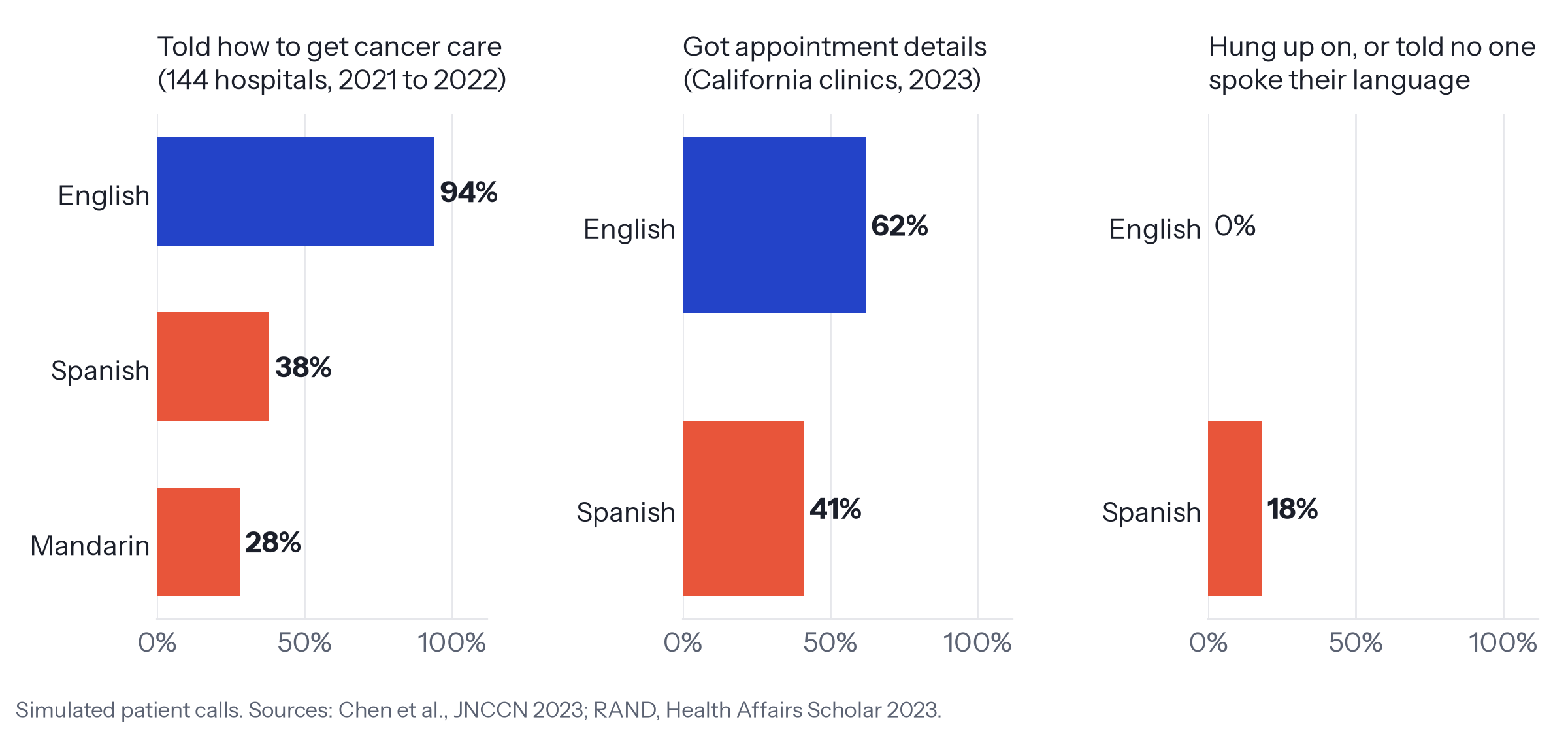
In one study, trained callers phoned 144 hospitals in twelve states asking how to get cancer care, 432 times each in English, Spanish and Mandarin. Ninety-four percent of English callers were told what to do next. For Spanish callers the figure was 38%, and for Mandarin callers 28%. Some were told no. Some were hung up on. Some were cut off by an automated menu that gave its instructions only in English. (Chen and colleagues, Journal of the National Comprehensive Cancer Network, 2023.)
A RAND study of California safety-net clinics the same year found the same pattern. Eighteen percent of Spanish-speaking callers were hung up on or told that no one could speak Spanish. No English-speaking callers were. English callers reached appointment details 62% of the time, Spanish callers 41%, and among those who got that far, Spanish callers were nearly twice as likely to sit on hold for more than five minutes.
These are health care lines, where the stakes are high and the people answering are usually trying hard. A city hall, a dental office or a home services company is unlikely to do better. And a caller who cannot get through rarely files a complaint. They hang up, and then they go somewhere else, or they go without.
Who is calling
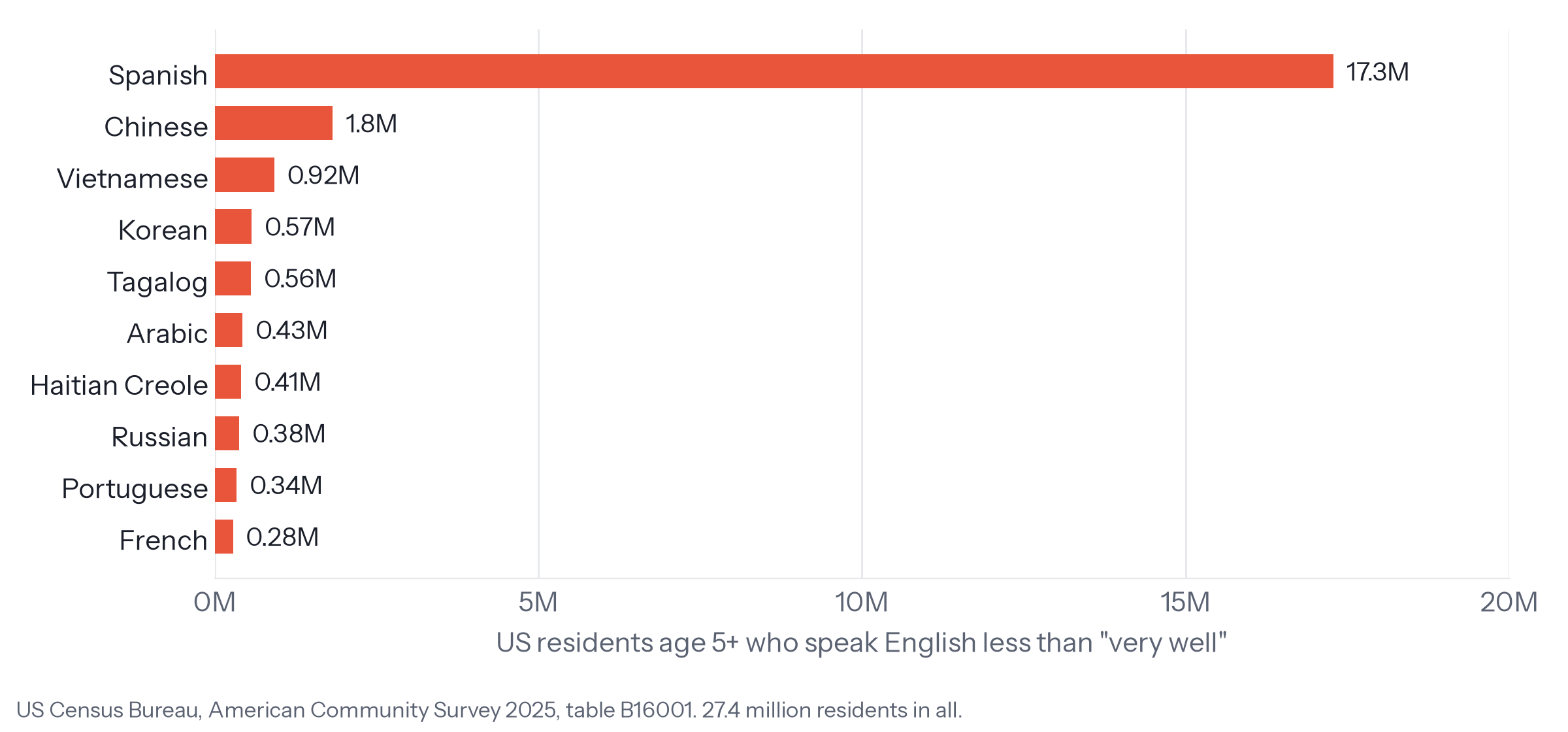
The Census Bureau counts 27.4 million US residents age five and older who speak English less than "very well," about 8.5% of that population (American Community Survey, 2025). About 5.7 million households, 4.3% of all households, have no member age 14 or older who speaks English very well.
Spanish speakers make up about 63% of that group, more than 17 million people. After Spanish the numbers fall off quickly, but they stay large. Chinese, Vietnamese, Korean, Tagalog, Arabic, Haitian Creole, Russian, Portuguese and French each have between a quarter of a million and nearly two million residents with limited English.
That national picture shows up on real phone lines. Our agents record the language spoken on every call, and we looked at 37,305 calls to 25 lines between March 1 and November 10, 2026, nearly all of them city and county government. About one call in 36 involved a language other than English, and about one in 100 had no English in it at all. Spanish made up 97% of those calls, followed by Portuguese, Polish, Hindi, Italian, Arabic, Japanese, Chinese and others.
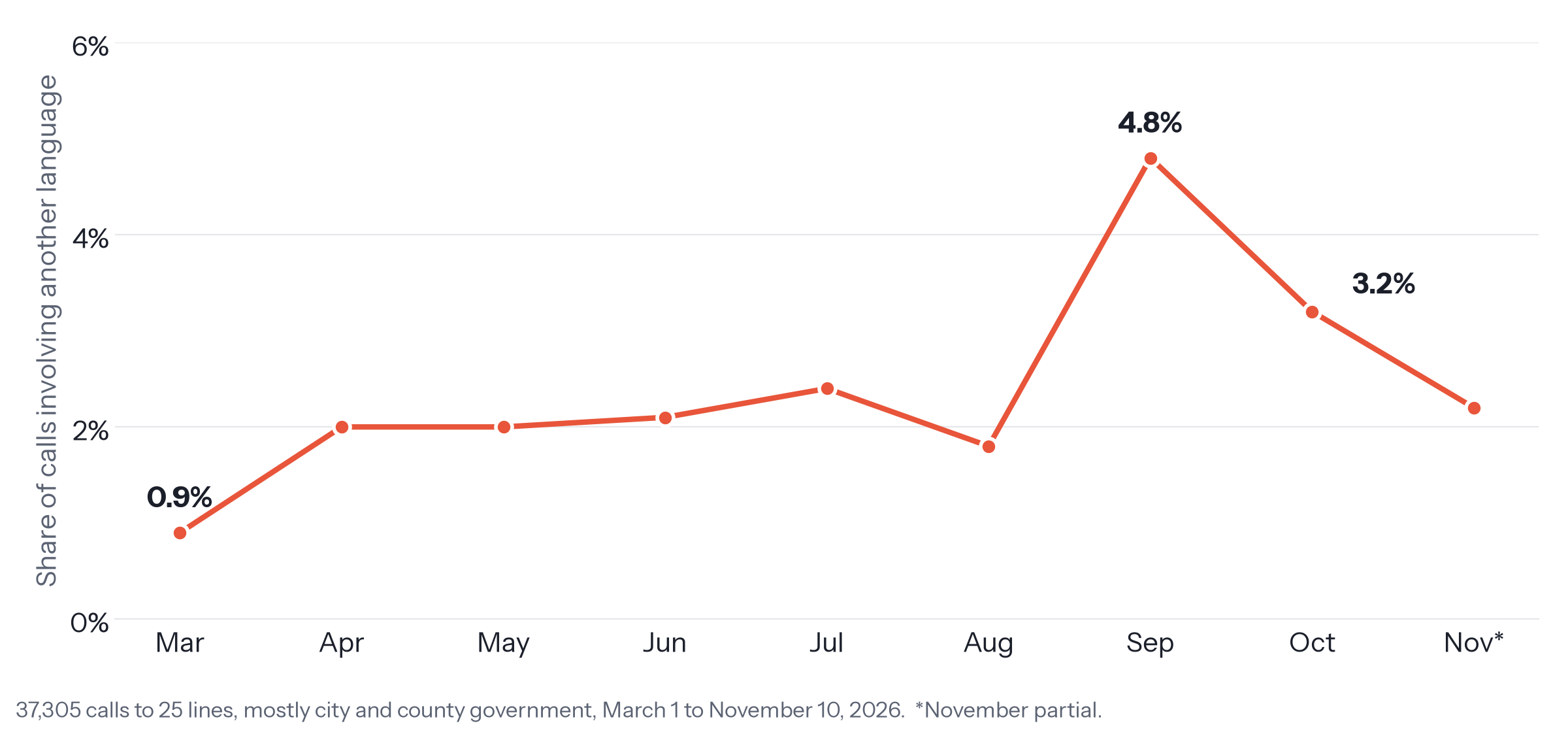
The share climbed through the year, from under 1% in March to a peak of nearly 5% in September, over the same months that most of these lines began offering Spanish. We read that as a sign of how much demand is waiting, and our numbers almost certainly understate it. These lines are advertised in English. A resident who does not expect to be understood often does not call at all, so the callers you hear from today are the ones who already found a way through.
When they call
This was the finding that surprised us most.
Callers in other languages reach us outside office hours more often than English callers do. On our lines, 18.6% of calls in another language came in before 8 in the morning, after 5 in the evening, or on a weekend, compared with 13.9% of English calls. That makes a caller in another language about a third more likely than an English caller to be calling when the office is closed.
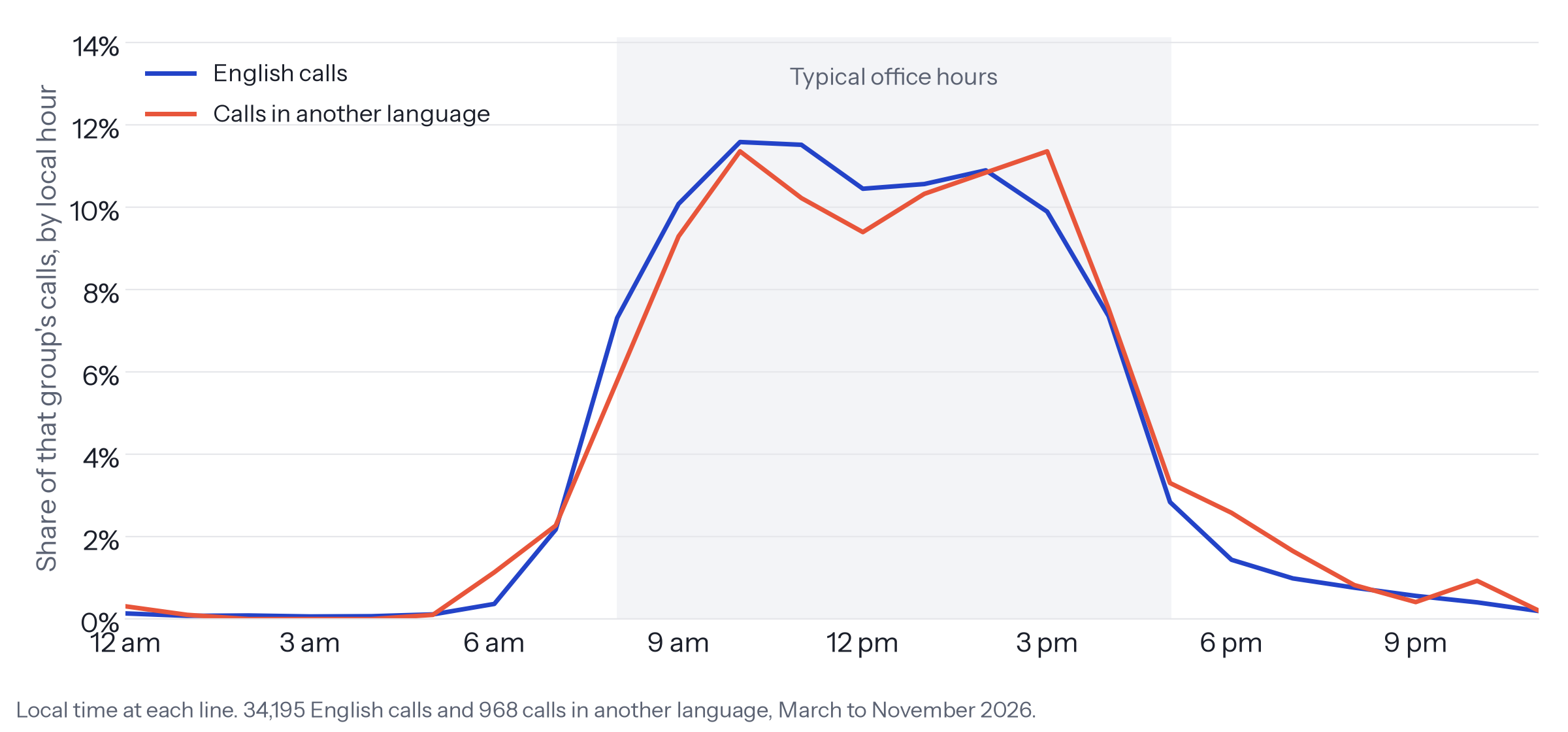
Our data cannot say why. A likely part of it is work: people on hourly jobs and long shifts often get their first free moment of the day in the early evening. Whatever the reason, it is exactly when a human interpreter is hardest to reach, because the person who would place the call to the interpreter service has gone home.
What happens when the agent answers
The more useful question for a business owner is what happens to these calls when they are answered well, in the caller's language, at any hour. Here is what our lines show, comparing calls in another language with English calls on the same lines over the same months.
- They stay on the line longer. The median call in another language lasted 70 seconds, against 54 seconds for English calls. Part of that is the language offer itself, and part is likely callers explaining more once they are understood.
- They get their answer during the call more often. We grade every call against a deliberately strict standard. A call counts as resolved only if the caller's question was fully answered by the agent during that call, with no transfer, no callback and no phone number handed off for the caller to dial themselves. By that standard, calls in another language were resolved within the call about a third more often than English calls on the same lines.
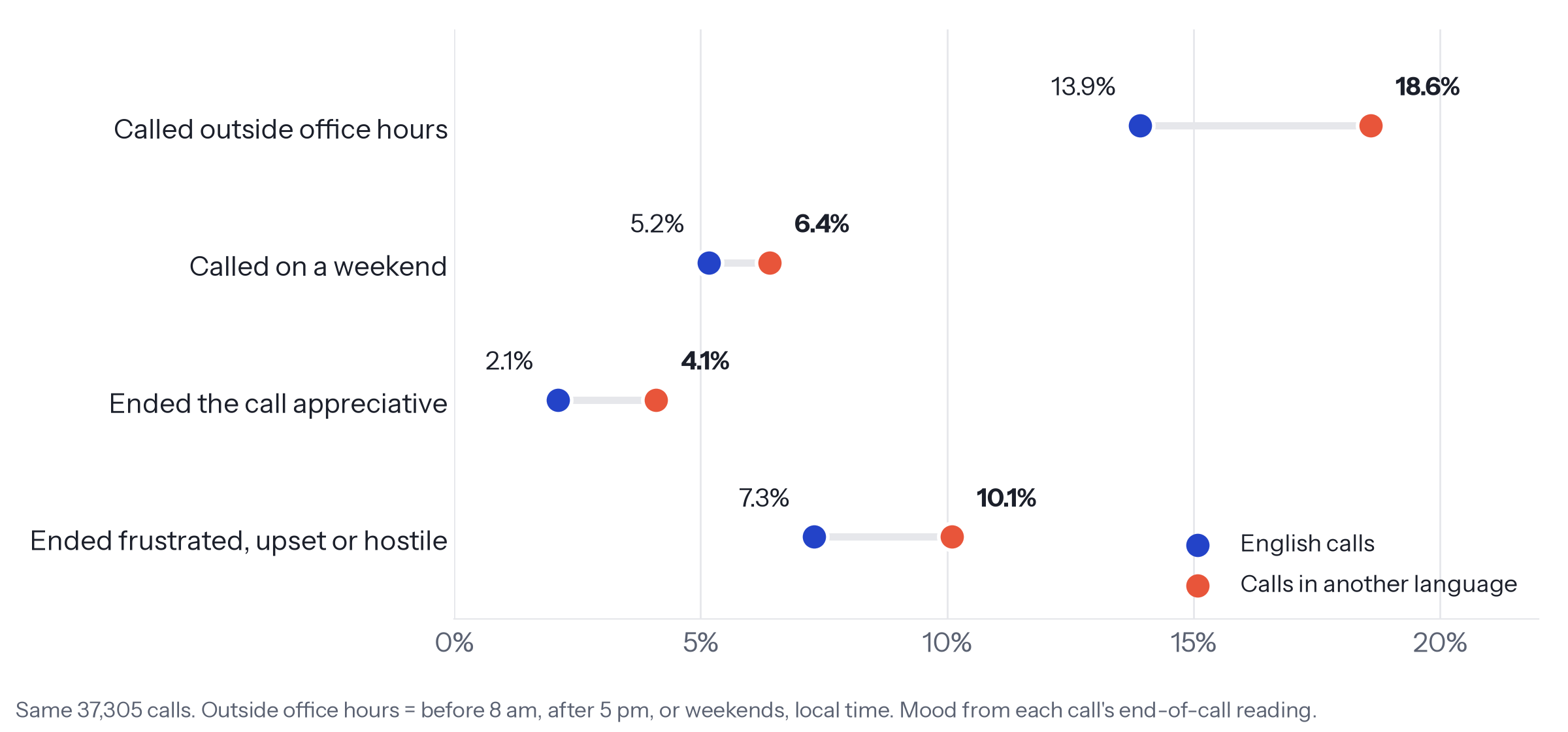
- They leave happier, about twice as often. An end-of-call reading of each caller's mood found 4.1% of callers in another language ending the call appreciative, against 2.1% of English callers.
- They are also more often upset. That reading found 10.1% ending frustrated, upset or hostile, against 7.3% of English callers. We read this as a sign that these calls carry higher stakes, a bill the caller cannot read or a notice they do not understand, and as a reason to keep a human within reach.
Taken together, this is the profile of a caller who has often waited longer and tried harder to be heard, and who notices when they finally are.
Two ways to answer the same call
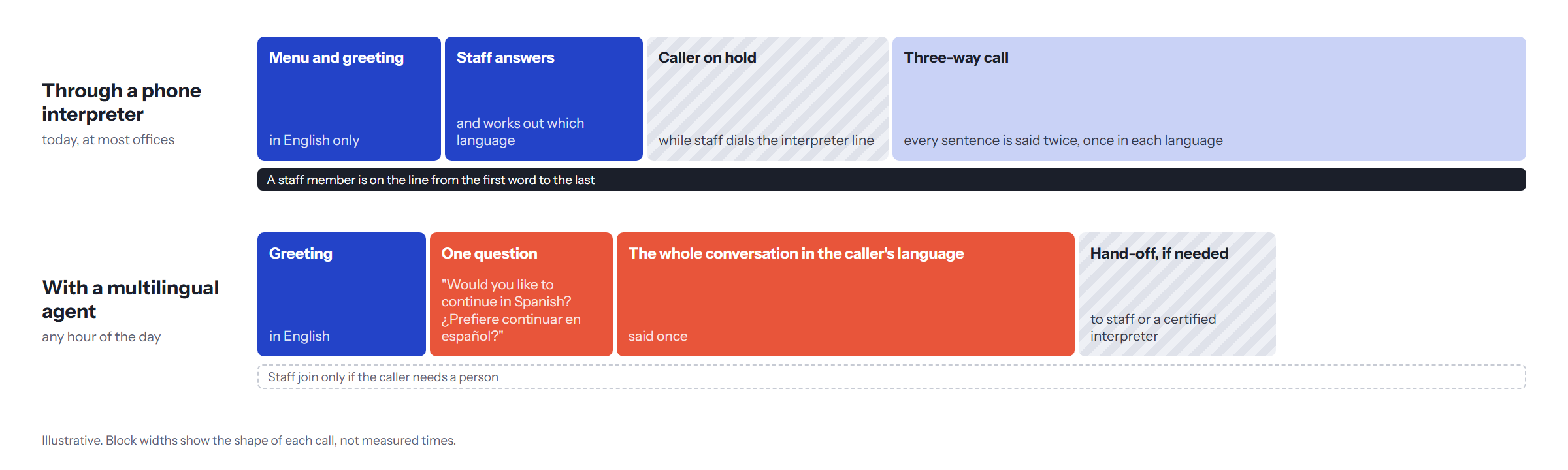
Most organizations that serve callers in other languages today use a phone interpreter service. It works, and for some calls it is the right tool. But the shape of the call is very different from a call answered directly in the caller's language.
On government cooperative contracts, phone interpretation costs about 56 to 69 cents a minute during business hours and up to 85 cents after hours. A business without a negotiated contract pays closer to the public rate of about $3.95 a minute. Those rates are lower than many people expect, so it is worth being plain about where the real cost sits.
- Staff time. A staff member stays on the line for the entire interpreted call, and every sentence takes twice as long because it is said twice.
- Hold time. Someone has to recognize the language, find the interpreter line and place the call, while the caller waits.
- After hours. When the office is closed there is usually no one to place that call at all, and that is when callers in other languages are most likely to be calling.
- The calls you never get. The resident who gave up, and the customer who booked with a competitor whose phone was answered in Spanish.
An AI agent that speaks the caller's language removes most of that. It answers at any hour, with no hold while someone finds an interpreter, at a fraction of interpreter rates per minute, and it does not tie up a staff member for the length of the call.
What this looks like for your organization
The table below applies our one-in-36 rate to four kinds of organizations. It assumes an interpreted call lasts four minutes, which is modest given that everything is said twice, and it applies the share of calls we saw arrive outside office hours.
| Organization | Calls a year | In another language | Interpreter fees, government contract | Interpreter fees, public rate | Staff hours on interpreted calls | Arriving after hours |
|---|---|---|---|---|---|---|
| City | 50,000 | about 1,400 | $3,100 to $3,900 | about $22,100 | about 93 | about 260 |
| County | 150,000 | about 4,200 | $9,400 to $11,600 | about $66,400 | about 280 | about 780 |
| Clinic or medical practice | 30,000 | about 840 | $1,900 to $2,300 | about $13,300 | about 56 | about 155 |
| Small business | 5,000 | about 140 | $310 to $390 | about $2,200 | about 9 | about 26 |
Two things stand out. For a government line on a cooperative contract, the interpreter bill itself is modest; the larger costs are the staff hours and the hundreds of calls a year that arrive when no one is there to place an interpreter call at all. For a business paying public rates, the bill is real, and losing even a few of those customers to a competitor who answers in their language can cost more.
The rules, briefly
This section is general information, not legal advice.
- Title VI of the Civil Rights Act still applies to anyone who receives federal funds. A March 2026 Treasury notice repeated that recipients have a continuing obligation to comply, and that denying language assistance can, under certain circumstances, be evidence of national origin discrimination.
- The federal guidance changed in 2025. A March 2025 executive order revoked the earlier federal language-access order, and a July 2025 Justice Department memo withdrew its long-standing guidance. Both say agencies are not required to stop offering services in other languages, and the Justice Department memo encourages "responsible use of artificial intelligence and machine translation" to communicate with people who have limited English.
- Health care keeps its own rule. Federal rules for health programs still require a qualified interpreter when interpretation is required, so in health care an agent is the first point of contact and scheduling help, with a path to a qualified interpreter.
- State and local laws continue. New York City's Local Law 30 requires city agencies to offer phone interpretation in at least 100 languages. California's Dymally-Alatorre Bilingual Services Act requires local agencies serving a substantial number of non-English speakers to have enough qualified bilingual staff or interpreters. The District of Columbia's Language Access Act requires covered agencies to offer oral language services and to translate vital documents for any group that makes up 3% or 500 people of the population served, whichever is less.
The platforms, in plain terms
Several large companies now build the voices behind these agents. ElevenLabs, whose voices our agents use, lets a single voice speak more than 90 languages with a native accent in each. Google's newest voice model lists more than 100 languages, Microsoft's Azure offers well over a hundred regional varieties, and Amazon, OpenAI, Cartesia and others cover anywhere from a handful to a few dozen languages. Part 1 of this series compares them in detail.
Language count is not the whole story. What matters on a phone line is how well the agent understands callers in each language, how naturally it speaks, how carefully it decides when to switch (Part 2 covers our rules), and, above all, what it actually knows.
What to turn on, and how to know it is working
- Start with your own callers. Census data by county or zip code shows which languages residents with limited English speak in your service area. Most organizations will start with Spanish and add one to three more.
- Ask before switching. Offer the caller's language in both languages at once and switch only when they say yes. Bilingual callers who are comfortable in English should never be switched without asking.
- Make sure the agent can actually help. Answering in a caller's language only goes as far as the information behind it. If the agent's knowledge stops at what is on your website, every caller in every language hits the same wall. (Building knowledge an agent can really use is the subject of a coming Workforce Wave article.)
- Keep a human within reach. Decide in advance which calls go to staff or a certified interpreter, and tell the caller, in their language, when that is happening.
- Test with native speakers before each language goes live, on a real phone line.
- Measure five things, by language. The share of calls in each language, how often the agent offers and switches, the share arriving after hours, how often calls are resolved during the call, and how callers feel at the end. Those five numbers show whether the line is working and which language to add next.
One call in 36 is already arriving in another language on the lines we run, before most of those callers have any reason to expect they will be understood. They call later, they stay longer, and they are twice as likely to hang up grateful. The organizations that answer them well will hear from a lot more of them.
About this series
This is Part 4 of Language Week, five pieces on language and voice AI published November 9 to 13, 2026. Part 1, Speaking Languages It Was Never Taught, reviews the research. Part 2, When to Switch, shows how our agents decide when to change languages. Part 3, One Voice, Twelve Front Desks, profiles twelve underserved languages our agents can now speak.
Related Case Studies
One Voice, Twelve Front Desks: Voice AI for Underserved Languages
Voice AI can now answer a city's phone line in Amharic, Lao, Wolof, Somali and eight more languages. Listen to all twelve and meet the communities they reach.
When to Switch: How We Prompt Voice Agents to Change Languages
How to prompt a multilingual voice agent to switch languages at the right moment, with recorded calls showing each rule, from explicit requests to place names.
Speaking Languages It Was Never Taught: Multilingual Voice AI, 2024 to 2026
How AI voices learned to speak 90+ languages: two years of multilingual speech synthesis research, a platform comparison, and our 20-language test.