
Case Study
Always Answering: A Year on a Municipal AI Voice Line
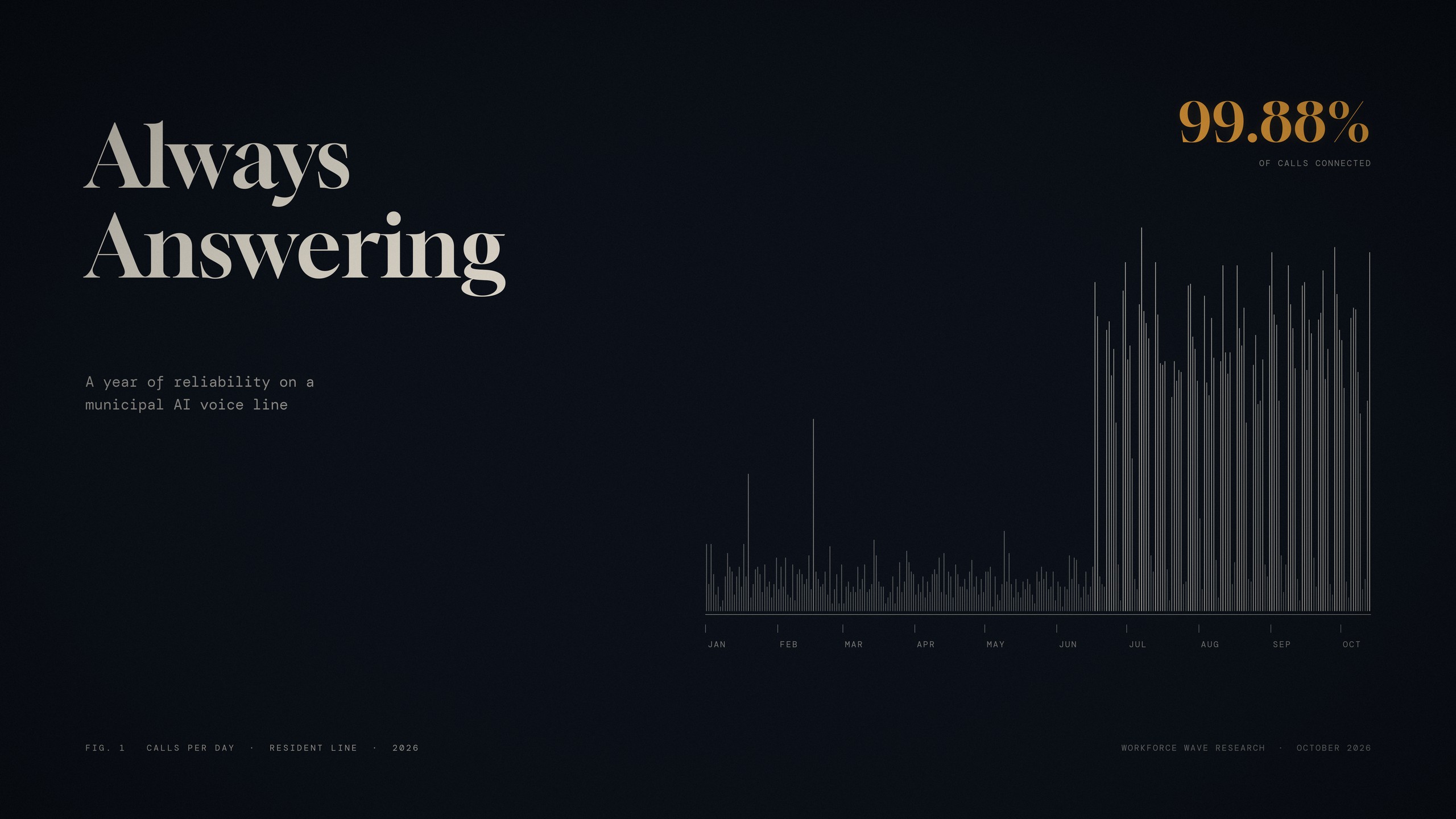
A Florida municipality's AI resident line connected 99.88% of 13,935 calls in 2026. How it compares with other ways a city answers its phone, and the backup routing that comes next.
Your brand doesn't just use voice agents—it casts them.
Open the Workshop — Get a CallSummary
A Florida municipality answers its main resident line with an AI voice agent. Between January 1 and October 13, 2026, the line took 13,935 calls. Counting each affected caller once, it connected 99.88% of them. Before October 13, only two calls all year failed to connect for a reason on our side, out of more than 12,700.
On the morning of October 13, a provider several layers beneath the line had an outage, and for about two hours some calls could not connect. This paper sets out what the line achieved over the year, how the numbers compare with other ways a city answers its phone, and the backup routing we are adding.
| Calls | 13,935 |
| Connected, counting each affected caller once | 99.88% |
| Connected, counting every attempt including redials | 99.53% |
| Time the line was available | 99.97% |
| Failed calls before October 13 | 2 |
1. The line
Residents call the line for trash and recycling schedules, permits, utility questions, parks, meetings and directions to the right department. The agent answers around the clock and passes requests that need staff to the right team. Call volume grew through the year, from about 450 calls in January to about 3,000 a month by summer.
Every call depends on a chain of services working at once: the phone carrier, the telephony provider that routes the number, the AI voice platform, the language model behind it, and the systems that turn text into speech and speech into text. A failure in any one of them can stop a call.
2. The year in numbers
Of 13,935 calls, 13,867 connected and completed. Two more ended because the line went silent on the caller's end for a full minute, which we count as the caller's side. That leaves 66 failed attempts on the service side, and 64 of them happened on October 13.
How those 64 are counted changes the headline, so we report it both ways. During the outage, residents redialed, some of them many times. Counting each affected caller once, 17 callers were affected all year and the line connected 99.88% of calls. Counting every attempt, including each redial, it connected 99.53%. We think the first number describes what residents experienced. The second is the stricter figure, and our fleet-wide study uses it.
Measured by time instead of calls, the line was unavailable for about 128 minutes in 286 days, an availability of 99.97%.
3. October 13
Early on October 13, the AI voice platform's data provider began timing out. Between 7:03 and 9:11 a.m. Eastern, some calls to the village line connected normally and others could not. From 9:14 a.m. every call connected, and the provider confirmed full resolution at 10:18 a.m. Figure 1 shows the morning in fifteen-minute intervals.
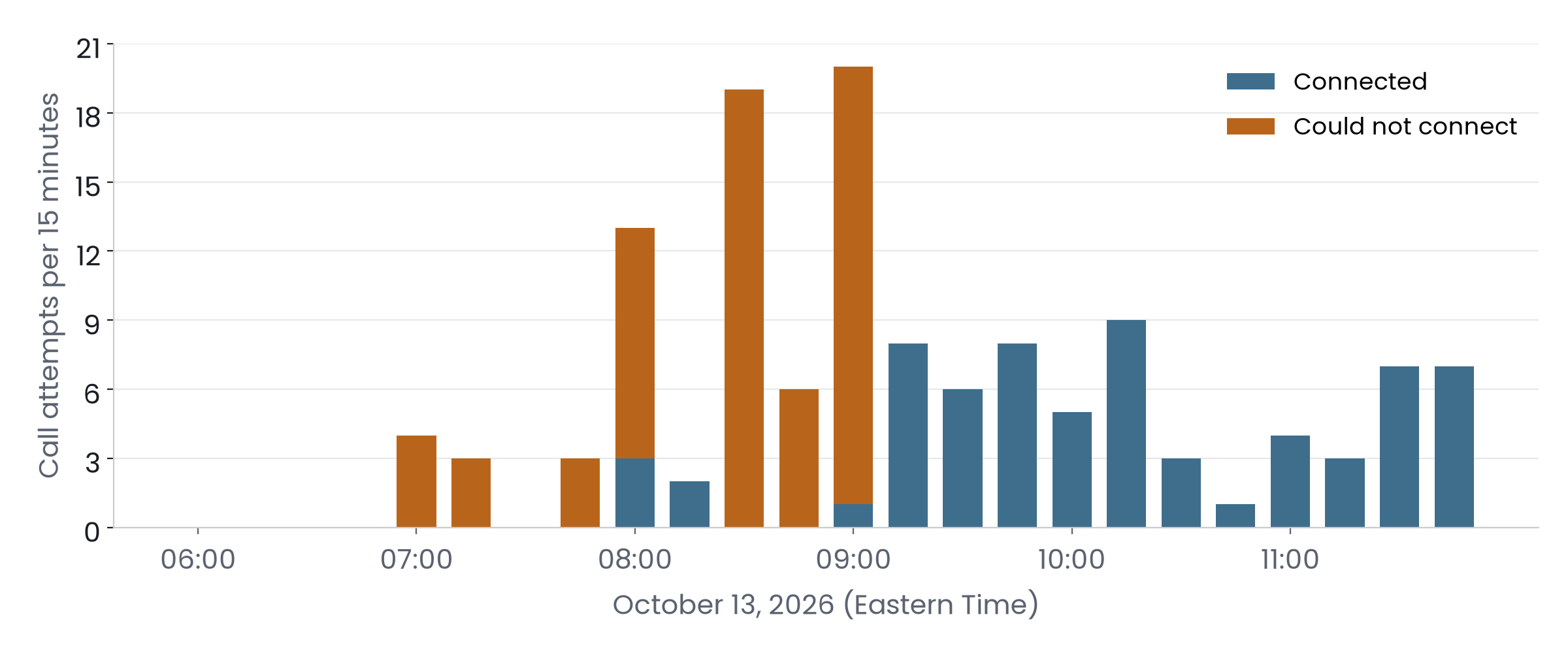
In all, 15 residents were affected. The agent's instructions, knowledge base and phone number were unchanged throughout, and nothing in the village's own setup caused the outage or was affected by it.
4. How this compares
Reliability figures are easy to quote and hard to compare, because they measure different things.
| Line or system | Figure | What it measures |
|---|---|---|
| This line | 99.88% of calls connected (99.53% of attempts) | Calls that reached the agent and completed |
| Local telephone network, original design objective | 99.93% of time | Network availability, Bellcore objective [1] |
| Cloud telephony provider contract | 99.95% of time | Provider uptime, excluding carrier faults and outages under five minutes [2] |
| New Orleans 311 | About 94% of calls | Calls not abandoned before an agent answered [3] |
| New York City 311, fiscal 2025 | 80% within 30 seconds | Speed of answer, on target [4] |
| 911 national standard | 90% within 15 seconds | Speed of answer, NENA standard [5] |
A human-staffed line measures whether a person answered, and its shortfalls come mostly from staffing: queues during storms, lunch hours, vacancies. An AI line measures whether the call connected, and it does not depend on who is at a desk. A line that combines both, with staff behind the agent and a backup route in front of it, gets the strengths of each.
Single outages elsewhere in the phone system have lasted far longer than this one. AT&T's February 2024 network outage lasted at least 12 hours and blocked more than 92 million calls, including more than 25,000 to 911 [6].
5. Backup routing
Every call to the line is logged with its outcome, so we can see within the same morning when anything beneath the line falters. The next step is a fallback route on the telephone number itself. If the AI platform ever fails to answer, the call goes elsewhere instead of to an error message:
- forward the call to a staffed village line, with the resident's number showing
- take a voicemail and email it, with a transcript, to the right department
- both, forwarding first and taking a voicemail if no one answers
The route is configured by the village's telephony partner, the village chooses the option that fits its staffing, and we test it before it goes live.
6. For a city evaluating AI phone service
- Ask for calls, not uptime. Any provider should be able to tell you what share of calls to a comparable line connected over a year, and how it counts redials.
- Ask what happens when the AI cannot answer. The answer should be a route to a person or a message.
- Know what you are replacing. If your staff already answer nearly every call within your target, an AI line mainly adds after-hours and overflow coverage, and the business case should rest on that.
About this paper
Prepared by Colin P. Highland and the Workforce Wave research team, October 2026. Figures come from the AI voice platform's call records for the line, January 1 to October 13, 2026. The municipality is not named. Workforce Wave builds and operates the agent described. The fleet-wide method is set out in Every Call Counts.
References
- Kuhn DR. Sources of failure in the public switched telephone network. IEEE Computer, 1997. Full text
- Twilio. Service Level Agreement, Twilio APIs. 2026. twilio.com
- City of New Orleans. ResultsNOLA, 311 call abandonment rate. datadriven.nola.gov
- City of New York. Mayor's Management Report 2025, 311 Customer Service Center. nyc.gov
- National Emergency Number Association. Call answering standard. nena.org
- Benton Institute. FCC report on the February 2024 AT&T wireless outage. benton.org