
Case Study
The Closure That Never Fired: Why an AI Agent Can Know the Answer and Still Get It Wrong
A resort's voice agent had the closure in its knowledge base and told callers the kitchen was open anyway. Three small causes, none of them retrieval, and the five tests that would have caught them.
Your brand doesn't just use voice agents—it casts them.
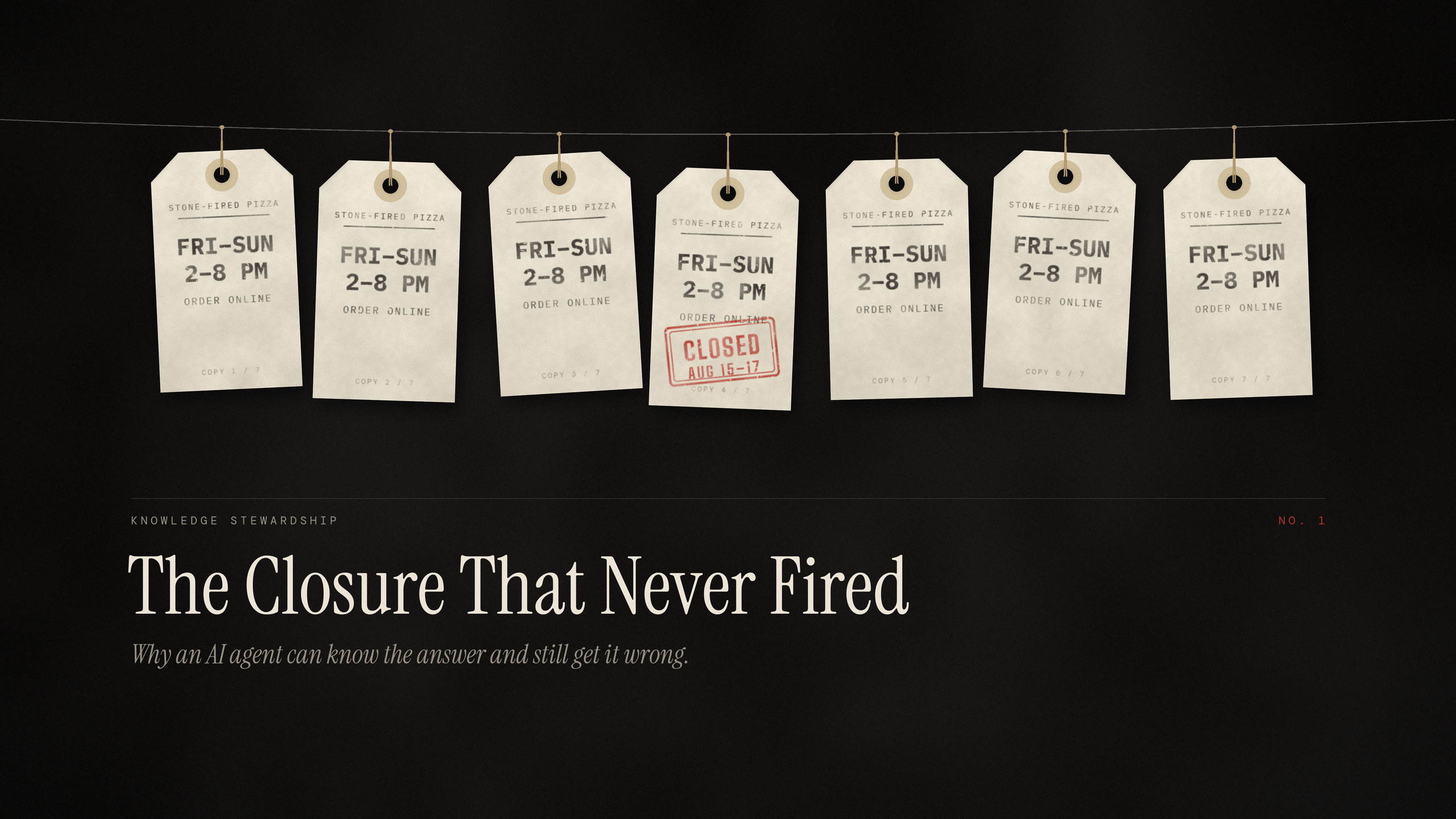
Open the Workshop — Get a CallThe pizza hours were in the knowledge base seven times.
The resort ran a stone-fired pizza window that took online orders Friday through Sunday, two to eight in the afternoon. In mid-August the kitchen shut online ordering for a three-day weekend. Somebody on the resort's team did exactly what you would hope. They opened the voice agent's knowledge base and added a dated closure: no online pizza orders, August 15 through 17.
Then the phones rang. Callers asked about ordering a pizza, and the agent told them the window was open and offered to text them the ordering link. Warmly, every time.
The resort's message to us was short. The agent doesn't know.
First, prove it isn't retrieval
When an agent gets a fact wrong, everyone's first suspect is retrieval. The search didn't find the passage, the document was too long, the right chunk ranked too low. Sometimes that is true. Here it was not, and it was worth proving before touching anything.
This agent wasn't searching its knowledge base at all. The whole document, about 60,000 characters, was loaded into the agent's context on every call. So we tested whether it could actually use what was in there. We asked six questions whose answers sat at different depths in the material, from near the top to near the very end. All six came back correct.
Then we tested the closure directly. A caller who named the date ("can I order a pizza online on the sixteenth?") got the closure instantly. A caller who asked whether there was anything in the knowledge base about the pizza window got it instantly too.
The agent knew. It just didn't think to check on an ordinary call. That narrowed the problem to how the agent decides what is true today, and that turned out to have three causes, stacked.
Cause one: the agent never asked what day it was
A dated closure only works if the agent compares it to today's date. This agent had a tool that returned the current date and time, shared by about a hundred agents across our fleet. The agent's instructions said, plainly, that it must call that tool once per call before giving any time or schedule information.
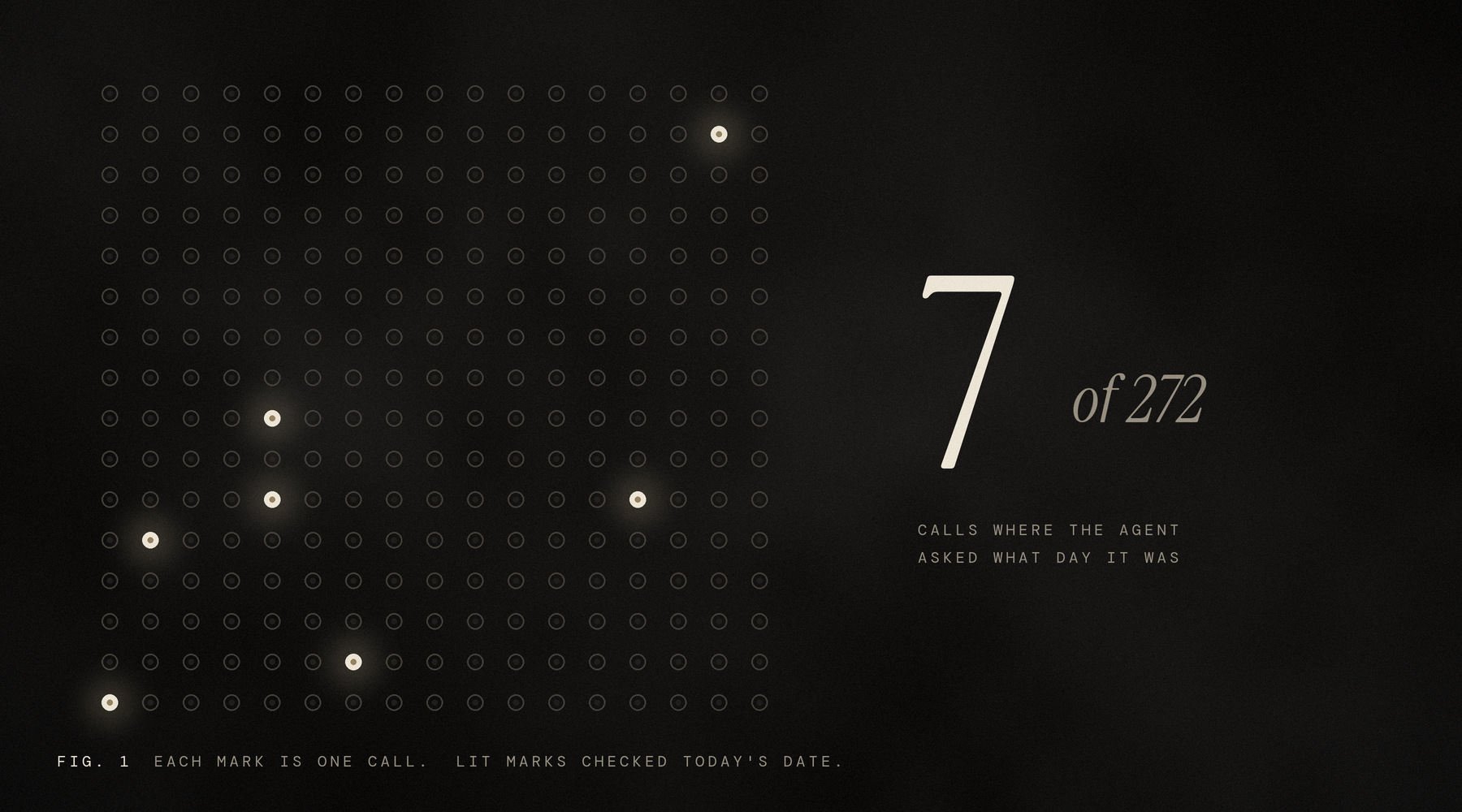
Across 272 calls, the tool fired seven times.
The reason was in the tool's own description, the short paragraph that tells the model when to use it. It said to reach for the tool when a caller used time-sensitive or relative phrases, such as "tomorrow at two," and before transferring a call. Nobody ordering a pizza says "tomorrow at two." Nobody ordering a pizza gets transferred. So the model, reading the narrower instruction sitting right next to the tool, skipped it, never resolved the date, and answered from the regular hours.
I have come to think of tool descriptions as a second set of instructions that most teams never review. The model reads them at the exact moment it decides what to do, and when they are narrower than the main prompt, the narrow one tends to win. A sentence written months earlier, for a different client, about transfers, quietly overrode a rule we thought was absolute.
That shared tool was a workaround, and we had always known it. In August the platform had no built-in way to hand an agent the date, so we built one, and a workaround only works when the model decides to use it. The platform has since added that capability natively, so our agents now receive the current date and time at the start of every call without having to ask. The lesson outlasts the fix. Anything an agent must know on every call should arrive on every call, and should never depend on the model remembering to go and get it.
Cause two: one exception against six certainties
Even with the date in hand, the closure was fighting bad odds. The pizza hours appeared seven times in the same document. One copy carried the dated closure. One carried a separate rider about concert weekends. The other five said, flatly and without qualification, Friday through Sunday, two to eight, order online.
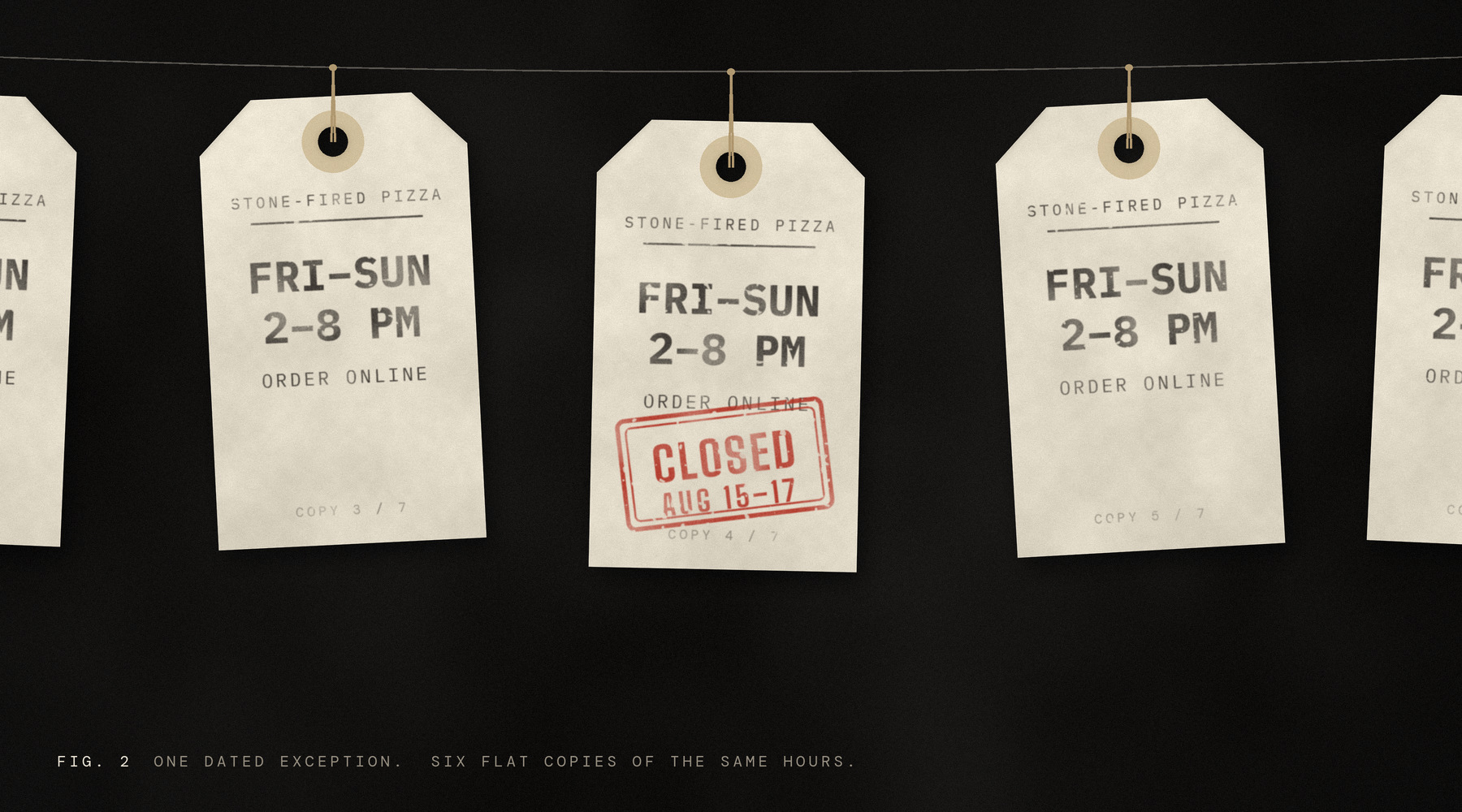
A language model weighs what it reads. Six confident statements and one dated exception do not produce a careful answer. They produce the majority answer, delivered with the confidence of the majority.
The same document had a second version of the problem. The resort sits near a concert venue, and the concert calendar appeared twice. The two copies disagreed about which weekend one festival fell on. The closure window and the concert window were also off by a day, so the "closed on concert weekends" rider and the dated closure contradicted each other on two of the four days in question.
None of these copies were mistakes when they were written. Each was added to help the agent answer some specific kind of question. Duplication is how a knowledge base grows when nobody owns the whole of it.
Cause three: last week's closure was still there
On August 14 and 15, the same agent told callers about a closure from the previous weekend, one that had already ended. It presented the expired closure as current.
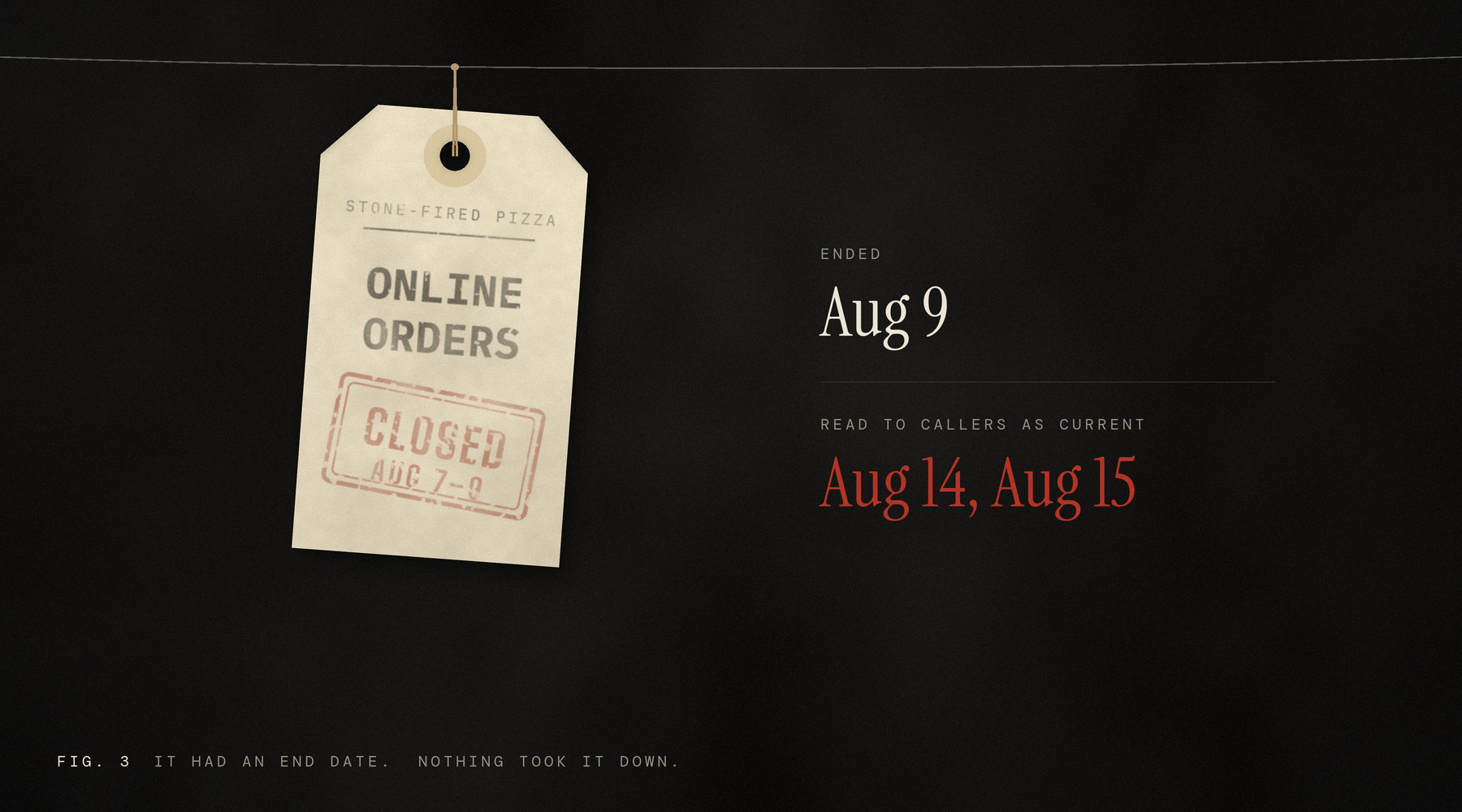
We had a routine that removed past-dated entries, but it only ran when our own team edited the agent. When the resort edited its knowledge base directly, which is exactly what we want clients to do, nothing cleaned up behind them. Old closures stayed in place and kept getting read aloud as fact.
So within the same week the agent ignored a closure that was live and announced one that was dead. Both failures came from the same missing idea: nothing in the system treated a closure as something with an end date.
The principle
A fact that can change needs one home, a date range, and an agent that checks today's date before it speaks.
Remove any one of those and the closure fails silently. The agent does not hesitate or hedge or say it isn't sure. It answers from whatever it read most often, in the same friendly voice it uses when it is right. That is what makes this failure expensive. Nobody notices until a guest drives over for a pizza that isn't being made.
I'll say the uncomfortable part, since I sell this kind of work. The fix did not need a better model, a bigger knowledge base or more tooling. Every remedy below is either a deletion or a sentence.
The practice: five tests for any agent with hours
1. Test with callers who don't name the date. Testers say "on the sixteenth." Real callers say "can I order a pizza?" Build your test calls the way real people talk, and put a dated closure in effect on the day you run them.
2. Read every tool description as an instruction. List each tool your agent can call and read its description next to the main prompt. Where the description is narrower than the prompt, the description usually wins. Rewrite it so both say the same thing, or remove the rule from one of them.
3. Give the agent the date without asking it to remember. If your platform can supply the current date and time on every turn, use that rather than an optional tool the model has to decide to call. An anchor the model has to remember to fetch is an anchor it will sometimes forget.
4. State each changeable fact once. Search the knowledge base for every mention of each hour, price and policy that can change. Keep one authoritative statement, with its dates and its exceptions, and have every other mention point to it. Seven copies is six places for the next change to be missed.
5. Expire closures on every edit path. Every closure and seasonal entry gets a start date and an end date, and something removes it when the end date passes, no matter who made the last edit. A cleanup that only runs when your own team touches the agent will miss the edits that matter most.
What we changed
Two of the fixes shipped, and they worked. The agent now receives the date at the start of every call, and you can hear it. On a Thursday in October a caller asked about pizza, and the agent said the oven runs Friday through Sunday, "though today being Thursday it's not running tonight." The knowledge base was rebuilt around a single section for hours, seasons and closures, labeled as the only place to update them, and eleven other mentions now say to look there and nowhere else.
In mid-October the pizza oven closed for the season. That was the real test, a closure measured in months instead of days. Of thirteen pizza answers we sampled from the weeks that followed, nine were exactly right: closed for the season, back in the spring. One call offered the ordering link and then corrected itself a few turns later. Three offered online ordering for an oven that was cold.
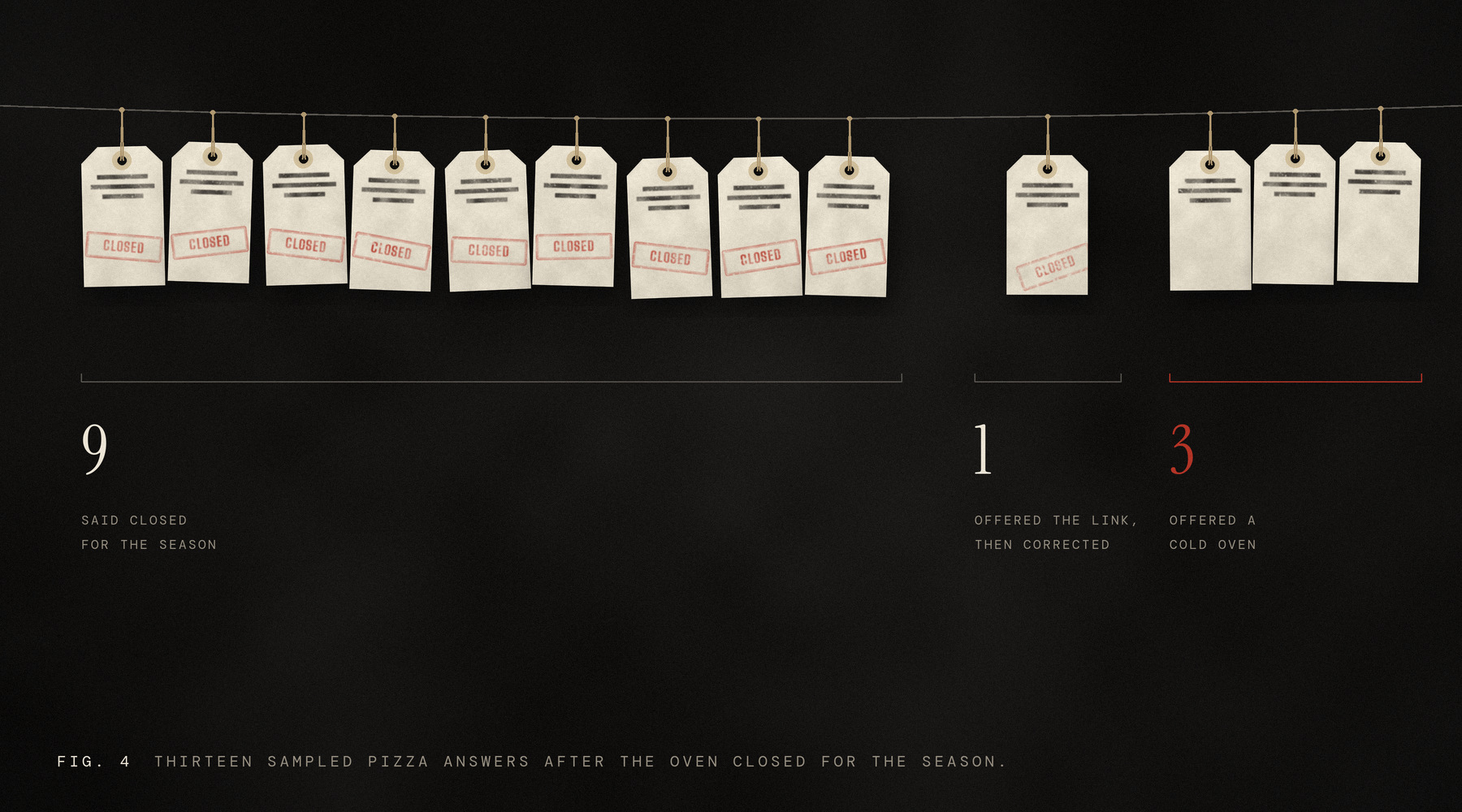
When we traced those three, the cause was familiar. The hours had one home, but a few passages still talked about pizza without deferring to it. The answer about room service still suggested ordering pizza to go. The guidance for texting the ordering link still described it as the fast way to skip the wait. The document also carried two different ordering links. We had cleared out the copies of the hours and left behind copies of the offer, which turned out to be the same problem wearing a different sentence. Since November 8 the sample is four for four, and those last passages are now on our list.
Two other items are still open, and I would rather say so than pretend otherwise. A Halloween event from three weeks ago is still listed in the events section, because nothing yet removes expired entries when the client edits the document. And the shared tool description that started all this still says "tomorrow at two." With the date now arriving natively it matters less, but it sits on about a hundred agents, so changing it is a fleet decision with its own testing, and we have not made it yet.
Knowledge stewardship looks like this most of the time. You fix the thing, you measure, you find the next smaller thing, and the library keeps growing while you work.
Related research
This incident is one case inside two larger studies:
- Is the Pool Open Today? Why AI Voice Agents Miss Answers That Expire measures time-dependent questions across 63,561 calls.
- Your Website Is Not a Knowledge Base looks at how 21,839 calls fared on crawled versus written knowledge.
Related Case Studies
Permission to Send
An email assistant should earn its access the way a new hire does, one kind of message at a time. Here is what that looks like when you actually build it.
The Opening Line · Full Episode
The AI that greets every visitor at workforcewave.com walks Viva through 72,798 business phone greetings, then the two of them try to write better ones.
Glad You Knocked · Scene 10
A great opening line sets the promise. So Viva asked for the closing line.