
Case Study
Is the Pool Open Today? Why Answers With an Expiry Date Break Voice Agents, and How to Keep Them Fresh
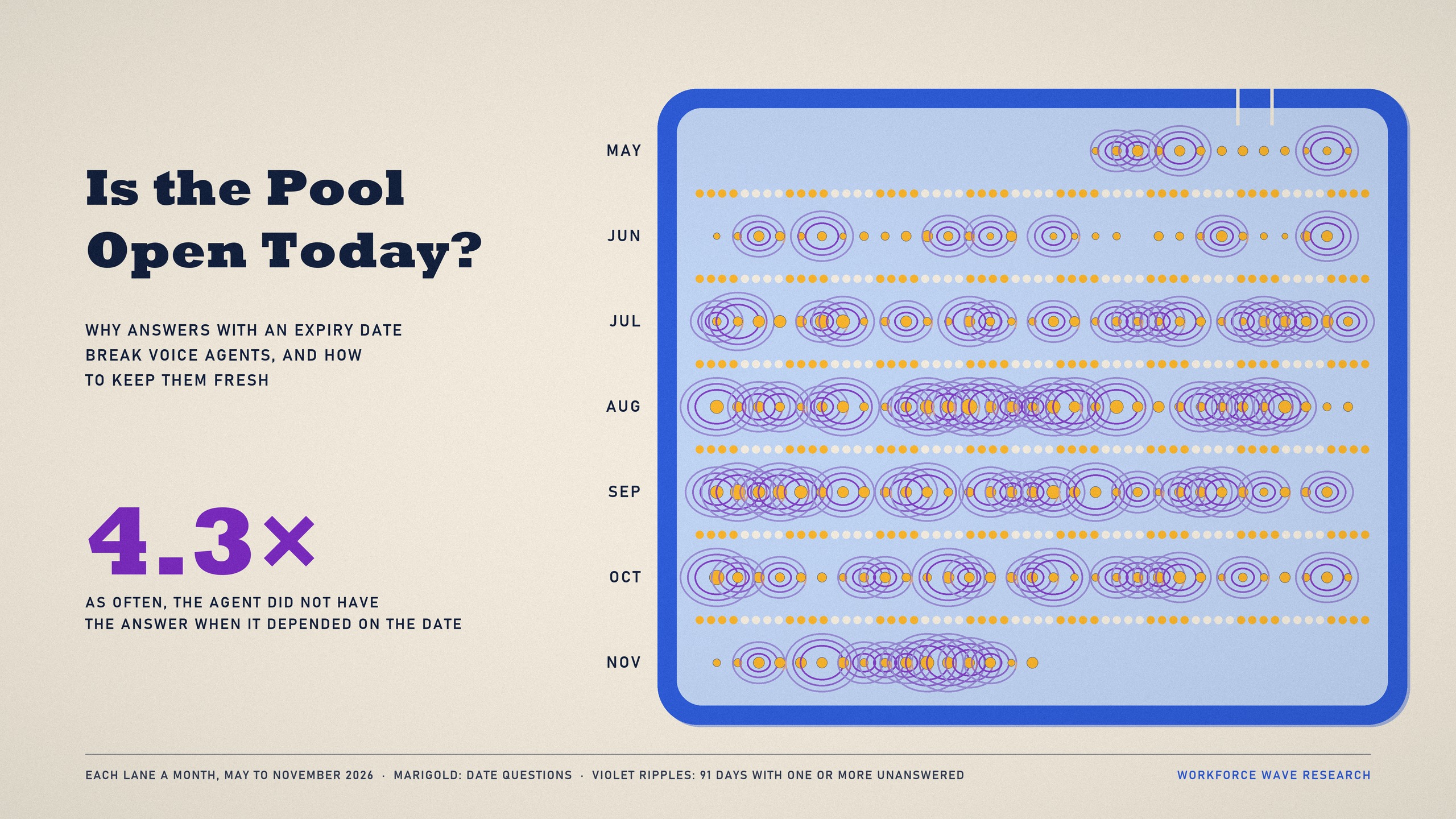
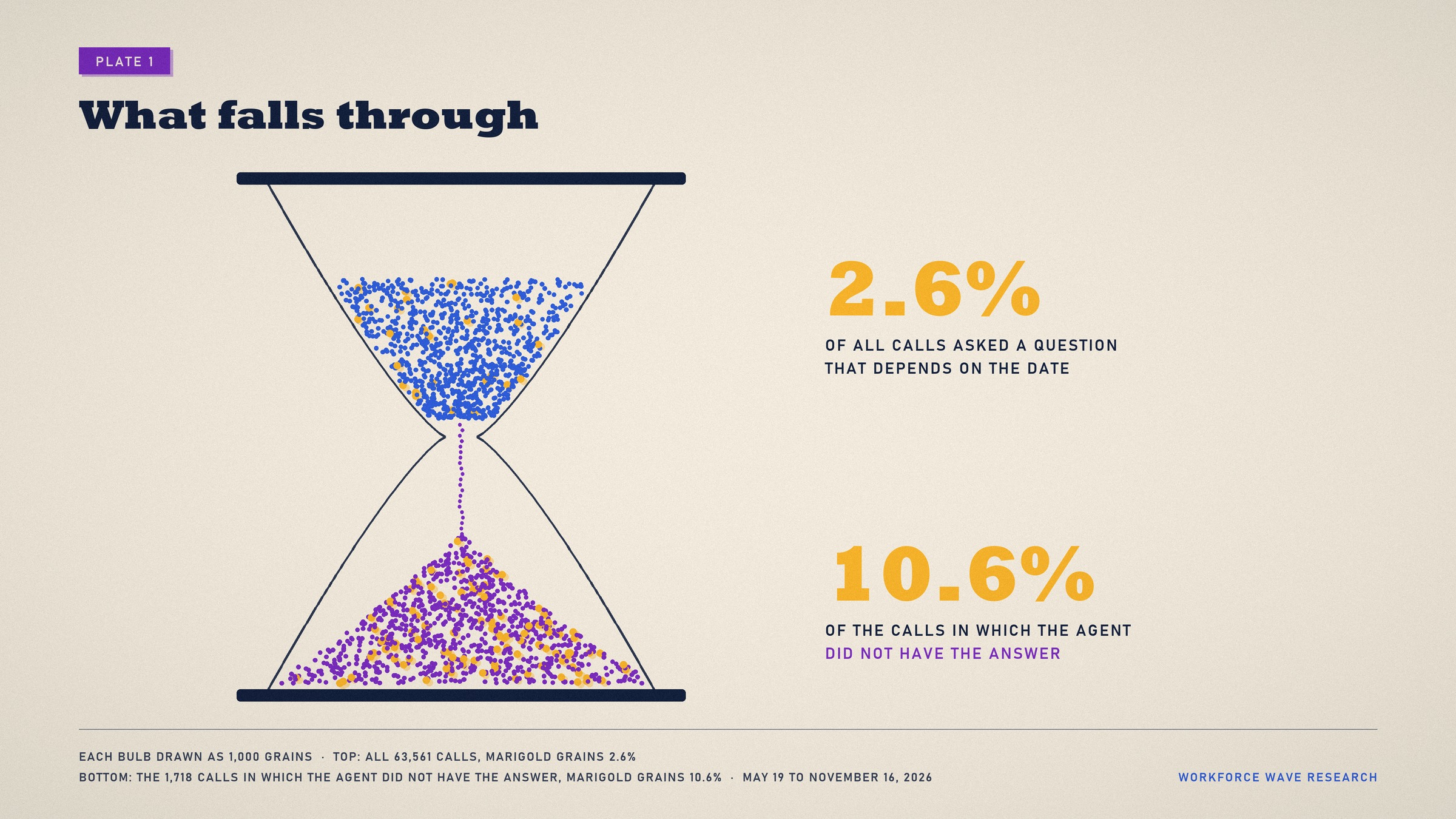
Across 63,561 calls over six months, questions that depend on the date were 2.6% of calls but 10.6% of the times a voice agent had no answer. When and why these questions fail, and how fields from transit to emergency alerts keep time-sensitive facts current.
Your brand doesn't just use voice agents—it casts them.
Open the Workshop — Get a CallAbstract
Background. Some answers are true for years. Others are true for a season, a holiday or a single evening. Voice agents answer from knowledge that someone wrote down at some point, and callers increasingly ask them questions whose answers depend on the day they call: whether the pool is open, whether the concert is still on in the rain, whether trash is picked up on the holiday. Little production data exists on how often these questions go unanswered or what organizations can do about it.
Methods. We analyzed six months of inbound calls to AI voice agents operated by Workforce Wave, May 19 to November 16, 2026, keeping calls in which the caller spoke at least twice: 63,561 calls across 85 government and business clients, treated as one fleet. We flagged caller questions whose answers depend on the date, in seven groups, and calls in which the agent said it did not have the answer. We checked both detectors against random samples. We then reviewed how other fields that publish time-sensitive facts handle expiry: business listings, structured web data, transit alerts, emergency alerts and support knowledge bases.
Results. Calls with a question whose answer depends on the date made up 2.6% of calls but 10.6% of the calls in which the agent said it did not have the answer. The agent ran out of answers on 10.8% of these calls, against 2.5% of all other calls, a ratio of 4.3. Because about half of the matched questions were not truly about time, the measured rate is a floor, and the sample-corrected rate is near 18%. Seasonal services were missed most often (28.4%), followed by events (17.8%) and holidays (14.6%). These questions were more than twice as common on weekends, when most offices are closed, and the miss rate peaked in August at 17.3%. Calls with these questions were transferred to staff less than half as often as other calls (22.9% against 53.7%), so the agent is often the caller's only source.
Conclusions. Answers with an expiry date fail for a different reason than missing answers. The knowledge usually exists somewhere, but not in a form that says when it starts, when it stops and what it overrides. Fields that publish time-sensitive facts at scale solve this the same way: every statement carries its own validity window, exceptions override the regular rule explicitly, and someone owns the next update. Knowledge bases for voice agents can adopt the same model before the next holiday season.
1. Introduction
On a Saturday in August, a resident calls the city and asks one question: is the pool open today? It is a simple question with a simple answer, and the answer changes. The pool keeps one schedule in June, another after school starts, closes for weather, closes for a swim meet and closes for the season on a date the parks department sets each year. The city's website has a page about the pool. The page lists the summer hours. It does not say what is true today.
In our calls, that question and others like it came up again and again over the summer. Callers asked whether the concert was still on tonight because it was raining, whether trash would be picked up on the holiday, whether a festival was still happening this weekend and whether the water would be turned back on today. Restaurant and resort callers asked how late the kitchen was open tonight. On these calls, the agent said it did not have the answer far more often than on any other kind of call.
Our last paper, Your Website Is Not a Knowledge Base, found that a quarter of the questions government voice agents could not answer asked for a date, a schedule or a live status [1]. This paper follows that thread across the whole fleet, government and business together, over six months. It asks three questions. How often do questions whose answers depend on the date go unanswered, compared with everything else? When and why do they come up? And how do fields that publish time-sensitive facts every day keep those facts correct, and what can an organization preparing knowledge for a voice agent take from them?
2. Answers with an expiry date
2.1 Four kinds of shelf life
Most of what an organization tells callers stays true for a long time. Where the building is, how to pay a bill, what a permit requires and which office handles animal complaints may not change for years. A smaller set of answers has a shorter life, and it is useful to separate them into four kinds.
- Regular schedules. Office hours, kitchen hours, collection days. These change rarely, but they are the base that every exception overrides.
- Seasonal schedules. Pool hours, leaf collection, snow operations, summer camps, winter hours. These are true for a few months and are usually announced once a year.
- Scheduled exceptions. Holiday closures, holiday trash delays, a special event that closes a road, a tax deadline. These are known in advance and are true for a day or a week.
- Live status. A concert cancelled for rain, a pool closed for lightning, a water main break, an office closed early. These are decided on the day and may be true for hours.
Each kind needs the one before it. A caller who asks whether the office is open on Veterans Day needs the regular hours, the holiday exception and, if something changed that morning, the live status. An answer is only as current as the shortest-lived piece it depends on.
2.2 Where these answers live
Long-lived answers usually live on web pages and in documents, which is why a crawl or a document upload captures them reasonably well. Short-lived answers are scattered. Seasonal schedules are often posted as PDFs or news items. Holiday schedules may appear as a banner on the home page for a week and then disappear. Events live in a calendar system that the website embeds but a crawler may not read. Live status is often announced on social media, by text alert or by a sign on the door, and never reaches the website at all.
The result is that a knowledge base built from the website at one point in time tends to hold the regular schedule, part of the seasonal schedule and almost none of the exceptions. It does not know which statement wins when two disagree, and it rarely knows when a statement stopped being true.
2.3 What "today" means to an agent
A language model has no clock of its own. It knows the date only if the system that runs it tells it. The agents we operate are given the current date and time when each call starts, so they can work out what "today" or "this weekend" means. That is necessary but not sufficient. Knowing that today is Saturday, August 15 does not help if the knowledge says only that the pool is open "during the summer season," or lists hours without saying which dates they cover. To answer, the agent needs knowledge that is itself dated.
3. Methods
3.1 Calls
We used inbound voice calls to agents operated by Workforce Wave between May 19 and November 16, 2026. We kept calls in which the caller spoke at least twice, to exclude hang-ups, wrong numbers and voicemail. This left 63,561 calls across 85 clients, including city and county governments, restaurants, resorts and spas, dental and medical offices, and home services. We treated them as one fleet. Every figure in this paper is an aggregate, and no client is named.
3.2 Questions whose answers depend on the date
We marked a caller turn as a time-dependent question when it was phrased as a question, either with a question mark in the transcript or by opening with a question word, and contained a term from one of seven groups: whether a place is open now or when it closes; today, tonight or tomorrow; this week or this weekend; holidays by name; deadlines and expiry; events; and seasonal services such as pool hours, leaf collection, snow operations, burn bans and holiday hours. We excluded turns about booking, reservations, appointments, callbacks or reaching a person, which are scheduling or routing requests rather than questions of knowledge, and greetings such as "how are you today."
3.3 The knowledge wall
As in our earlier paper, we flagged a call when the agent said, in any of several phrasings, that it did not have the information, could not find it or could not confirm it [1]. We call this the knowledge wall. We also counted walls that came within the agent's next two turns after a time-dependent question, as a tighter link between the question and the miss.
3.4 Validation
We read random samples of matched turns. Of sampled calls with a time-dependent question and a wall, about nine in ten were genuine cases of a caller asking a question about the date and the agent not having the answer. Of sampled time-dependent questions overall, about 55% truly asked for a fact that depends on the date. The rest mentioned a time word in passing ("Yes, today?") or asked something else. Because the false matches inflate the number of time-dependent calls but rarely the number of walls, the measured wall rate for these calls is a floor. Correcting for both sample rates puts it near 18%. We report the measured figures throughout.
3.5 Other fields
We reviewed public documentation for five systems that publish time-sensitive facts at scale: Google Business Profile special hours, schema.org opening hours markup, the GTFS Realtime service alerts used by transit agencies, the Common Alerting Protocol used for emergency alerts, and article verification in a widely used support knowledge base. We also drew on the Knowledge-Centered Service method for content health.
4. Results
4.1 Four times as likely to hit the wall
Of 63,561 calls, 1,678 included at least one time-dependent question, 2.6% of the total, across 57 clients. The agent hit the wall on 10.8% of them, compared with 2.5% of all other calls (Table 1). On 6.6% of these calls the wall came within two agent turns of the time-dependent question itself.
| Calls | Share of calls | Calls with a wall | Wall rate | Transferred to staff | |
|---|---|---|---|---|---|
| Asked a question that depends on the date | 1,678 | 2.6% | 182 | 10.8% | 22.9% |
| All other calls | 61,883 | 97.4% | 1,536 | 2.5% | 53.7% |
| All calls | 63,561 | 100% | 1,718 | 2.7% | 52.9% |
Table 1. Calls with a question that depends on the date, May 19 to November 16, 2026. A call can include more than one kind of time-dependent question.
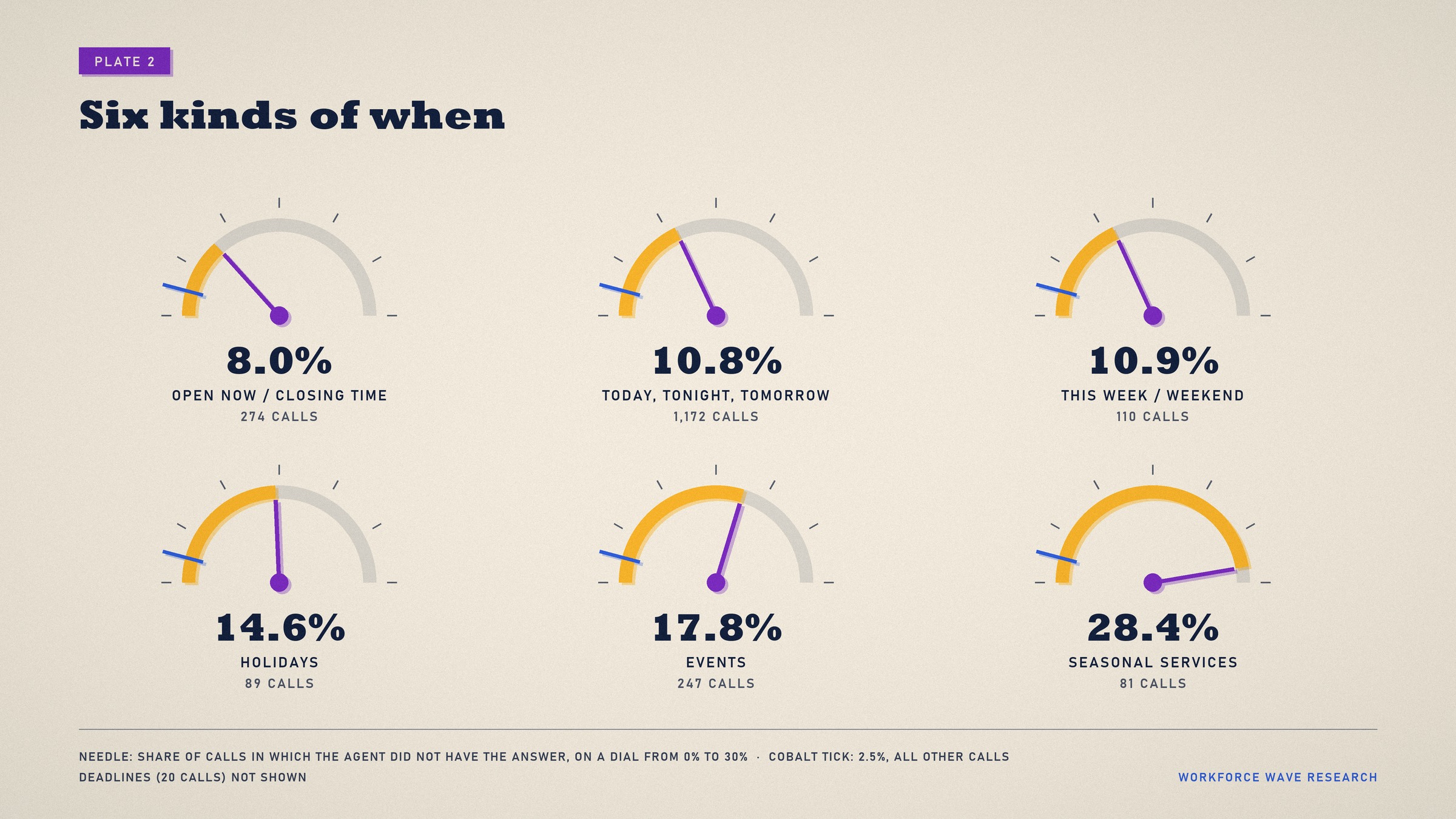
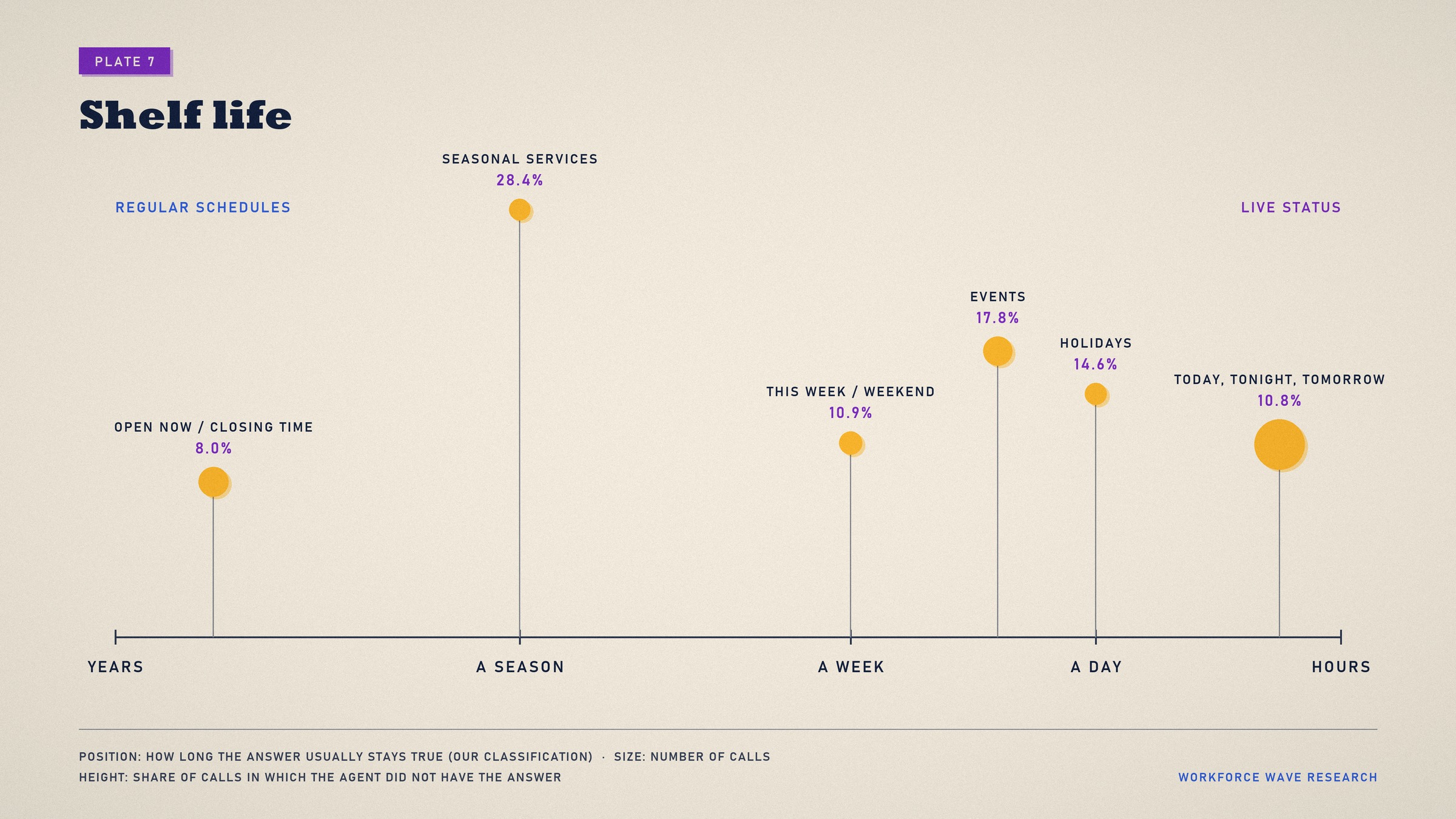
The gap held in every group (Figure 1). Questions about whether a place was open now or when it closed were missed least often, at 8.0%, because regular hours are usually in the knowledge. Questions about today, tonight or tomorrow and about this week were missed at about 11%. Holidays reached 14.6%, events 17.8% and seasonal services 28.4%. Deadlines were missed on 4 of 20 calls, too few to rate on their own.
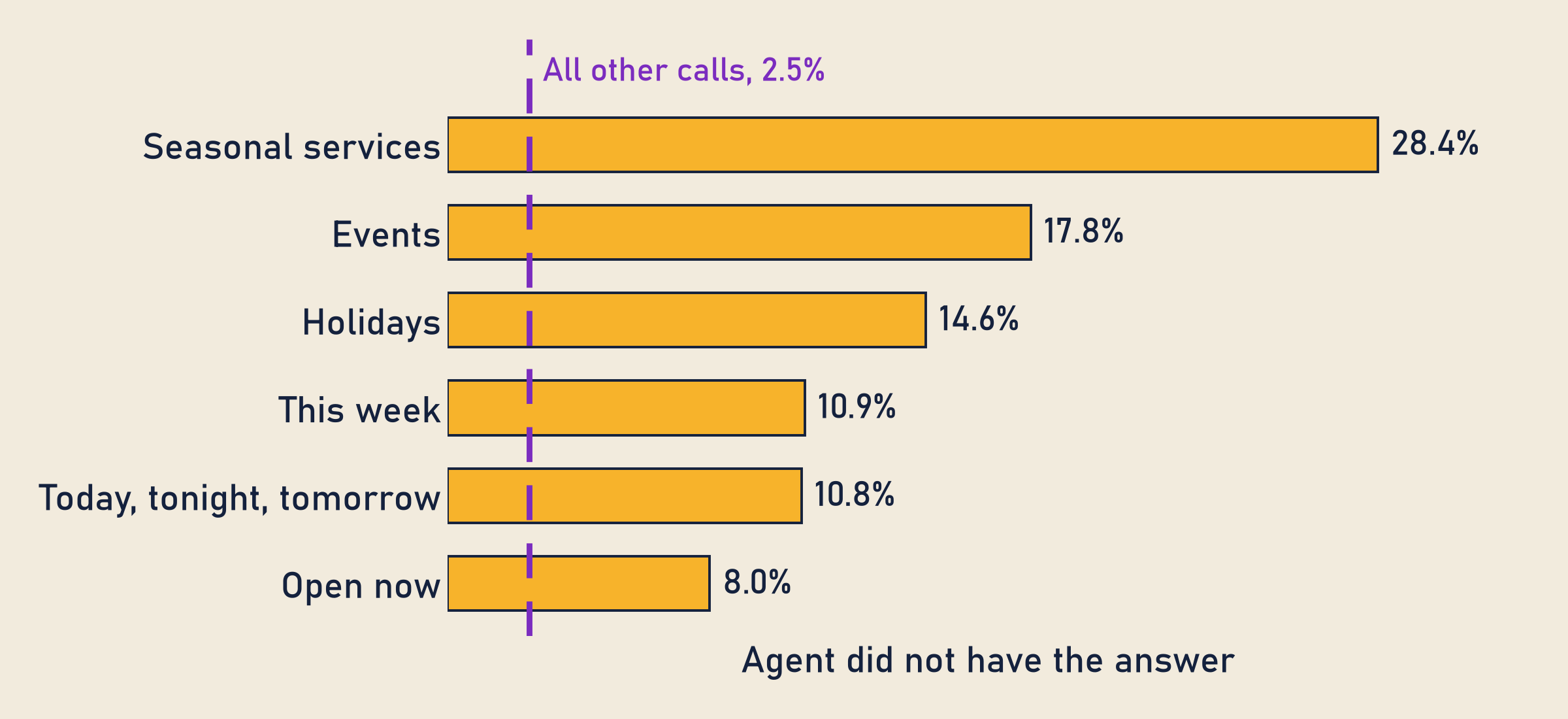
The ordering follows how the answer is kept. Regular hours, which change rarely and are usually written down, were missed least. Seasonal services, events and holidays, which depend on schedules announced once and changed every year, were missed most (Plate 2).
4.2 Weekends ask about time
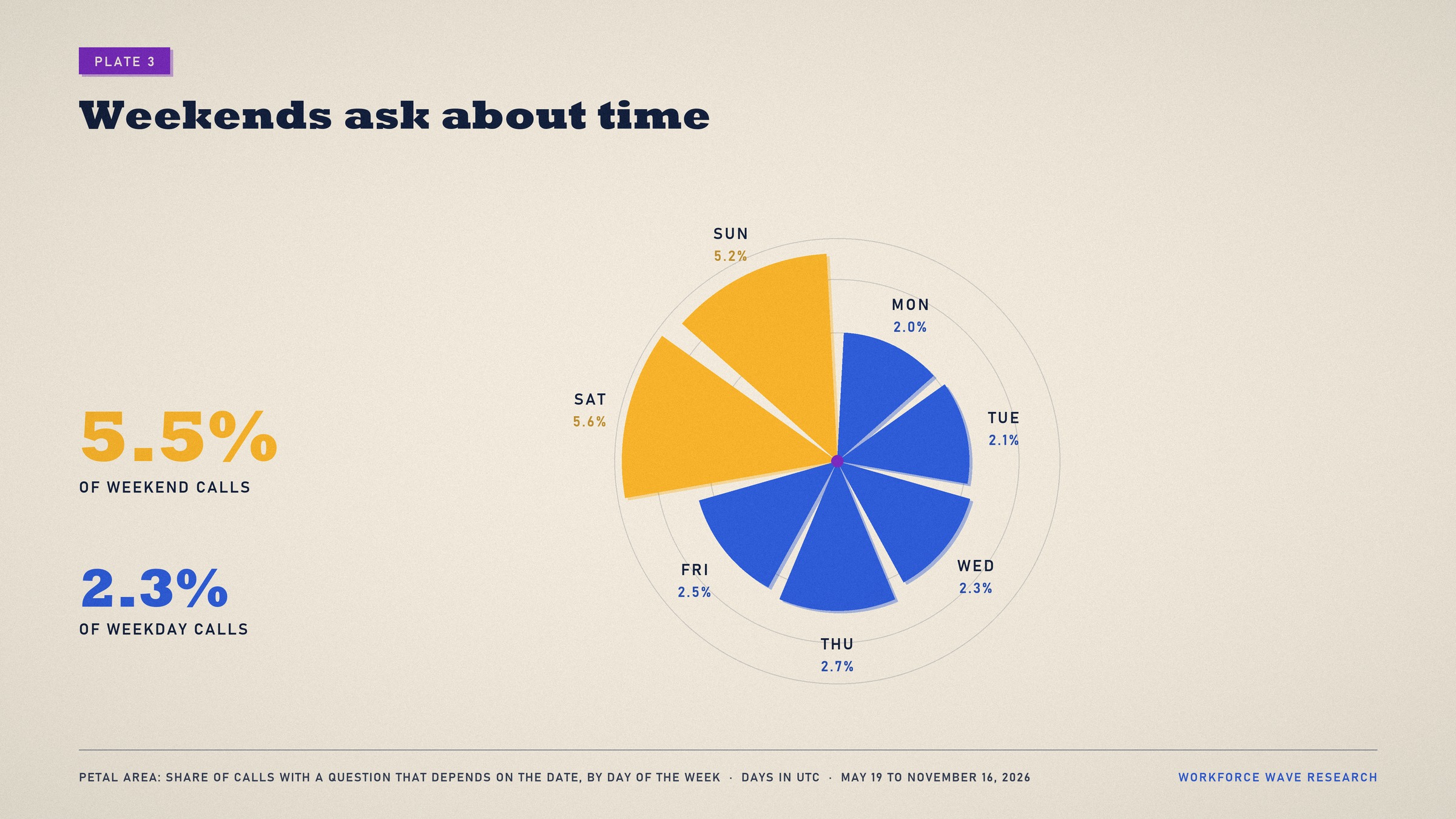
Callers asked time-dependent questions more than twice as often on weekends. They were 5.5% of Saturday and Sunday calls, against 2.3% of weekday calls (Plate 3). Weekends carried 10.8% of all calls, but questions such as "are you open today" and "is it still on tonight" made up a much larger part of what weekend callers wanted. Those are also the days when most government offices and many businesses are closed, so there is often no one to transfer the caller to.
4.3 The summer wall
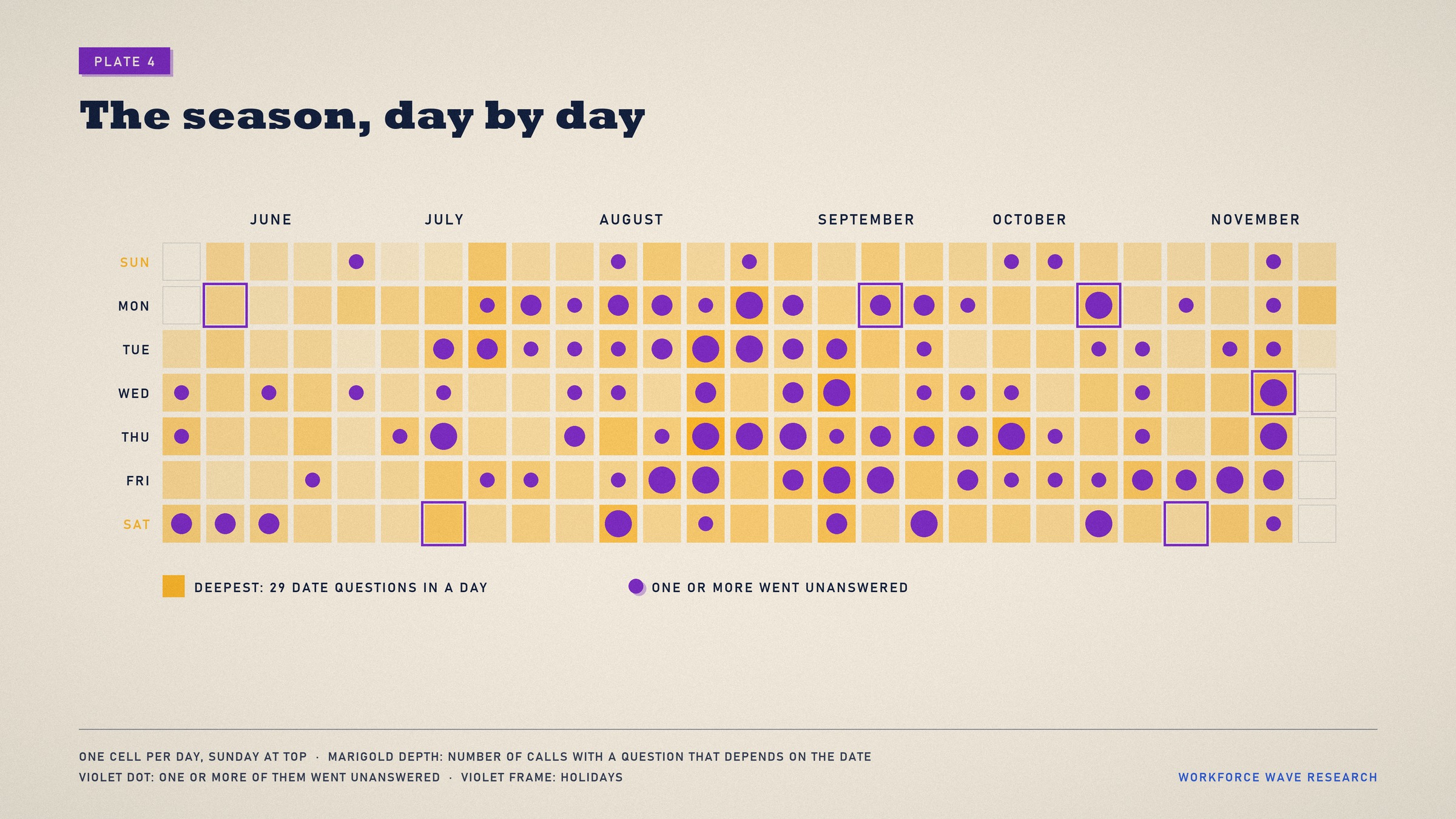
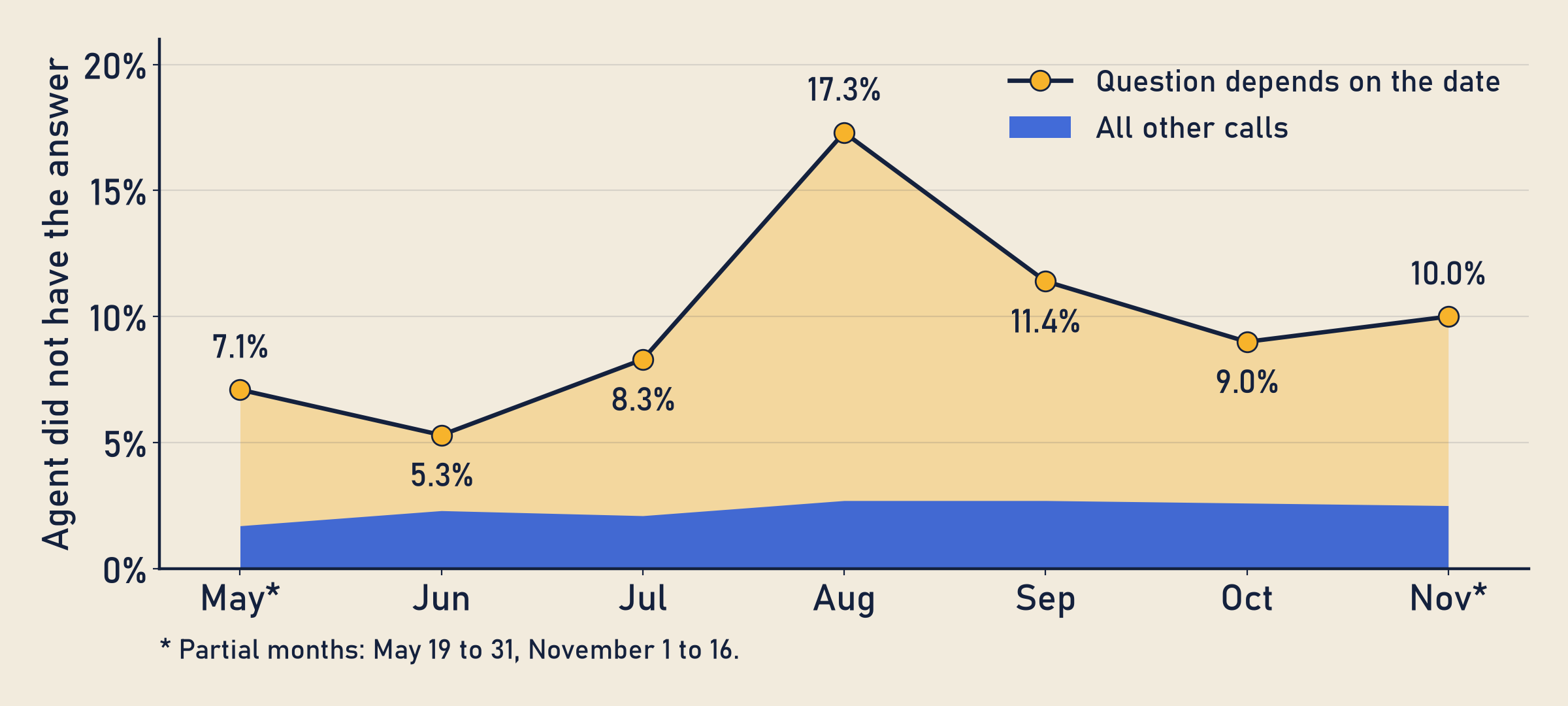
The wall rate for time-dependent questions rose through the summer and peaked in August at 17.3%, when pools, outdoor concerts, festivals and summer programs were at their busiest. It fell to 9.0% in October and was 10.0% in the first half of November. The wall rate for all other calls stayed between 1.7% and 2.7% every month (Figure 2). Seasonal knowledge is the hardest kind to keep current, and it is also the kind callers ask about most when the season is at its peak (Plate 4).
4.4 Holidays arrive as questions
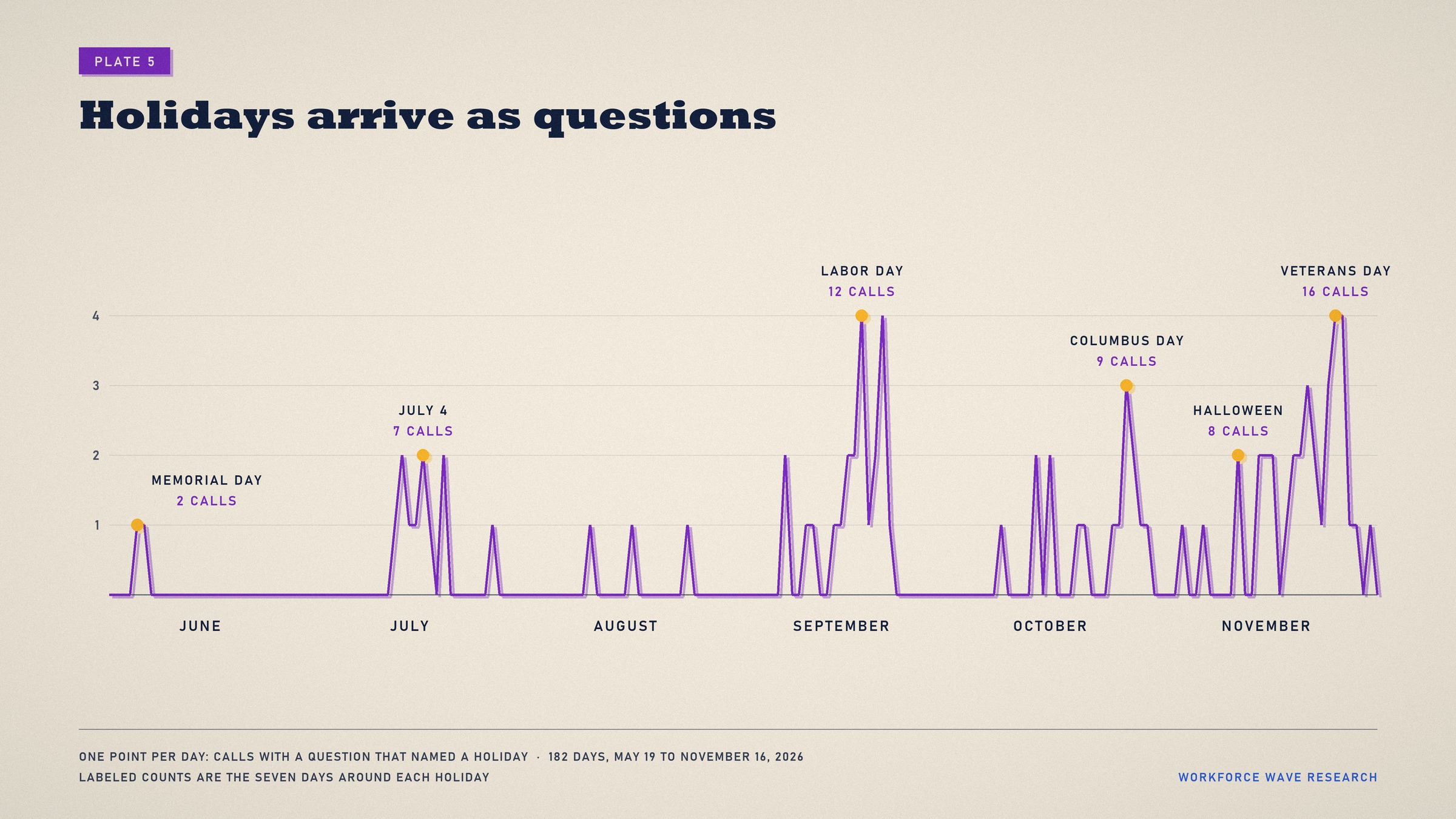
Questions that named a holiday came in clusters around each one. In the week centered on Veterans Day, 16 calls asked about it, the most of any holiday in the window, followed by Labor Day with 12, Columbus Day with 9, Halloween with 8 and the Fourth of July with 7 (Plate 5). The questions were nearly always the same: is the office open, is trash delayed, is the restaurant open on the holiday. The wall rate on holiday questions was 14.6%, almost six times the rate for other calls. Every one of these holidays was on the calendar a year in advance.
4.5 The agent is often the only source
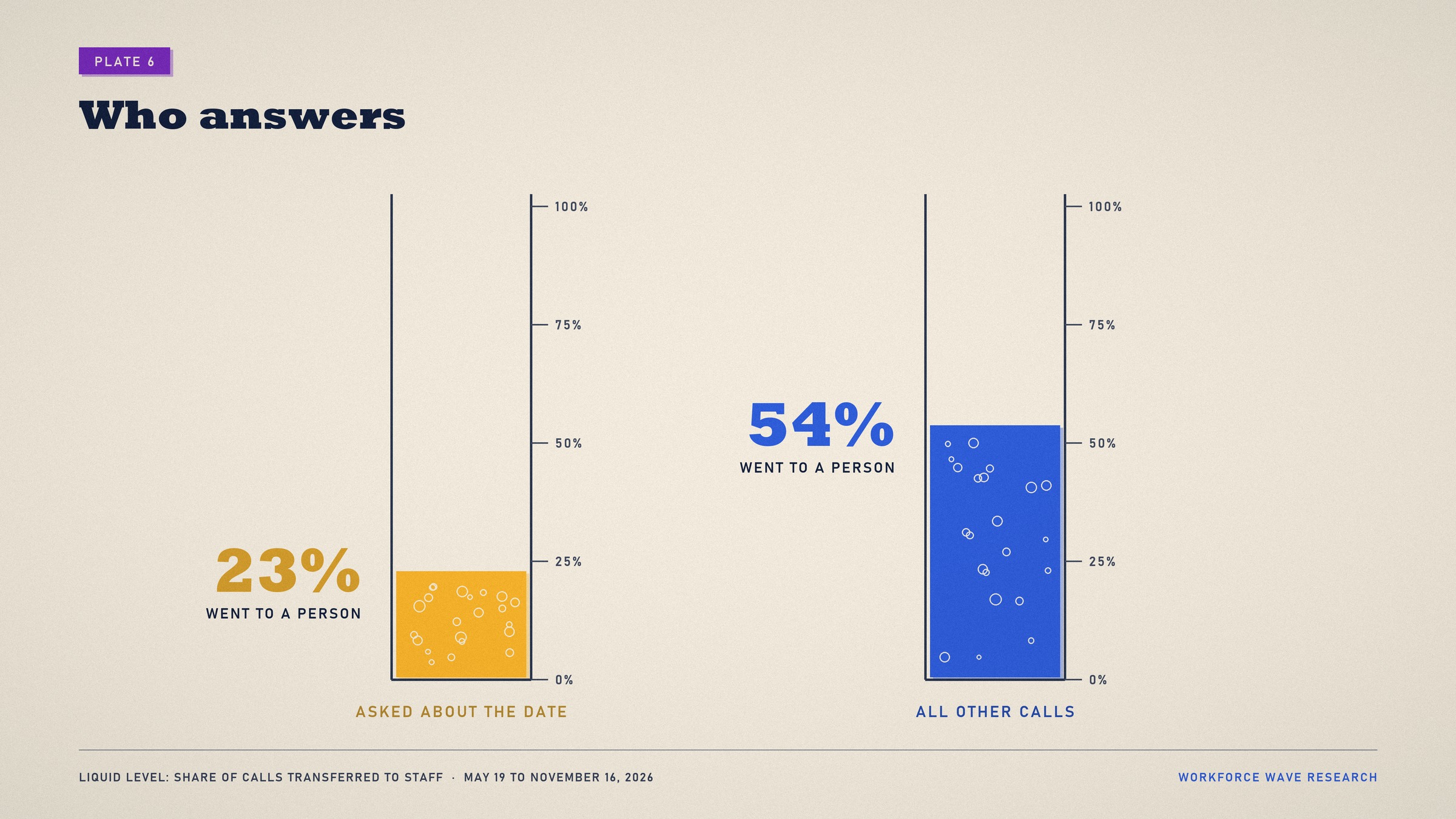
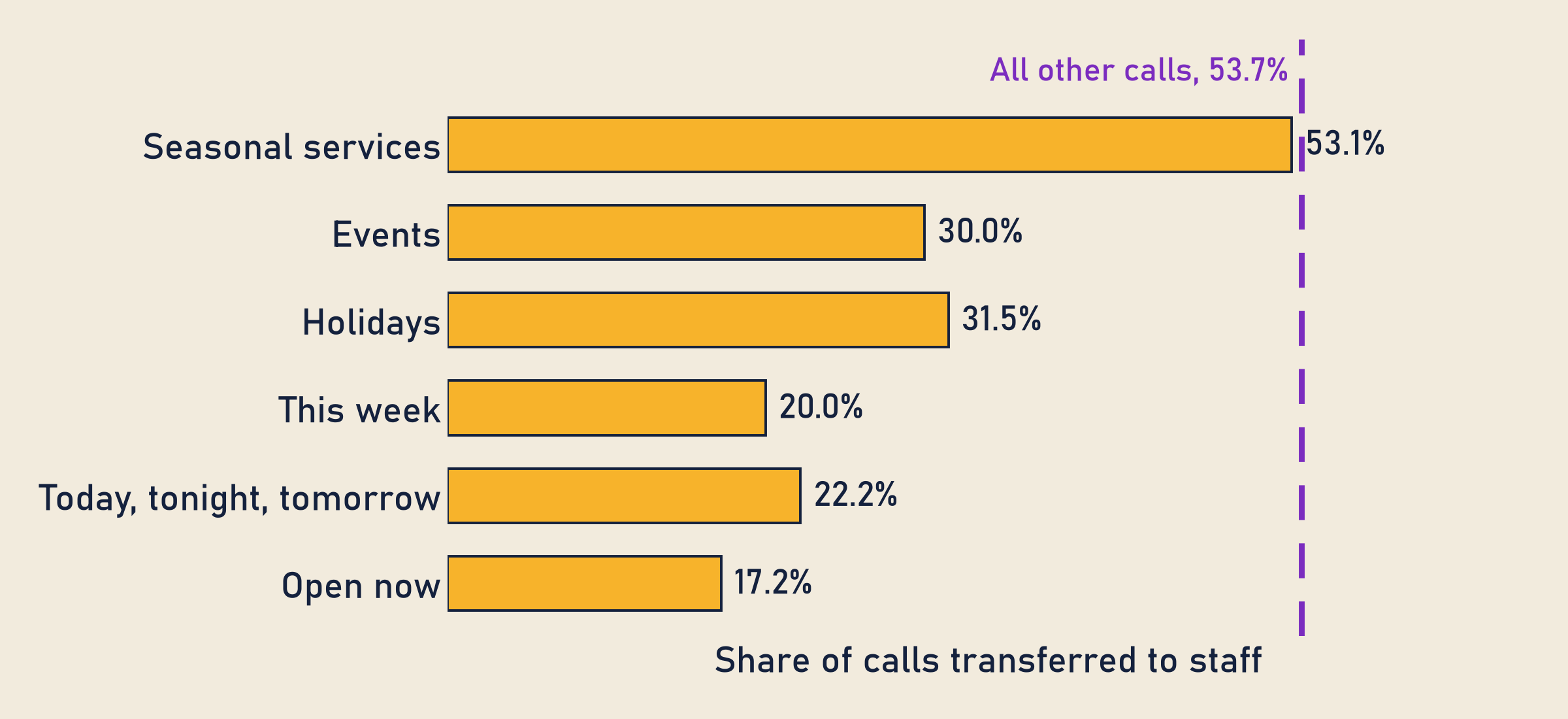
Calls with a time-dependent question were transferred to staff 22.9% of the time, less than half the 53.7% rate for all other calls (Plate 6, Figure 3). Many of these callers want one fact and do not need a person. That makes the agent's answer more important, not less. When the agent knows the answer, the call is complete. When it does not, and the call comes on a weekend or after hours, there is often no one to transfer to, and the caller leaves without an answer or with a guess.
4.6 What the questions sound like
Reading the calls in which the agent missed, the same handful of questions recur. "Is the pool open today?" came up again and again over the summer. Others asked "Is the concert still on tonight? It's raining," "Is there garbage tomorrow?," "Is the festival still happening this weekend?," "Will the water be turned on today?" and "What's the deadline for summer taxes?" Almost none of these are hard questions. Each has a definite answer that someone at the organization knew that day. The agent simply had not been given it in a form that said it applied today.
5. Why dated answers break
When the agent missed a time-dependent question, the knowledge was rarely absent in a simple sense. From the calls we read and from building these agents, five reasons recur, and they map onto the four kinds of shelf life described in Section 2 (Plate 7).
5.1 The rule is there, the exception is not
The knowledge holds regular hours but not the holiday closure that overrides them. Asked whether the office is open on the holiday, the agent either says it does not know or, worse, reads the regular hours. The second failure does not show up as a wall at all, so our numbers undercount the problem.
5.2 The season has no dates
Seasonal knowledge is often written as "summer hours" or "during the season" with no start or end date. The agent knows today's date but cannot tell whether today is in the season. Seasonal services had the highest wall rate in our data, 28.4%.
5.3 The answer lives in another system
Events live in a calendar, closures in an alert system, collection delays in a waste hauler's notice and cancellations on social media. None of these is in a knowledge base built from web pages unless someone copies it in. Events had a wall rate of 17.8%.
5.4 Last year's answer
Seasonal and holiday pages are often updated in place each year, or left up after the date passes. A stored copy can hold last year's holiday schedule or a festival date that has already gone by. Our earlier paper documented stored pages that kept describing a program years after it ended [1].
5.5 Nobody owns the update
The person who decides that the pool will close early for a swim meet is rarely the person who maintains the knowledge base, and there is usually no step in the process that connects the two. The fact is announced where that person usually announces things, and the agent never hears it.
6. How other fields keep answers fresh
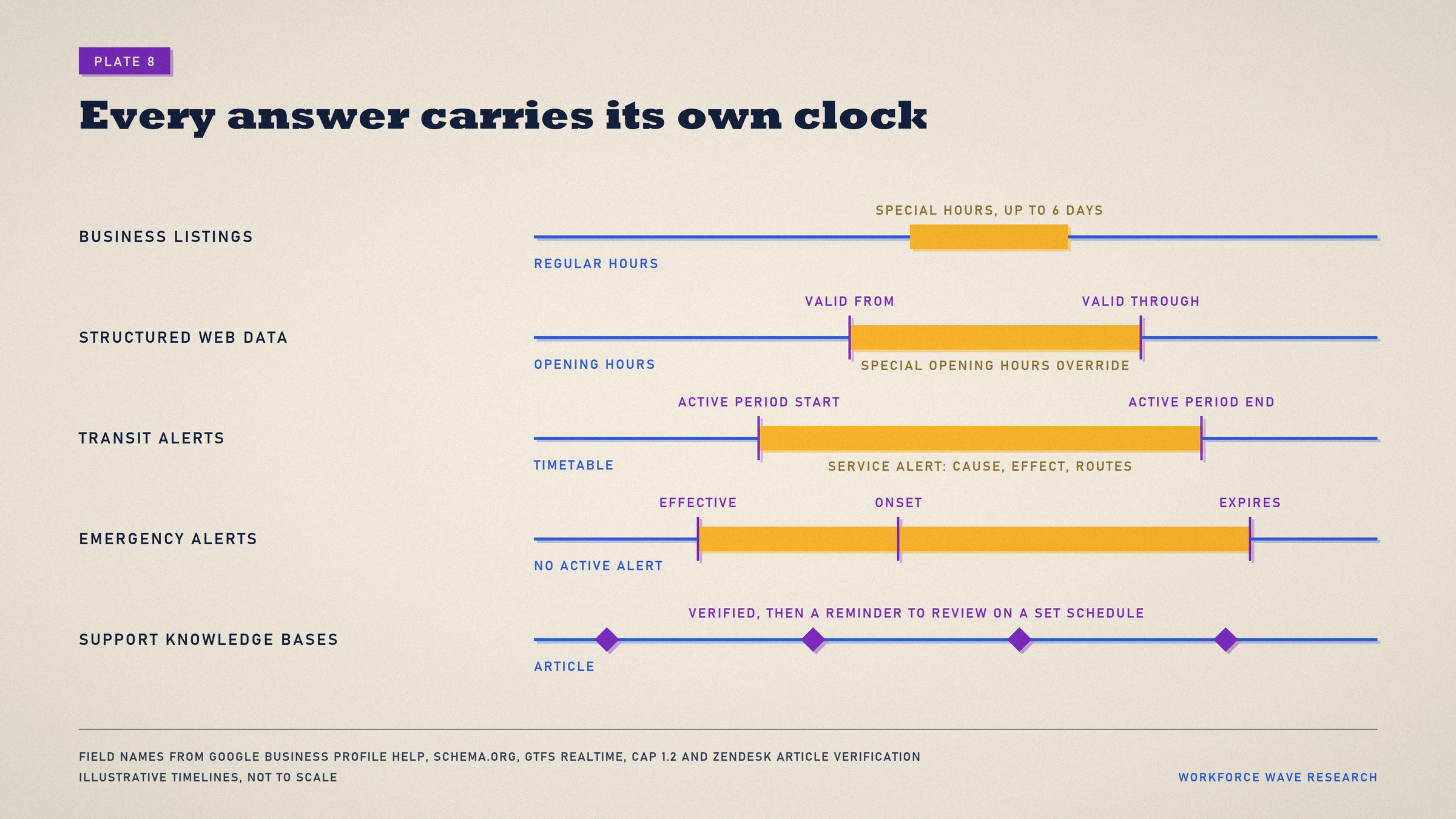
Many systems already publish facts that expire, at large scale and to automated readers. They differ in purpose, but they share one design idea: a time-sensitive statement carries its own validity window, and exceptions are stated as exceptions (Plate 8).
6.1 Business listings: special hours
Google Business Profile lets a business set special hours for holidays, special events and other exceptional circumstances, for closures of up to six days in a row, separate from its regular hours [2]. Google advises confirming hours for official holidays even when they are the same as regular hours, so that customers know they were checked [2]. The design separates three things a voice agent's knowledge often mixes together: the regular rule, the dated exception and the confirmation that someone looked.
6.2 Structured web data: overrides with dates
The schema.org vocabulary, used to describe places for search engines, has a property for special opening hours whose purpose is to explicitly override general opening hours [3]. Each opening hours statement can carry valid-from and valid-through dates [4]. A holiday closure is therefore written as a dated override of the regular schedule rather than as a sentence on a page. The same pattern fits seasonal hours.
6.3 Transit alerts: an active period
Transit agencies publish service alerts through GTFS Realtime, the feed format that trip planners read. Each alert carries a time range, which the specification says should cover the entire time the alert is useful for the passenger to see, together with a cause, an effect and the routes or stops affected [5]. The feed also allows alerts with no effect on service, for example to announce public meetings [5]. The alert is separate from the timetable, and it stops applying on its own.
6.4 Emergency alerts: effective and expires
The Common Alerting Protocol, an OASIS standard used for public warnings, gives each alert message times for when it takes effect, when the event begins and when the message expires [6]. Receivers stop showing an alert once it expires. No one has to remember to take it down.
6.5 Support knowledge bases: verification on a schedule
Support knowledge bases handle the slower kind of expiry. Zendesk describes article verification as a setting that marks whether an article is accurate and current or needs review, and lets administrators set reminders so that articles are reviewed on a schedule [7, 8]. The Knowledge-Centered Service method takes a related view: content is reviewed as it is used, and anyone who finds a problem flags it or fixes it, so knowledge health becomes part of daily work rather than a separate project [9].
6.6 What they share
Three ideas run through all five. Time-sensitive facts carry their own start and end. Exceptions are stated as overrides of a regular rule rather than as competing statements. And there is a defined owner or process for the next update, whether that is a business confirming its holiday hours, a transit dispatcher issuing an alert or a support team responding to a review reminder.
7. A design for dated answers
A knowledge base for a voice agent can adopt the same model without new technology. The central change is to store time-sensitive facts as dated entries rather than as text. Table 2 shows the fields we recommend.
| Field | What it holds | Example |
|---|---|---|
| Statement | The answer as the agent should give it | The outdoor pool is closed today for the swim meet and reopens tomorrow at noon. |
| Kind | Regular, seasonal, scheduled exception or live status | Scheduled exception |
| Valid from | When the statement starts to apply | August 15, 6:00 AM |
| Valid through | When it stops applying | August 15, 11:59 PM |
| Overrides | The regular rule it replaces while valid | Summer pool hours |
| Owner | The person or team who decides and updates it | Aquatics supervisor |
| Source | Where it is announced, if anywhere else | Parks alert feed |
| Review by | For regular and seasonal entries, when someone must confirm it | May 1 each year |
Table 2. Fields for a dated answer.
With these fields, the agent can follow a simple rule at call time: use a live status entry if one is valid, otherwise a scheduled exception, otherwise the seasonal schedule, otherwise the regular schedule. An entry past its valid-through date is never read. An entry past its review date is flagged to its owner. When nothing is valid for the date the caller asks about, the agent says so plainly and offers the best next step, such as the alert line or the department's hours on the next business day, instead of reading an old schedule.
Live status is the one kind that should not be typed into a knowledge base at all if it can be avoided. Where an organization already publishes alerts, an event calendar or a closure feed, the agent should read it directly at call time. The transit and emergency alert formats in Section 6 exist for exactly this reason.
8. Limitations
Our detectors are pattern-based. About half of the questions we flagged as depending on the date did not truly do so, which lowers the measured wall rate, and our phrase list for the wall may miss some ways an agent says it lacks an answer. We report measured rates, which we believe understate the true gap. The wall measures only the misses the agent admits. An agent that reads the regular hours on a holiday gives a wrong answer without hitting the wall, and our data does not count those. Calls are grouped by UTC day, so some Friday and Saturday evening calls in US time zones fall on the following day. The fleet grew during the window, from about 1,000 calls a week in late May to nearly 4,000 in August, so the mix of clients changed over time, and monthly figures partly reflect which clients were active. Some groups are small: deadlines had 20 calls and seasonal services 81 calls across 9 clients. The clients are customers of one company and may not represent all organizations. Our review of other fields is based on public documentation, not on interviews with the people who operate those systems.
9. Practical implications
These steps apply to a city, a county, a resort, a restaurant or any organization preparing knowledge for a voice agent, and most of them can be done before the December holidays.
- Load the holiday calendar now. For each holiday through New Year's Day, write a dated entry for every office, facility and service: open, closed or changed hours, and any collection delays. Include holidays on which nothing changes, and say so.
- Give every seasonal schedule dates. Replace "summer hours" with the dates they apply. Add the closing date for the season and the date the next season's schedule will be announced.
- Write exceptions as overrides. Keep the regular rule, and add the exception with its own dates and a note of which rule it replaces. Do not edit the regular hours to describe one closed day.
- Connect the calendar and alerts. If events, closures or alerts are already published somewhere, have the agent read them at call time. If they are not, decide who will copy them in and how fast.
- Name an owner for every answer with an expiry date. The person who decides the pool closes early should have one step that tells the agent.
- Retire expired entries automatically. An entry past its end date should never be read again. Seasonal and regular entries should prompt a review on a set date each year.
- Plan for weekends. Time-dependent questions are more than twice as common on weekends, when no one may be available to transfer to. Make sure weekend and evening status is in the knowledge before Friday afternoon.
- Read the walls by date. Review calls in which the agent did not have the answer every week, and look at them by date. A cluster around a holiday or a weekend event is a missing dated entry.
10. Talk with us
We would like to hear from parks and recreation staff, public works and solid waste teams, communications offices, resort and restaurant managers, and anyone who has to tell the public what is open today. Tell us how your schedules, exceptions and closures are announced now, and we will show you what it would take for a voice agent to answer them correctly on the day. We are also inviting guests to the Workforce Wave podcast to talk about keeping public information current. If that is you, we would love to have you on the show.
Authors
Colin P. Highland and the Workforce Wave research team. November 2026.
Data availability
Aggregate tables and the analysis code are available from the authors on request. Call-level data and transcripts are not shared, to protect clients and callers.
Conflict of interest
The authors work for Workforce Wave, which builds and operates the voice agents studied here and offers knowledge base design as part of its services. The authors have no relationship with Google, Schema.org, MobilityData, OASIS, Zendesk or the Consortium for Service Innovation. No external funding was received.
Suggested citation
Highland CP, Workforce Wave Research. Is the Pool Open Today? Why Answers With an Expiry Date Break Voice Agents, and How to Keep Them Fresh. Workforce Wave, November 2026.
References
- Workforce Wave. Your Website Is Not a Knowledge Base: What 21,839 Voice Agent Calls Show, and How Large Organizations Curate Knowledge for AI. November 2026. workforcewave.com
- Google. How to set special hours, Google Business Profile Help, 2026. support.google.com
- Schema.org. Property definition for specialOpeningHoursSpecification, version of September 2026. schema.org
- Schema.org. Type definition for OpeningHoursSpecification, version of September 2026. schema.org
- MobilityData. GTFS Realtime documentation on service alerts, 2026. gtfs.org
- OASIS. Common Alerting Protocol Version 1.2. July 2010. oasis-open.org
- Zendesk. About article verification and how it works. zendesk.com
- Zendesk. Managing article verification rules. zendesk.com
- Consortium for Service Innovation. KCS v6 Practices Guide, Practice 5: Content Health. serviceinnovation.org
Related Case Studies
Your Website Is Not a Knowledge Base: What 21,839 Voice Agent Calls Show, and How Large Organizations Curate Knowledge for AI
Voice agents answering from a website crawl told callers they had no answer twice as often, and two in three of those calls went to staff. What residents asked, five ways crawls fail, and how organizations that answer at scale build knowledge for AI.
The Outbound AI Call Compliance Guide
How to place outbound calls with AI voice agents and stay inside FCC, TCPA and state rules, explained with pictures, sample calls, a decision guide, a section for agencies, seven quick scenarios and a printable checklist.
Before You Dial: The Cautions of Outbound Voice AI Campaigns
Outbound AI calling is the fastest way to reach customers, and the fastest way to get sued, blocked or named in an FCC notice. Six cautions for businesses and voice AI agencies, told partly through the night 1,797 impostor robocalls put a carrier in front of the FCC.