
Case Study
Your Website Is Not a Knowledge Base: What 21,839 Voice Agent Calls Show, and How Large Organizations Curate Knowledge for AI
Voice agents answering from a website crawl told callers they had no answer twice as often, and two in three of those calls went to staff. What residents asked, five ways crawls fail, and how organizations that answer at scale build knowledge for AI.
Your brand doesn't just use voice agents—it casts them.
Open the Workshop — Get a CallAbstract
Background. Many city, county and special district voice agents answer residents from a copy of the government's public website, gathered by a crawler and searched at call time. Websites are curated to publish information to people who can see, scan and click. They are maintained on their own schedules, often on vendor platforms, and they leave out much of what callers ask. Almost no production data has been published on what this costs the people who call.
Methods. We analyzed inbound calls to AI voice agents operated by Workforce Wave between September 17 and November 16, 2026, keeping calls in which the caller spoke at least twice. We compared agents that answer from website crawls (24 government clients, 11,674 calls) with agents that answer from knowledge bases written for them (50 business clients, 10,165 calls). We flagged calls in which the agent said it did not have the answer, measured what followed, grouped the questions behind those calls, and documented field cases of crawl failure. We then reviewed public guidance on how large organizations curate knowledge for AI: Knowledge-Centered Service, municipal 311 programs and the readiness frameworks published by customer service AI vendors.
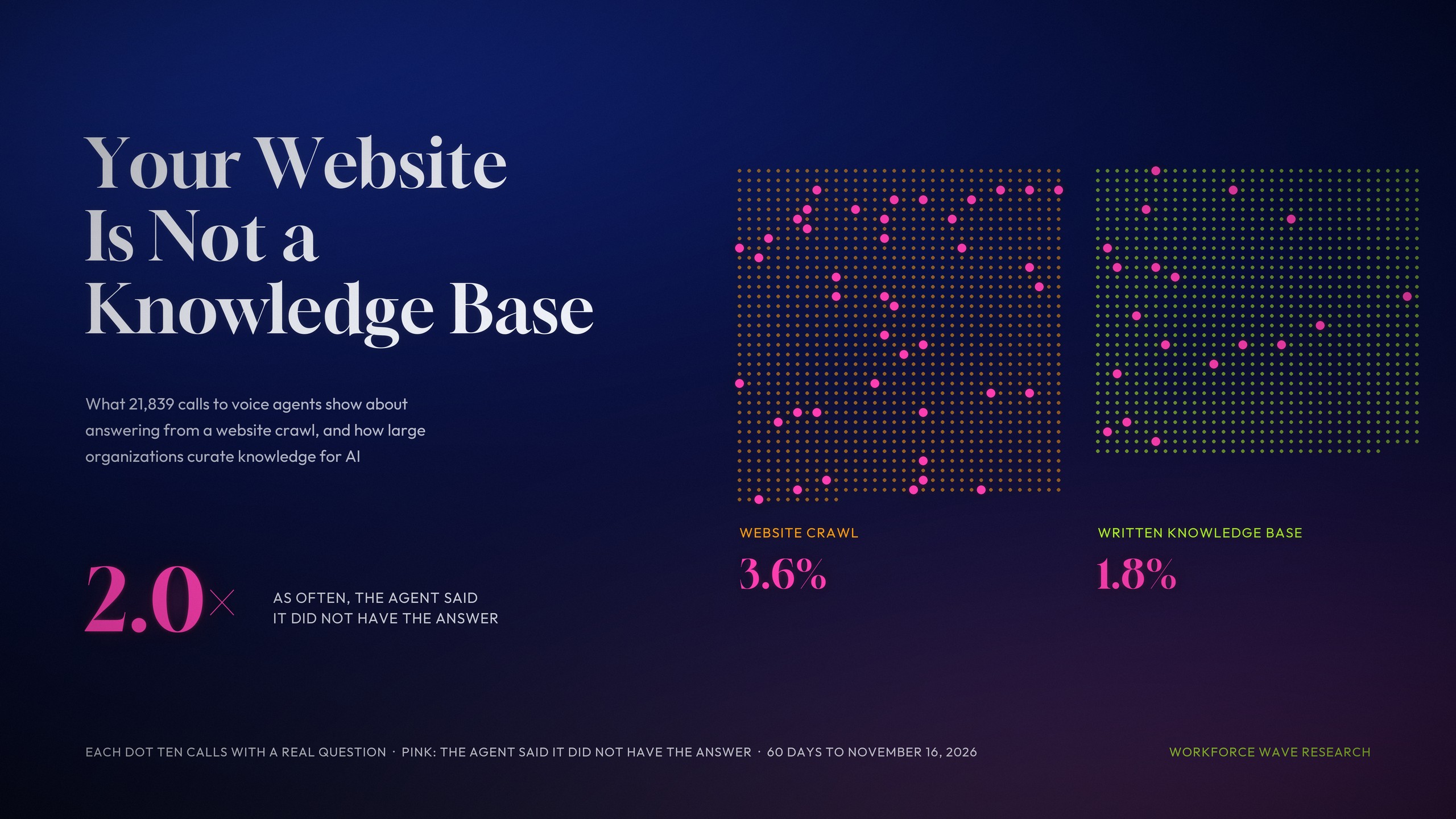
Results. Agents answering from a website crawl told callers they did not have the answer in 3.6% of calls, twice the 1.8% rate for agents answering from written knowledge bases. Two in three of those municipal calls ended in a transfer to staff, against one in six for written knowledge bases. For residents, 74% of these moments came by the caller's second turn, usually on the first real question. A quarter of the unanswered questions asked for a date, a schedule or a live status, and most of the rest asked for steps, fees, address-specific answers or a named contact, information that usually lives in calendars, fee schedules, maps and directories rather than on a page a crawler can read. Field cases showed five distinct ways a crawl fails: navigation menus filling the readable window, pages stored as titles only, facts dropped from banners, expired pages outliving the real ones, and long pages cut short.
Conclusions. A website and a knowledge base for a voice agent do two different jobs. One is curated to publish and the other to answer. Organizations that answer at scale, from support centers to municipal 311 programs, build knowledge from the questions people actually ask, capture it from the people who answer them, keep one statement of each fact with an owner and a date, and connect live questions to live systems. Prose quality matters less than completeness. Because a voice agent can now answer in dozens of languages, every gap in that knowledge is a gap in every language at once.
1. Introduction
A resident calls a North Carolina city and asks how to pay a water bill. The city's voice agent is quick, polite and fluent, and in testing it answered by describing the ordinance that governs shutting off water for nonpayment.
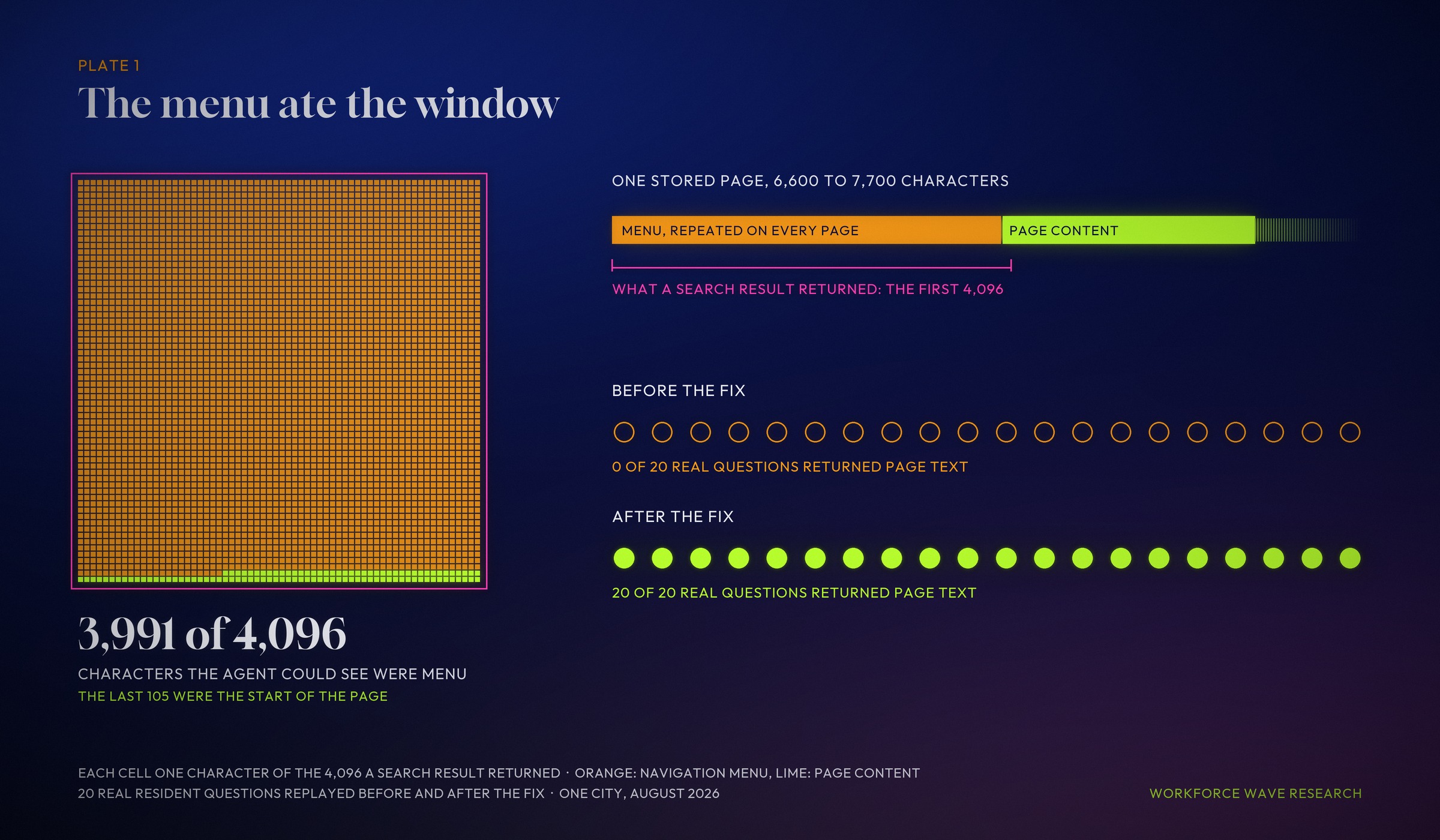
The agent did what it was built to do. It searched the city's stored knowledge and read back the closest match. The problem sat underneath. The city's knowledge for the agent had four parts: a crawl of the public website, a table of frequently asked questions, a table of events and the city code. The question and event tables were empty. The website crawl was complete, but each page on that site opens with a navigation menu of about 4,000 characters, and the search system behind the agent returns only the first 4,096 characters of each matching page. On this site the menu took 3,991 of them (Plate 1). The water billing page was found. What came back was the menu. The only other source with any text in it was the city code, so the agent reached for the code.
That one city is a small version of a common problem. Last week, in Part 3 of our Language Week series, we wrote that answering a resident in their own language solves the first ten seconds of a call, and that what happens next depends on what the government has actually written down [1]. This paper is about that second part.
It asks three questions. How often does a voice agent built on a website crawl run out of answers, compared with one built on knowledge written for it? What were callers asking when it did? And how do organizations that answer large volumes of questions build knowledge for AI, and what can a city, a county or a company take from them?
2. Two jobs
2.1 A website is curated to publish
A government website is an editorial product. Someone decides what belongs on a public page, how it should read, which department owns it and when it goes live. Those decisions are made for a reader who can see the whole page, scan the headings, open the PDF, check the date in the corner and judge for themselves whether a notice still applies. They are also made with care about what is appropriate to publish at all. Internal routing rules, the exceptions staff handle every day, what to do when an inspector does not show, which office really owns a question that sits between two departments: most of this never appears on a public page, and much of it should not.
A voice agent answering the same government's phone line needs a different set of things. It needs every answer a caller might reasonably ask for, stated so that it stands on its own, with the fee, the steps, the exceptions and who to call when the answer depends on something the agent cannot see. It does not need a polished page. It needs coverage. The two collections overlap, and the overlap is real, but neither one contains the other.
2.2 Who keeps the website current
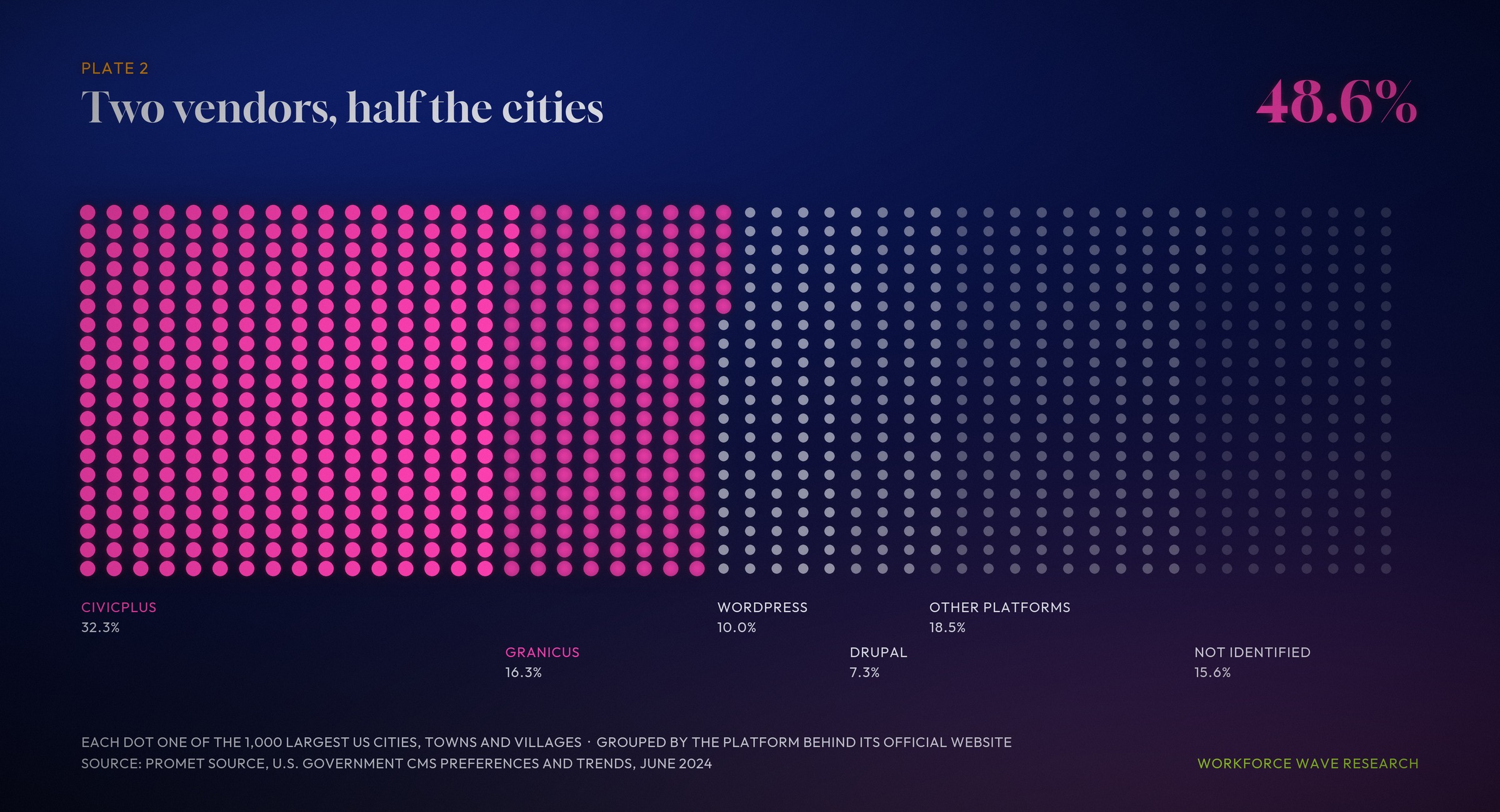
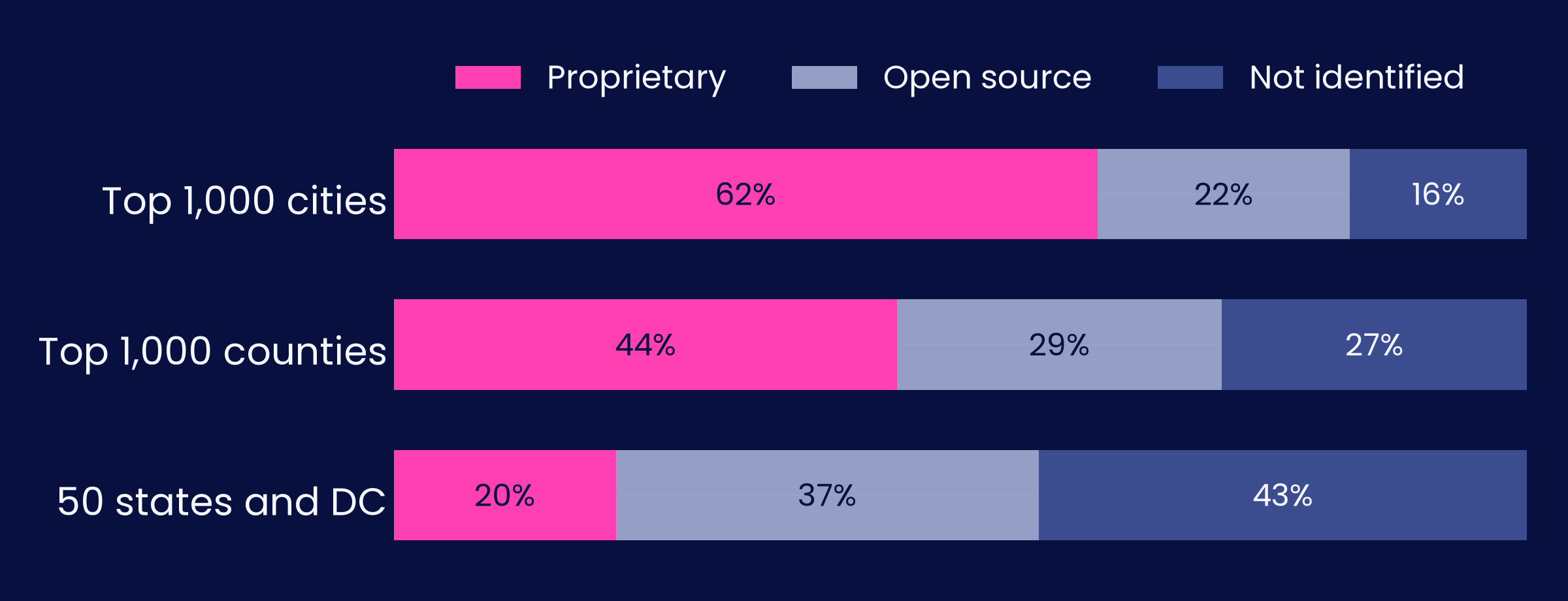
Most local government websites run on platforms built for the public sector. In a 2024 study of the official websites of the 1,000 largest US cities, towns and villages, Promet Source found that 32.3% ran on CivicPlus and 16.3% on Granicus, so about half sat on one of two vendors' proprietary platforms (Plate 2) [2]. Across those cities, 62.1% used a proprietary platform, compared with 44.4% of the 1,000 largest counties and 19.6% of state governments (Figure 1) [2].
These platforms make routine updates easy for staff, and content is usually edited by people spread across departments. Promet's comparison of government platforms notes that some custom changes or feature requests on CivicPlus may require vendor intervention or support tickets [3]. Structural changes, such as how a navigation menu is built or how a page is marked up, are therefore often out of the hands of the people who would notice a voice agent struggling. Content changes follow each department's own rhythm, which means a fee can change in a council resolution weeks before the page does, and a page can stay up long after a program ends.
2.3 How a voice agent reads a website
A typical build works in four steps. A crawler visits the site, usually from its sitemap, and stores the text of each page. The text is cut into passages. Each passage is converted into a numerical representation of its meaning so that it can be searched. When a caller asks a question, the system finds the passages closest in meaning and hands the best few to the language model that writes the agent's reply. In the government agents we studied, the model reads three results.
Every step can lose the answer. The crawler can keep the page furniture and miss the content, or keep a stale copy. The cutting can split a fact from its context. The search can rank the right passage too low for the model to see it. And the website may simply never have contained the answer in the first place.
3. Methods
3.1 Data source
Workforce Wave builds and operates AI voice agents that answer inbound telephone calls for businesses and public agencies. We analyzed all inbound calls between September 17 and November 16, 2026 for which a transcript was available.
3.2 Two groups
The first group is agents that answer from a website crawl. These are the agents of 24 government clients, mostly cities, counties and special districts, whose knowledge is a crawl of the government's public site, supplemented in some cases by small tables of frequently asked questions, events or city code. The second group is agents that answer from knowledge bases written for them: the agents of 50 business clients, including restaurants, spas, medical practices, resorts and service companies, whose knowledge was assembled from client intake forms, documents and the questions their callers ask. Some business agents also look up live information such as appointment availability.
3.3 Inclusion
We kept calls in which the caller spoke at least twice, so that hang-ups, wrong numbers and silent lines did not count. That left 11,674 calls in the website crawl group and 10,165 in the written knowledge base group, 21,839 in all.
3.4 The knowledge wall
We flagged a call when the agent said, in so many words, that it did not have the answer. Two pattern sets were used. The first matched direct statements such as "I don't have information on that" or "I wasn't able to find that." The second matched the phrasing our agents use when a search comes back without the answer, such as "I'm not seeing that in the information I have," "I couldn't find a verified fee for that" or "nothing specific came up." We call this moment the knowledge wall. A random sample of flagged calls was read to confirm the patterns matched real gaps. We also tested a broader measure, agents mentioning the website, and dropped it, because most such mentions were good answers that also gave a link.
3.5 Measures
For each group we report the share of calls that hit the wall, the share of those calls that then ended in a transfer to staff, the caller's turn at which the wall first appeared, the number of agent turns after it, and median call length with and without a wall. We report the wall rate for each agent with 40 or more calls. For the website crawl group, we grouped the questions asked just before the wall by keyword into six types and read a random sample of 45 to check the grouping.
3.6 Field cases and literature
Section 5 describes failures found while building and repairing government agents in 2026, drawn from our engineering records. Section 6 reviews public material on knowledge curation for AI: the Knowledge-Centered Service methodology, published accounts of municipal 311 programs, and content guidance from two customer service AI vendors.
3.7 Privacy
Only aggregate counts are reported. No caller numbers, names or recordings appear in this paper, quoted questions are paraphrased, and no client is named. Field cases are described by state or type of government only.
4. Results
4.1 Twice as often, and more often passed on
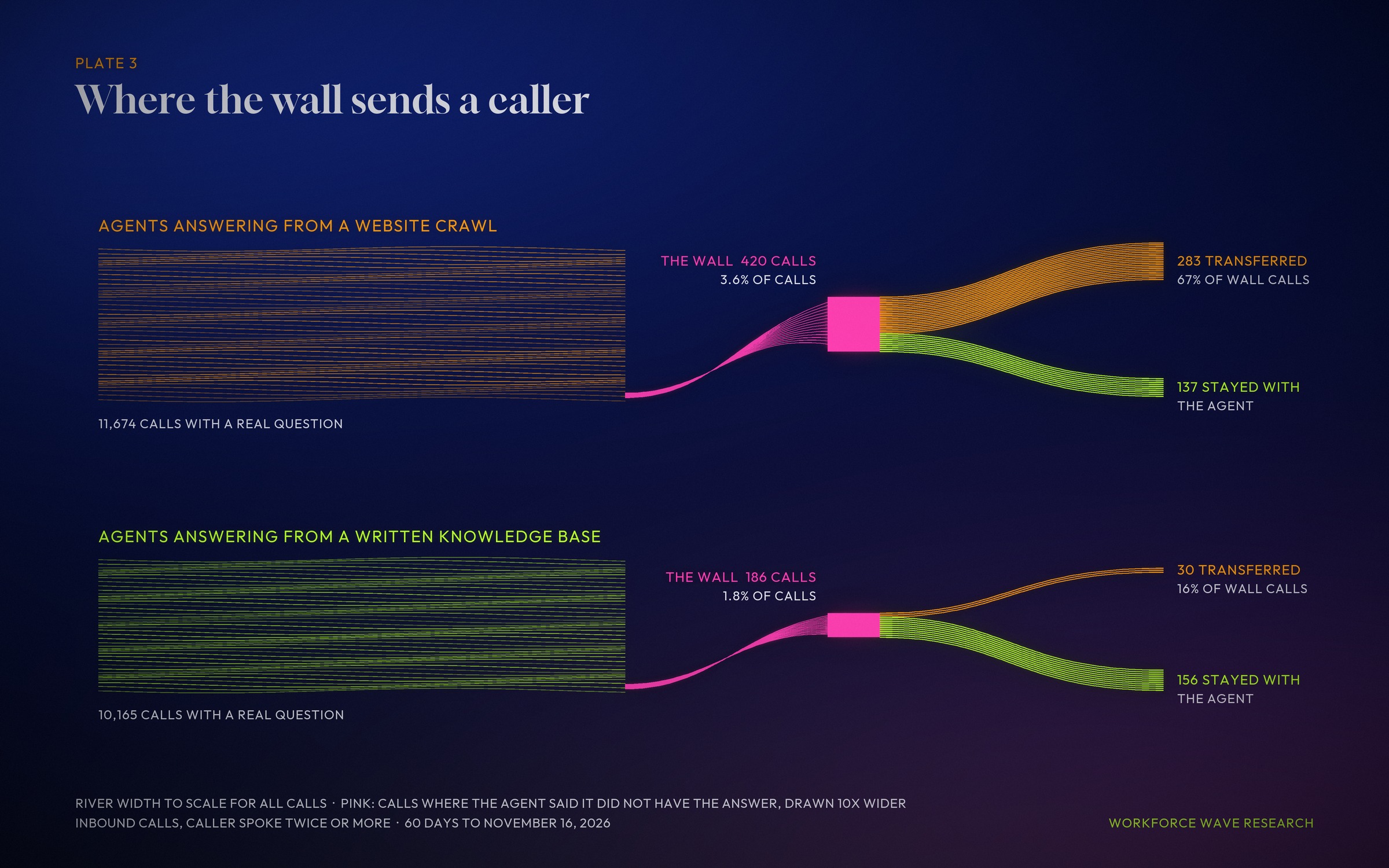
Agents answering from a website crawl told callers they did not have the answer in 420 of 11,674 calls (3.6%). Agents answering from written knowledge bases did so in 186 of 10,165 calls (1.8%) (Table 1).
| Measure | Website crawl | Written knowledge base |
|---|---|---|
| Clients | 24 | 50 |
| Calls with a real question | 11,674 | 10,165 |
| Calls where the agent said it did not have the answer | 420 (3.6%) | 186 (1.8%) |
| Of those, ended in a transfer to staff | 283 (67%) | 30 (16%) |
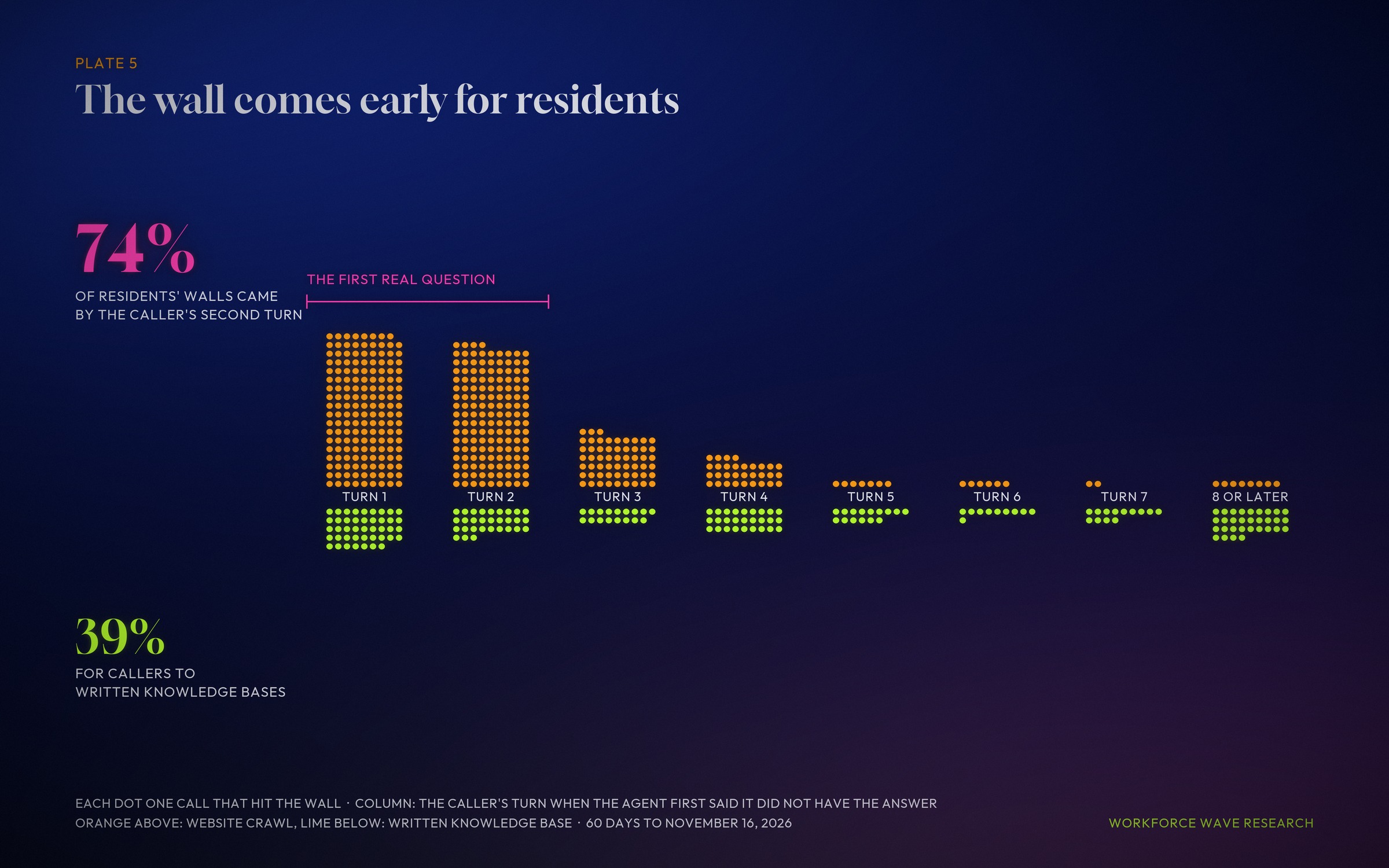
| Wall first reached by the caller's second turn | 74% | 39% |
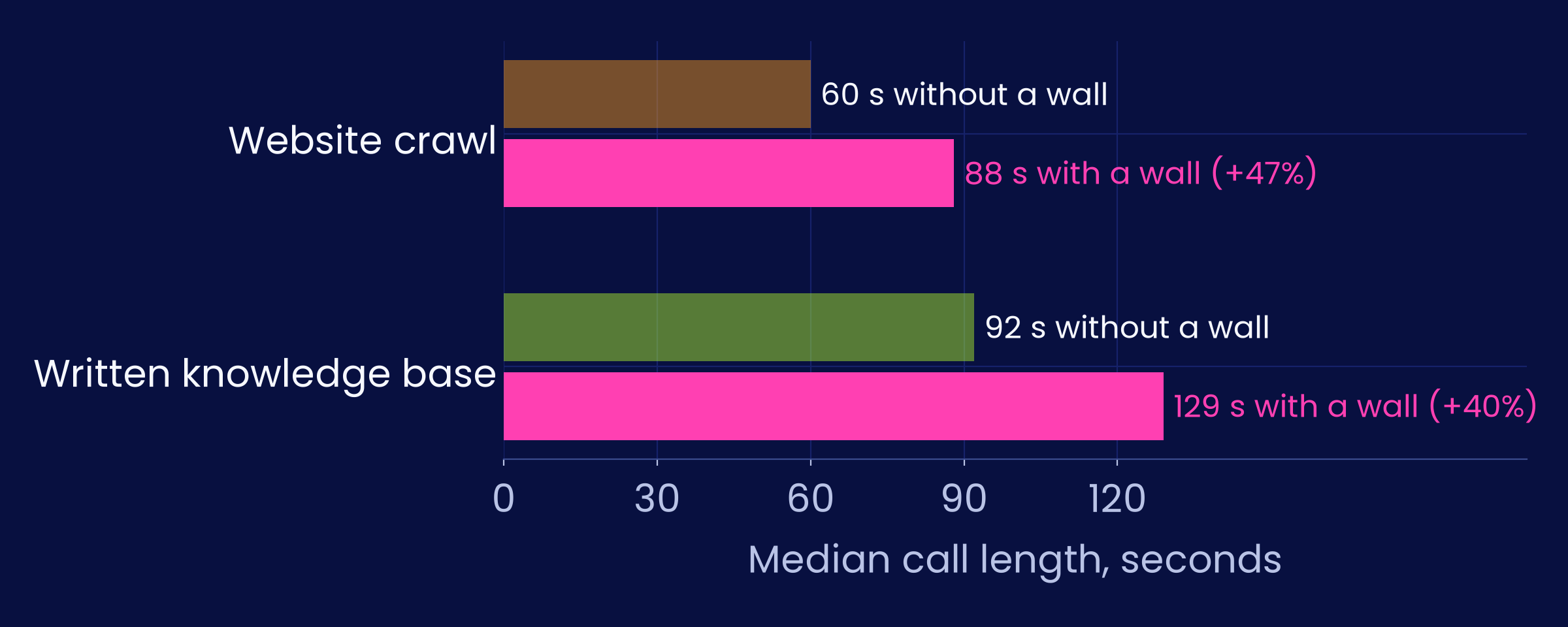
| Median call length, no wall | 60 s | 92 s |
| Median call length, with a wall | 88 s | 129 s |
What happened next differed even more (Plate 3). When an agent answering from a website crawl hit the wall, 283 of 420 calls (67%) went to a person on staff. When an agent answering from a written knowledge base hit it, 30 of 186 calls (16%) did, and the other 156 stayed with the agent. A written knowledge base tends to hold the next best thing even when it lacks the exact answer, such as who handles a question, what to bring or when to call back, so the agent has somewhere useful to go.
Treat 3.6% as a floor. Our government agents are instructed never to guess, and many reach the edge of what they know and route the caller to a department without saying so out loud. Those calls are not counted here. Government agents are also designed to route many requests to staff on purpose, such as reporting a problem or reaching a named office, so overall transfer rates are not comparable between the groups and are not reported.
4.2 Every agent, one star
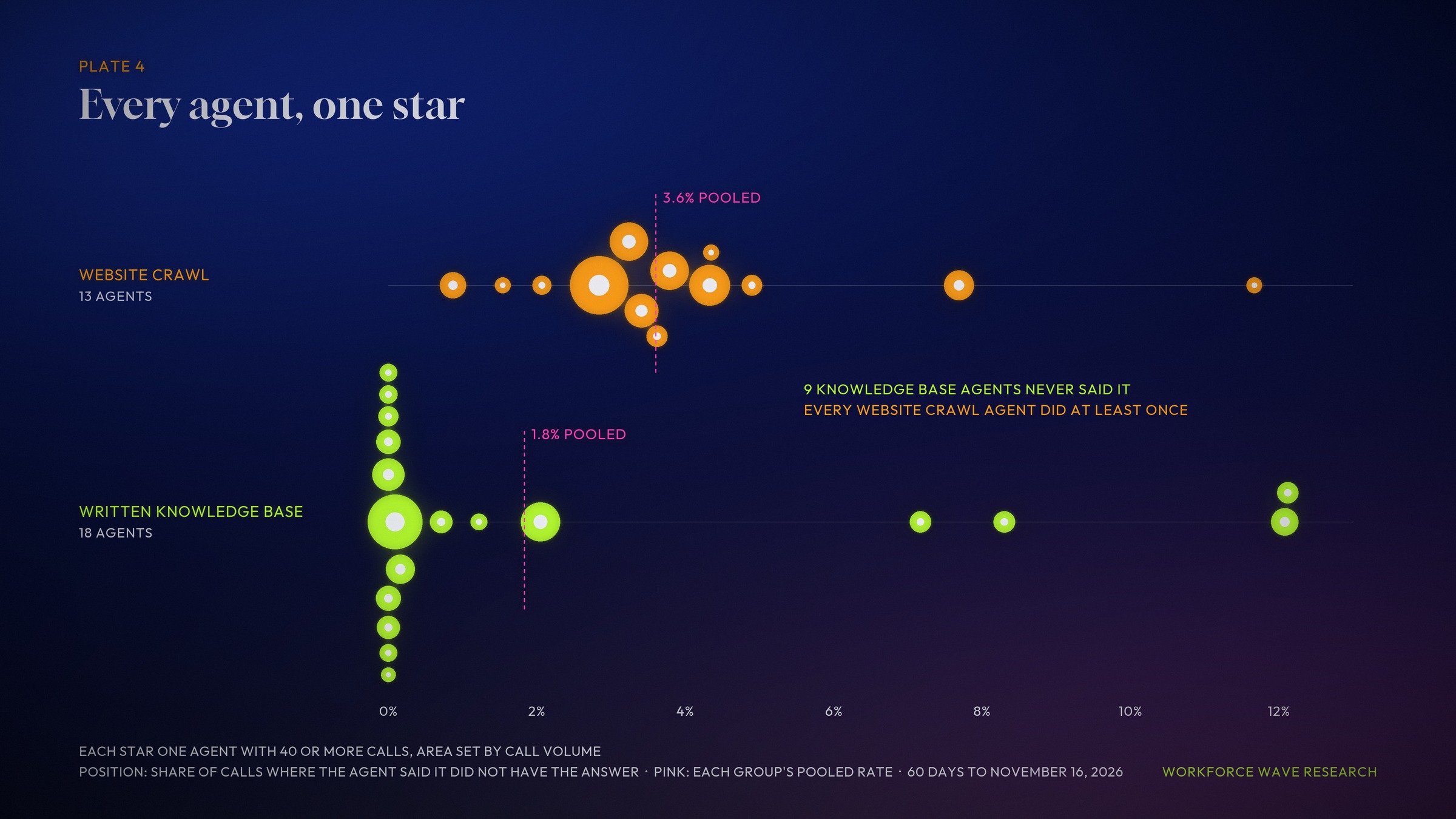
The pooled rates hide a wide spread (Plate 4). Every one of the 13 government agents with at least 40 calls hit the wall at least once, at rates from 0.9% to 11.7%. Among the 18 business agents with at least 40 calls, nine never did. Four business agents had rates of 7% or more, which shows that a written knowledge base is not automatically a complete one.
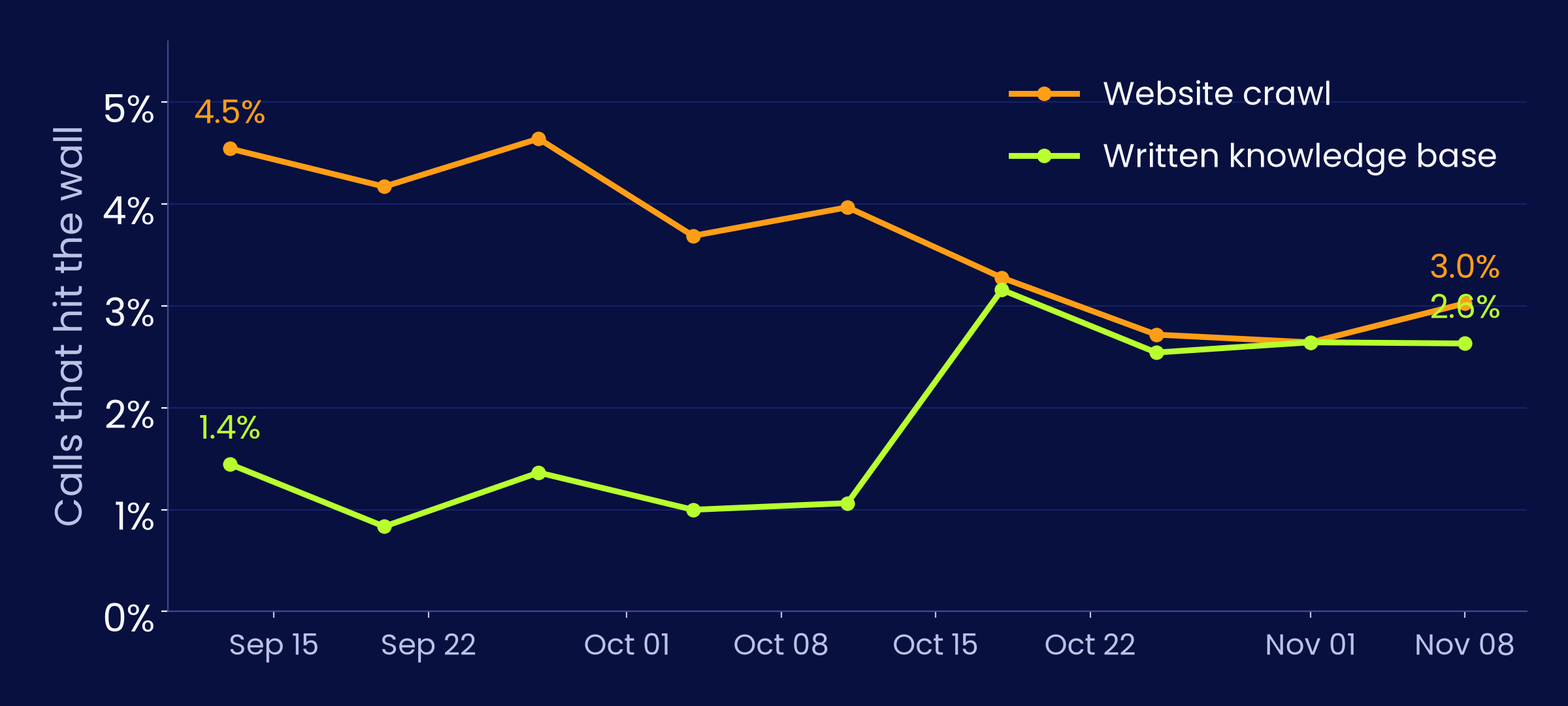
The spread also moved over time (Figure 2). The website crawl group's weekly rate fell from 4.5% in the first full week to about 3% by November. The written knowledge base group's rate rose from about 1% to about 2.6% after mid-October. That rise came from a change in mix rather than a change in quality: three appointment-based business agents with high and stable wall rates took far more calls after October 18, as new lines came online. The other business agents held at 0.8% before and 0.9% after. A pooled comparison is only as stable as the mix behind it, and the weekly view is the honest companion to Table 1.
4.3 The wall comes early for residents
Where in the call the wall appears tells its own story (Plate 5). For agents answering from a website crawl, 161 walls came on the caller's first turn and 148 on the second: 74% of all walls had arrived by the caller's second turn, which in most calls is the first real question after a greeting. For agents answering from written knowledge bases, 39% did. Business callers who hit the wall usually did so deep in a conversation, after several questions had been answered, often on a detail the knowledge base did not cover. Residents hit it at the door.
4.4 What a wall costs a call
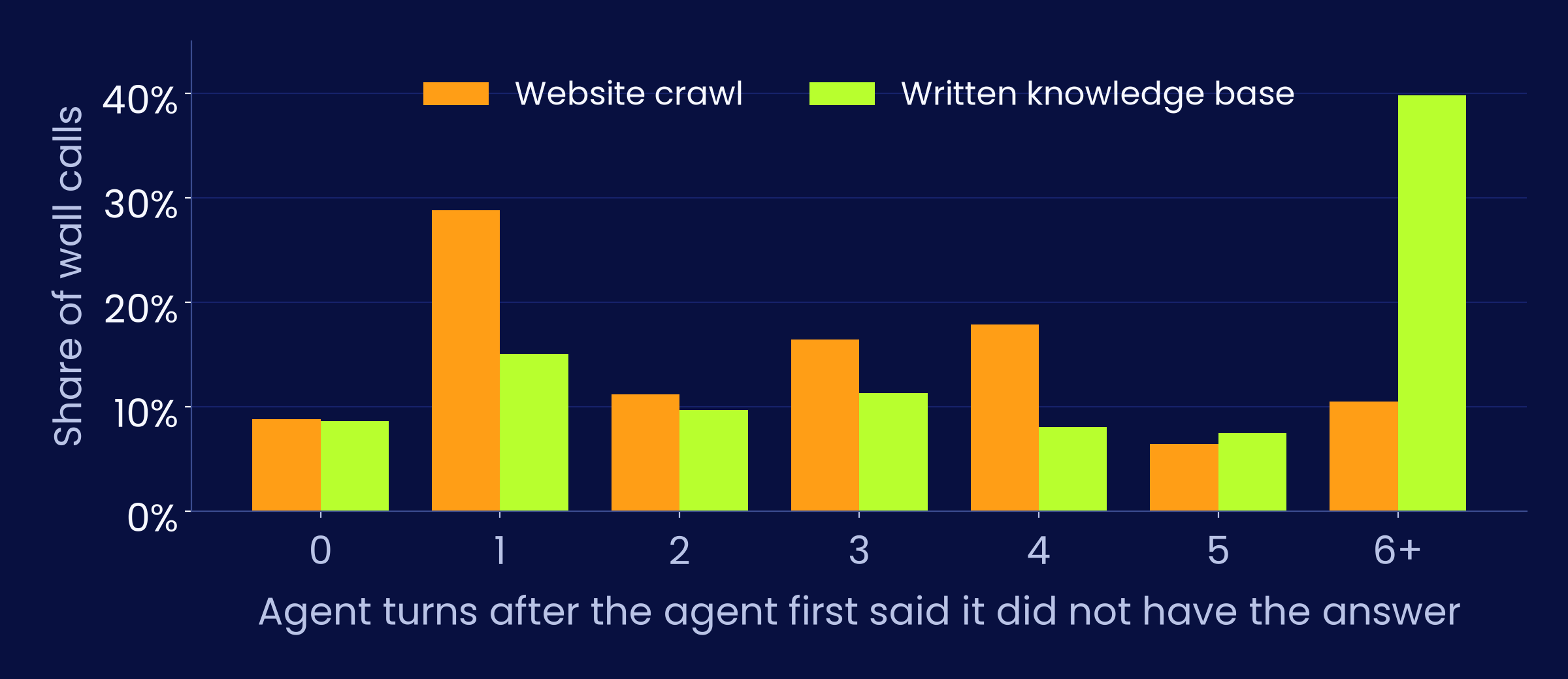
A call that hit the wall ran longer in both groups (Figure 3): a median of 88 seconds against 60 for government calls without a wall, and 129 against 92 for business calls. After the wall, government calls tended to end quickly: 38% ended within one more agent turn (Figure 4). On written knowledge bases, 40% of calls went on for six or more agent turns after the wall, so the conversation usually continued.
4.5 What residents asked
We grouped 407 government calls in which the agent said a search came back without the answer by what the caller asked just before it (Plate 6).
- A date, a schedule or a live status (25%). When the canal behind a home gets mowed. Whether tonight's program was canceled for rain. When the next council meeting is. Whether a park is closed today.
- The steps to get something done (15%). Reinstating an expired permit. Reporting an abandoned vehicle. Getting a boat ramp permit. Changing an appointment.
- One address or account (10%). Which leaf collection zone a street is in. When sewer work reaches a specific block. The status of an application.
- A fee (8%). A certified copy of a marriage certificate. Recording a transfer-on-death deed. Renting the recreation center.
- A specific person (5%). A department director's email. Where to send a records request.
- Everything else (37%). Locations, eligibility, program details and questions that fit no single group.
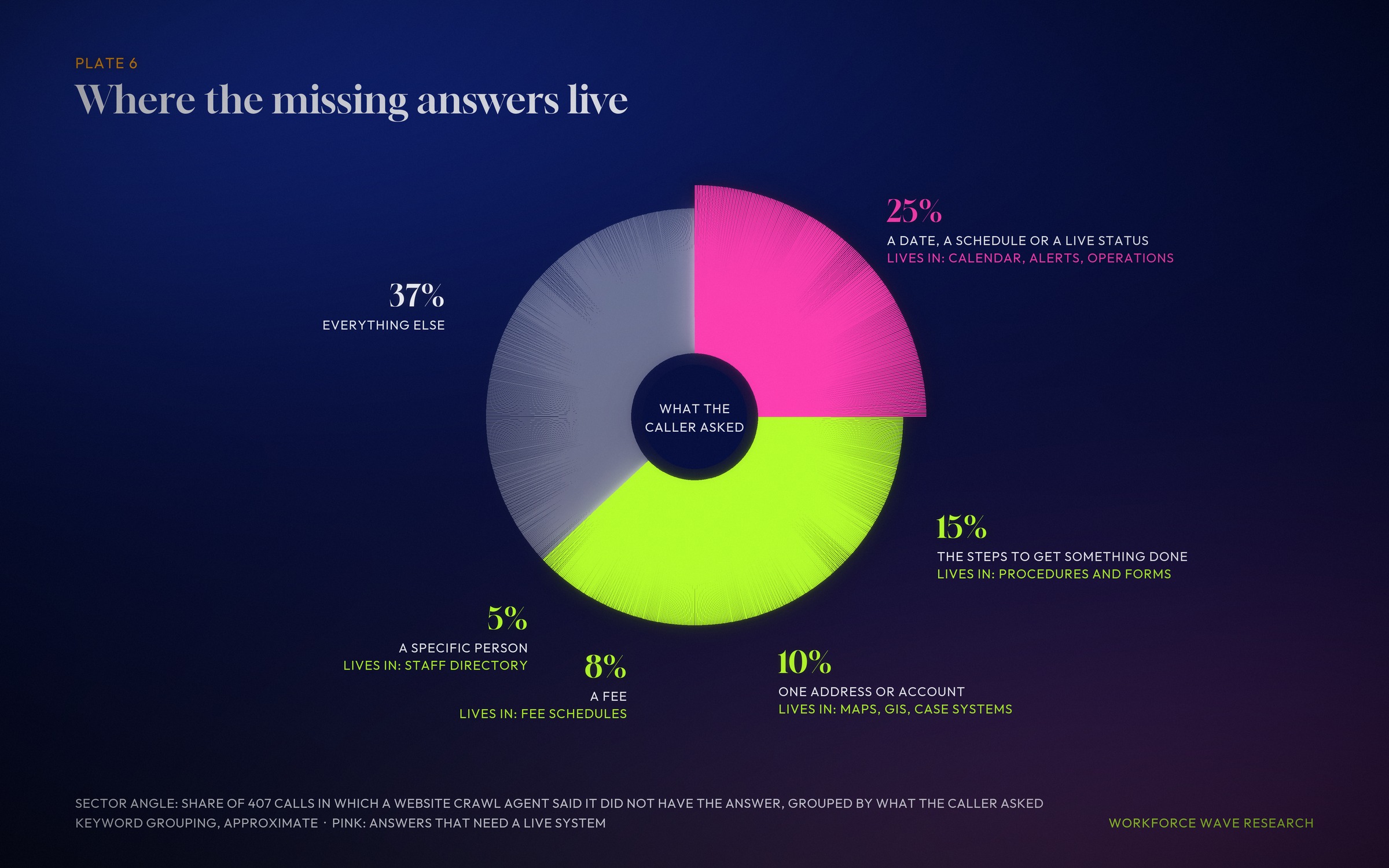
Very little of this is missing from government. Almost all of it exists somewhere. The fee is in a PDF fee schedule. The steps are spread across three pages and a form. The mowing schedule is in an operations calendar, the leaf zone is on a map, and the director's email is in a staff directory. A person can usually find it. A crawler reading pages as text usually cannot, and a quarter of these questions ask about something that changes daily and was never going to be on a static page.
5. Five ways a crawl fails
Each failure below happened on a real government agent in 2026. None of these governments has a bad website. Each has a website built for a different reader.
5.1 The menu buries the page
The North Carolina city in Section 1 is the clearest case. Large navigation menus, footers, cookie banners and "related links" panels repeat on every page. A crawl stores all of it. For a search system that hands back a limited amount of each page, the repeated material can crowd out everything else (Plate 1). The crawl configuration that worked for other cities kept the whole page by default, and it broke only when it met a site whose menu was larger than the window. Nothing in the crawl reported an error.
5.2 The crawl keeps the title and loses the text
At a New York county, the crawl captured only the page furniture. Pages for child support, the public defender, food assistance and the sheriff were stored as a title and a link with no content behind them. The agent knew these offices existed and could say nothing about what they do.
5.3 The crawl drops the fact
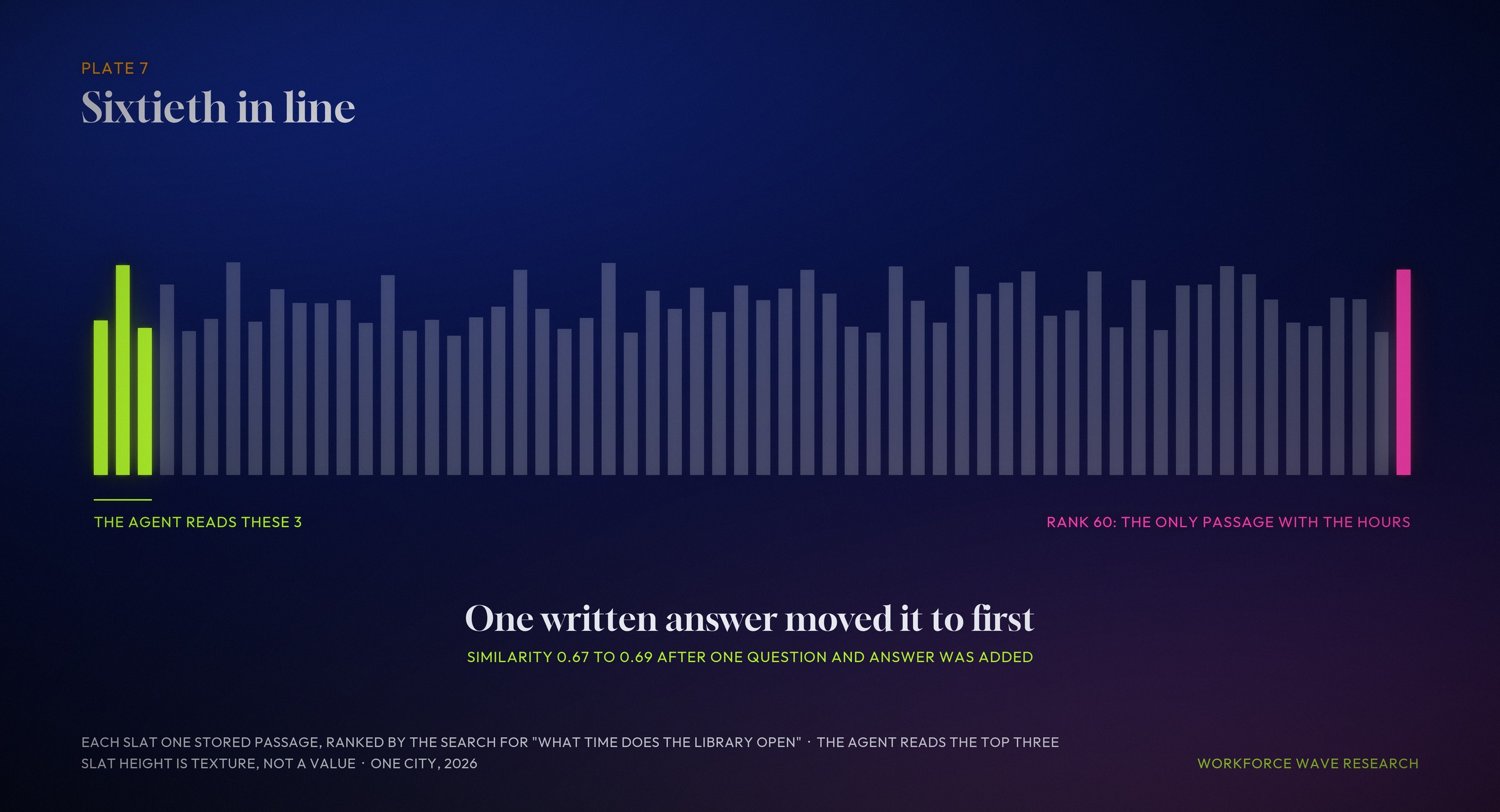
At a Utah city, library hours appeared in a banner at the top of the library's pages, and the crawl did not keep the banner. The only stored passage that mentioned the hours ranked about sixtieth among the results for "what time does the library open." The agent reads three (Plate 7). One written question and answer, added to the city's table of frequently asked questions, matched the question with a similarity of 0.67 to 0.69 and moved the answer to first place.
5.4 Old copies outlive the real ones
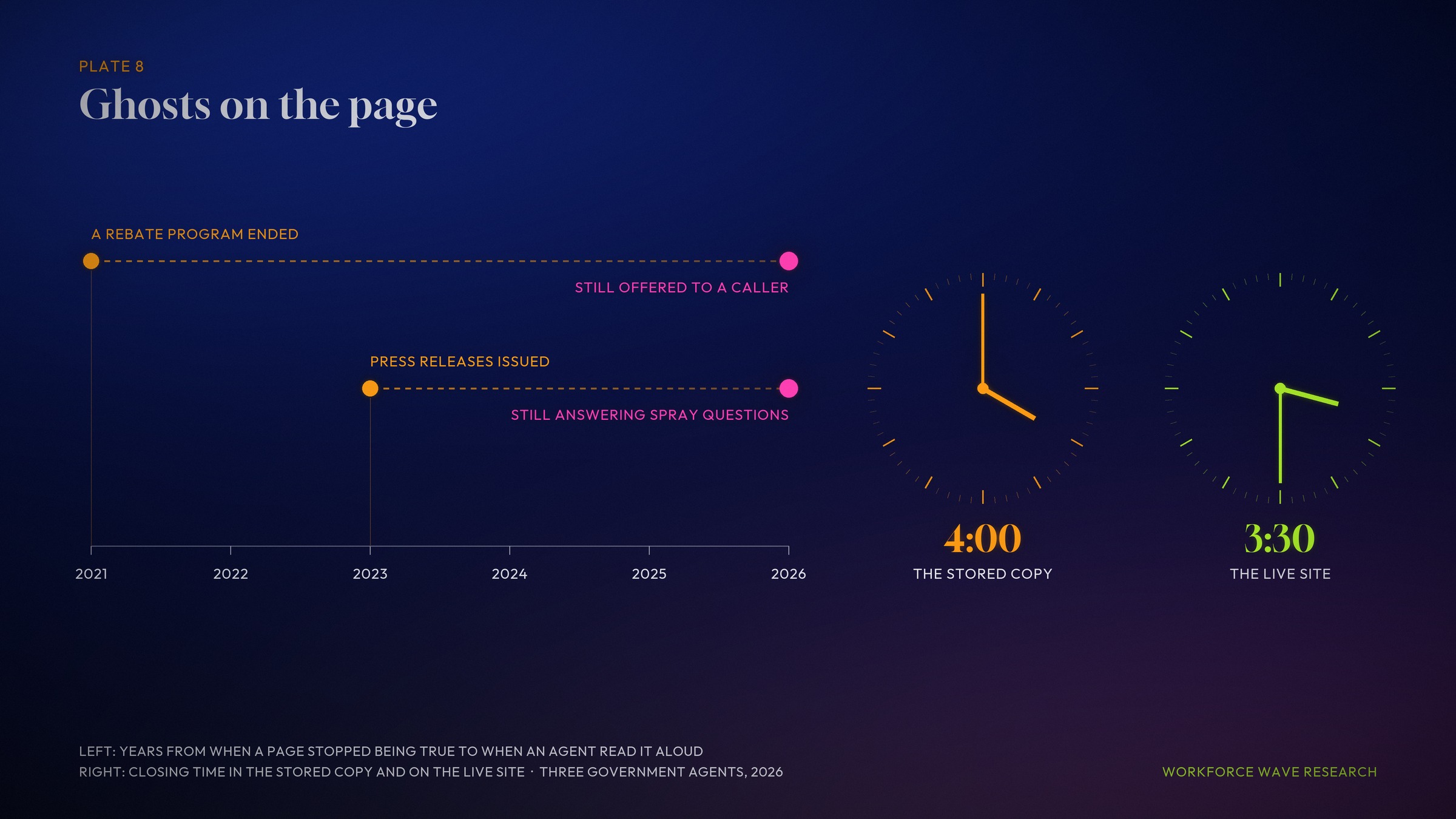
A mosquito control district's stored pages said its office closed at 4:00 while the live site said 3:30, and questions about spraying surfaced press releases from 2023. A Southern California city's agent offered a caller a rebate program that had ended in 2021 (Plate 8). A website can keep a past event or an expired program online for years without misleading anyone, because a reader can see the date. An agent reading the same text treats it as current. At the Utah city, the crawl itself appeared to date from an earlier year, and past event pages were read as upcoming.
5.5 Long pages get cut short
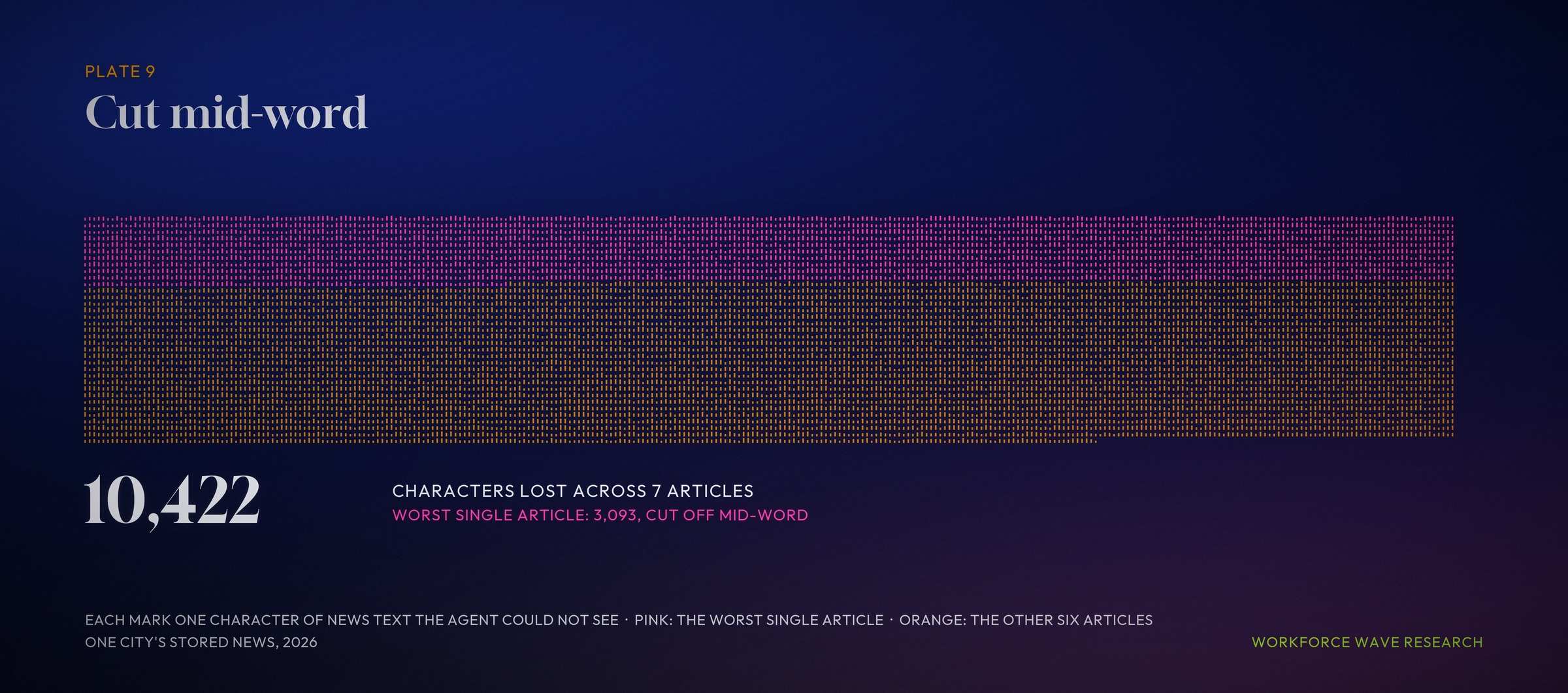
At a Bay Area city, stored news articles longer than the search window were cut off when retrieved, some in the middle of a word. Across seven articles, 10,422 characters were out of the agent's reach, 3,093 of them from a single article (Plate 9). The details that sit at the end of an announcement, such as dates, locations and contacts, are the ones residents ask about.
None of these failures shows up in a demonstration, which tends to use the questions a site answers well. Each appeared only when real residents asked real questions, and most were found by reading transcripts.
6. How large organizations curate knowledge for AI
Organizations that answer questions at scale faced this problem before voice agents existed. Support centers, help desks and municipal 311 lines all learned that the material they publish and the knowledge their staff use are different things. Their practices offer a working model.
6.1 Knowledge-Centered Service
Knowledge-Centered Service (KCS), maintained by the Consortium for Service Innovation and renamed Knowledge-Centered Success in 2026, is a long-established method for building support knowledge. Its position on AI is direct: AI systems are only as effective as the knowledge they use, and KCS exists to create knowledge that is structured, reusable, continuously improved and created in the context of real demand [4]. Four of its practices bear directly on voice agents.
- Capture in the moment. Knowledge is written by the people answering questions, while they answer them, capturing the requester's context [6]. It starts from demand, not from a page plan.
- Complete thoughts, not complete sentences. KCS uses a simple template and asks for complete thoughts rather than polished prose [6]. An article can be a set of short, precise statements. What it cannot be is incomplete.
- Reuse is review, flag it or fix it. Every time someone uses an article, they check it, and anyone who finds a problem either fixes it or flags it for the owner [5, 6]. Knowledge stays current because it is used, not because someone remembers to audit it.
- Content health. Articles carry metadata for audience, confidence and governance, which control who can see an article and who can change it [5]. A fact meant for staff can sit beside a fact meant for the public, each labeled.
The Consortium also reports that organizations adopting AI are discovering gaps in their knowledge practices, and that the most active work is in using AI to find missing content, flag duplicates and prompt for missing context at the moment knowledge is captured [4].
6.2 What 311 programs build
Municipal 311 lines are the closest public-sector parallel to a government voice agent, and their knowledge is not their website. The City of Edmonton describes 311 agents who must search "hundreds of complex, highly conditional policy scripts" and scattered knowledge articles, which lengthens calls and stretches training over months. Its 2026 project builds an AI retrieval layer over that internal knowledge for the agents who answer the phone [7].
When Kyle, Texas, built an AI-powered 311 system, its IT team found it needed a central repository for "text documents, images, CSV files, spreadsheets, geographic information systems, and other raw data," and the city created an internal knowledge base for staff that included full transcripts and agendas from every council meeting, so that staff could answer questions outside their own departments instead of passing callers along [8]. After launch, the city kept adding rules the website never held: an abandoned car on a road is handled differently from a junked car on a lawn, and potholes on roads maintained by the state take longer to fill. The city reports more than 12,000 requests and nearly 90% of users getting their question answered or issue resolved on first contact [8]. In El Paso, a 311 center's contractor built an AI knowledge base to shorten training and make answers consistent across agents [9].
None of these programs started from the website. Each started from the questions residents ask and the material staff actually use.
6.3 What AI vendors ask for
Customer service AI vendors now publish detailed guidance on preparing knowledge for their agents. Intercom's 14-factor content readiness framework asks that every section make sense when retrieved on its own, that numbers, limits and durations be exact, that limitations and workarounds be written down, that each piece of content say who it is for, and that terms and acronyms be defined [10]. It also tells customers to turn their support team's saved replies into AI knowledge, and to use internal articles that the AI can read but customers never see [10]. Zendesk's guidance makes the same core points: self-contained content, complete answers, no linking out, and no duplicate or conflicting articles [11].
The two vendors disagree on format. Zendesk advises avoiding tables because a language model reads sentences more reliably. Intercom asks for structure, with headings, numbered steps and introduced tables [10, 11]. The disagreement is instructive. Format matters less than whether each piece of knowledge is complete, current and able to stand alone.
6.4 One statement of each fact
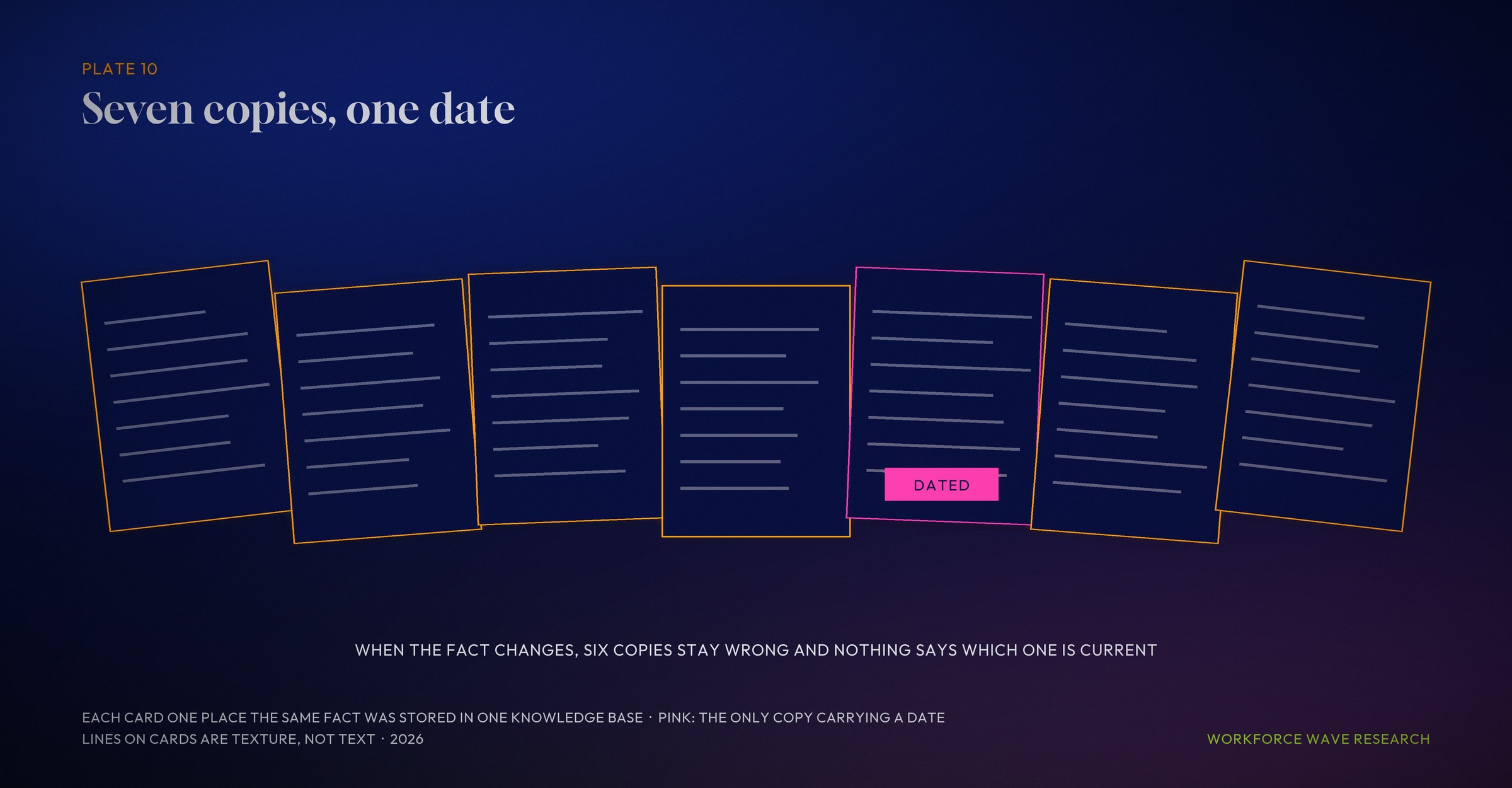
Written knowledge bases fail too, usually through duplication. One business knowledge base we reviewed stated the same fact in seven places, and only one copy carried a date (Plate 10). When that fact changed, six copies stayed wrong, and nothing told the agent which one was current. Closures that had already passed had never been removed. Every source above arrives at the same rule: keep one authoritative statement of each fact, give it an owner and a date, and point everything else at it.
6.5 Live questions need live systems
A quarter of the questions behind the walls in Section 4.5 asked about something that changes daily: whether tonight's game is canceled, whether a park is open, when a crew reaches a street. No document answers these. Kyle's system connects requests to work order systems and lets residents track status [8]. The equivalent for a voice agent is a connection to the calendar, the map or the case system. Until that connection exists, the knowledge base should say exactly who has the live answer and how to reach them, which is still far better for a caller than "I'm not seeing that."
7. One answer, every language
Language Week was about reaching residents who have never been served well by phone. Those residents are often the least able to fall back on the website, which is usually written in English, and the most likely to wait longest when a call goes to staff, because an interpreter has to be found [1, 13].
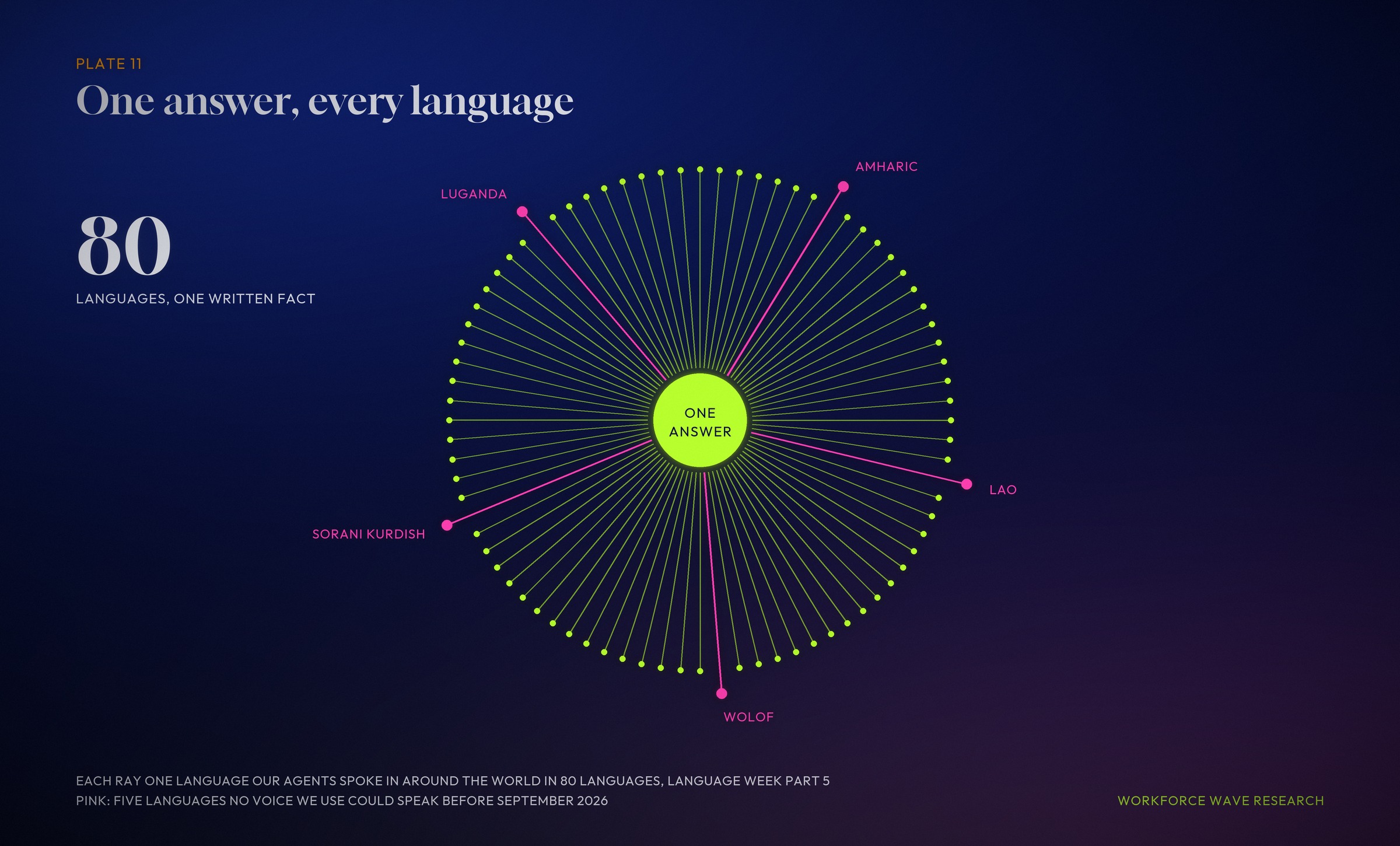
That is why knowledge pays off more in a multilingual agent. Our agents spoke 80 languages in the final part of the series, including five that no voice we use could speak before September 2026 [12]. An answer written once is delivered in every one of them (Plate 11). When a city writes down its leaf collection zones, its marriage certificate fee and the steps to reinstate a permit, an Amharic, Lao or Spanish caller gets that answer at the same moment an English caller does. A gap in the knowledge base is a gap in every language at once, and it lands hardest on the callers with the fewest other options.
8. Limitations
This is an observational study of one operator's agents over 60 days. The two groups differ in more than their knowledge source. Government and business callers ask different kinds of questions, government agents are designed to route many requests to staff, and the clients in each group differ in size and call volume. The comparison shows how often each kind of agent ran out of answers in practice. It does not isolate the effect of the knowledge source alone. The knowledge wall is detected from the agent's words, so it misses calls in which the agent routed silently, and it may include a few calls in which the agent declined a request for other reasons. The business group's rate depends on its mix, as Section 4.2 shows. The question types in Section 4.5 come from keyword grouping checked against a sample, and the shares are approximate. Field cases are drawn from agents we built and repaired, which are the cases we know about. Section 6 relies on vendor guidance and on governments' and contractors' own accounts of their programs, most of which have not been independently evaluated.
9. Practical implications
These recommendations apply to a city, a county, a special district or a company preparing knowledge for a voice agent.
- Start from what callers ask. Pull a month of real questions from calls, emails, front desk logs or an existing agent's transcripts, and build the knowledge base around the top few hundred. In our data, dates and schedules, procedures and fees lead every government's list.
- Collect from the people who answer, not only from the website. The best sources are the scripts, saved replies, routing notes, fee schedules, spreadsheets and maps that staff already use. Treat the public website as one input, not the source of truth.
- Write complete thoughts. Each entry should stand on its own and include the exact number, the steps, the exceptions and what to do if the answer depends on something the agent cannot see. Short statements are fine. Missing pieces are not.
- Keep one statement of each fact, with an owner and a date. Programs, events, closures, rebates, construction and seasonal schedules need a start date, an end date and a person responsible for removing them.
- Label what is public and what is internal. Some knowledge helps the agent route or explain without being read aloud word for word. Mark it so, the way support teams label audience.
- Connect live answers to live systems. Calendars, alerts, maps and case status need a lookup, not a document. Until one exists, write down who has the answer.
- If you crawl, check what the agent actually sees. Strip navigation and page furniture, keep banners, refresh on a schedule, and test retrieval with real questions rather than the ones the site answers well.
- Read the walls. Every time an agent says it does not have the answer, it names a missing piece of knowledge. Review those calls weekly and close the gaps, which is the "flag it or fix it" loop applied to a voice agent.
10. Talk with us
We would like to hear from city and county staff who answer residents' calls every day, from 311 and contact center leaders, from knowledge managers and from businesses whose front desks carry the same load. Tell us which questions your callers ask that your website does not answer well, and we will tell you what it would take for an agent to answer them. We are also inviting guests to the Workforce Wave podcast to talk about how public knowledge is written, owned and kept current. If that is you, we would love to have you on the show.
Authors
Colin P. Highland and the Workforce Wave research team. November 2026.
Data availability
Aggregate tables and the analysis code are available from the authors on request. Call-level data and transcripts are not shared, to protect clients and callers.
Conflict of interest
The authors work for Workforce Wave, which builds and operates the voice agents studied here, including agents that answer from website crawls and agents that answer from written knowledge bases, and which offers knowledge base design as part of its services. The authors have no relationship with Promet Source, CivicPlus, Granicus, Intercom, Zendesk, Salesforce, DATAMARK or the Consortium for Service Innovation. No external funding was received.
Suggested citation
Highland CP, Workforce Wave Research. Your Website Is Not a Knowledge Base: What 21,839 Voice Agent Calls Show, and How Large Organizations Curate Knowledge for AI. Workforce Wave, November 2026.
References
- Workforce Wave. One Voice, Twelve Front Desks. Language Week, Part 3, November 2026. workforcewave.com
- Promet Source. U.S. Government CMS Preferences and Trends. June 2024. prometsource.com
- Promet Source. A Comparison of Six Government CMS Platforms. August 2025. prometsource.com
- Consortium for Service Innovation. Knowledge-Powered AI. 2026. serviceinnovation.org
- Consortium for Service Innovation. KCS v6 Practices Guide, Practice 5: Content Health. serviceinnovation.org
- NiCE. KCS capabilities: the eight KCS practices. nice.com
- Apolitical. 311 Knowledge Engine: an AI-powered retrieval solution for 311 call centre agents (City of Edmonton). 2026. apolitical.co
- Salesforce. How the City of Kyle, Texas used AI to reinvent city government. August 19, 2025. salesforce.com
- DATAMARK. Transforming municipality services: how AI-powered knowledge boosted efficiency at the El Paso, TX 311 call center. 2025. datamark.net
- Intercom. Optimizing content for Fin. 2026. intercom.com
- Zendesk. Optimizing your knowledge content for generative AI. 2026. zendesk.com
- Workforce Wave. Around the World in 80 Languages. Language Week, Part 5, November 2026. workforcewave.com
- Workforce Wave. Every Caller, Every Language: The Business Case for Multilingual Phone Answering. Language Week, Part 4, November 2026. workforcewave.com
Related Case Studies
Before You Dial: The Cautions of Outbound Voice AI Campaigns
Outbound AI calling is the fastest way to reach customers, and the fastest way to get sued, blocked or named in an FCC notice. Six cautions for businesses and voice AI agencies, told partly through the night 1,797 impostor robocalls put a carrier in front of the FCC.
The Outbound AI Call Compliance Guide
How to place outbound calls with AI voice agents and stay inside FCC, TCPA and state rules, explained with pictures, sample calls, a decision guide, a section for agencies, seven quick scenarios and a printable checklist.
The Pause: Voice AI Latency After a Year of Production Calls, and the Price of Full Duplex
Voice agents got much faster in a year, and their slowest turns improved most. What production data shows about latency today, and what an agent would give up to talk while it listens.