
Case Study
No Missed Calls: Reliability on a National Restoration Brand's AI Voice Lines
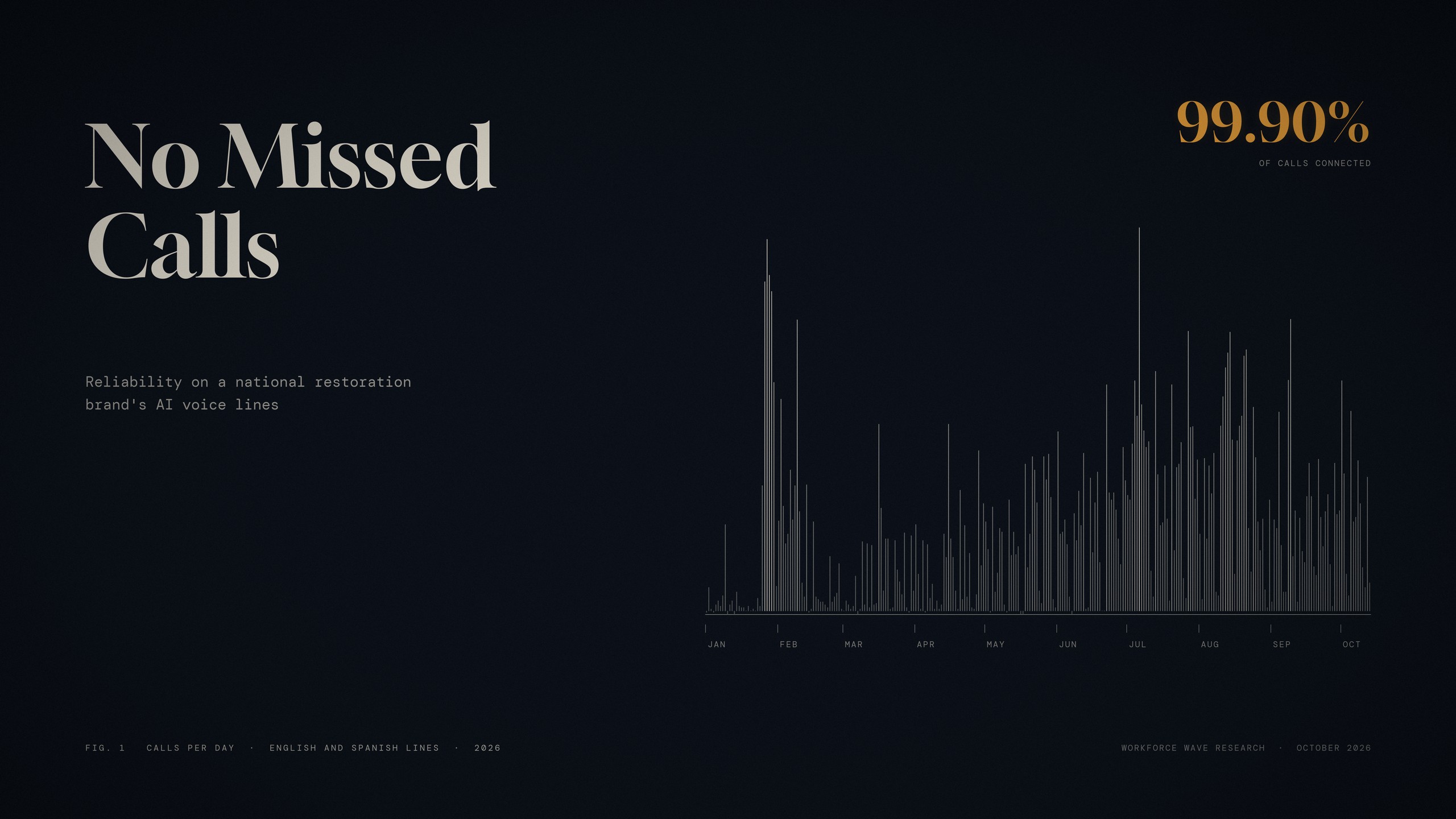
A national restoration brand's English and Spanish AI lines connected 99.90% of 24,054 calls in 2026, with every failure a one-off. Plus the backup route that sends callers to a person if the AI ever fails.
Your brand doesn't just use voice agents—it casts them.
Open the Workshop — Get a CallSummary
A national property-restoration brand answers its customer line with AI voice agents in English and Spanish, backed by a contact-center partner that takes live transfers. Between January 1 and October 13, 2026, the two lines took 24,054 calls.
Counting each affected caller once and setting aside calls the caller abandoned, the lines connected 99.90% of calls. Without any exclusions, 23,978 of 24,054 calls completed, 99.68%. The Spanish line had no failures at all, and outside a brief provider outage on October 13, every service-side failure was a one-off.
| Calls | 24,054 |
| Completed, no exclusions | 99.68% |
| Connected, each affected caller counted once | 99.90% |
| Spanish line | 1,447 calls, no failures |
| Most service-side failures on any day before October 13 | 3 |
1. Why this line has to answer
People call a restoration company when water is coming through a ceiling, after a fire, or when mold turns up in a wall. Many of them call one company, and if no one answers they call the next. In home services generally, about half of inbound calls reach a person, according to a 2026 benchmark drawn from the call logs of home-services businesses [1]. A missed call on a restoration line is often a lost job and a homeowner left waiting.
The AI agents on this line take the details of a loss, confirm the address, answer common questions and hand callers to the contact-center partner when they ask for a person. Every call depends on a chain of services working at once: the phone carrier, the telephony provider that routes the number, the AI voice platform, the language model, and speech recognition and synthesis.
2. The year in numbers
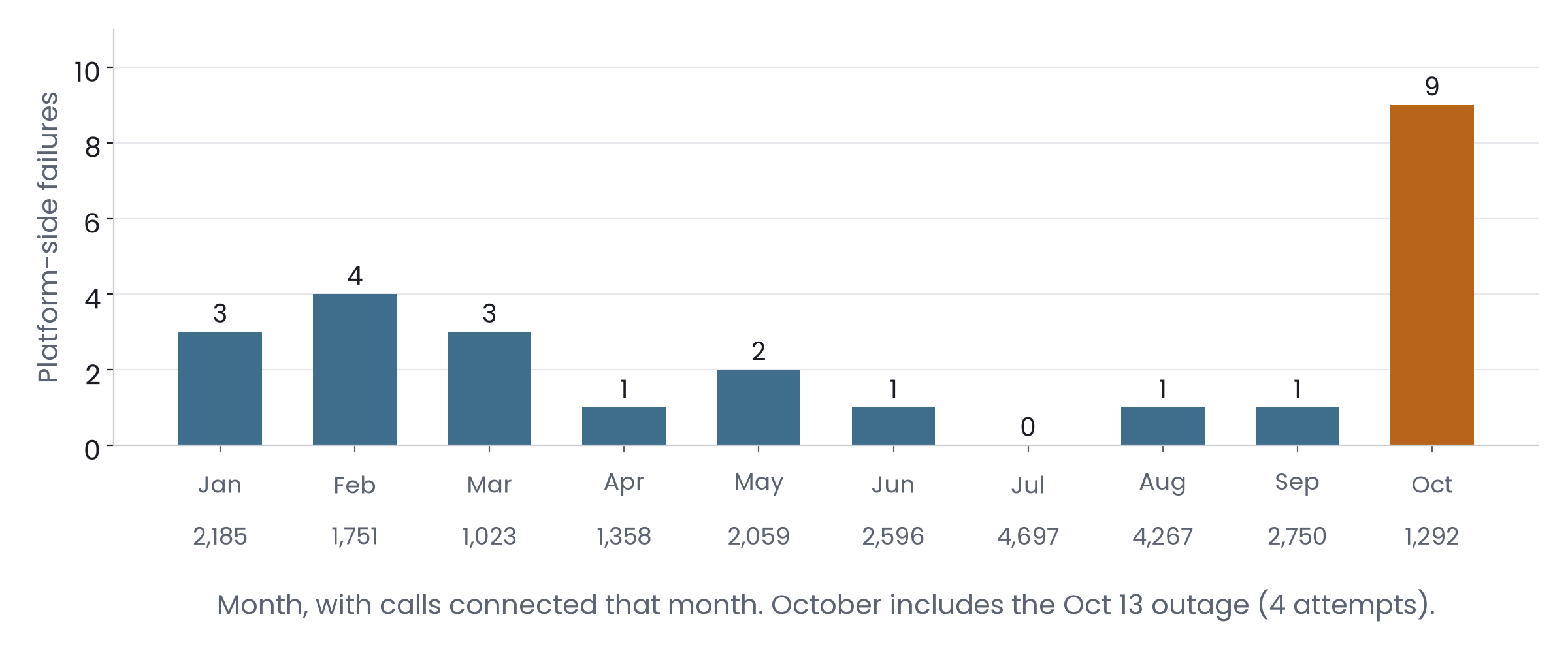
Of 24,054 calls, 23,978 completed. Of the 76 that did not, 51 ended because the line went silent on the caller's end for a full minute: a caller who hung up, lost signal or set the phone down. We count those as the caller's side. The remaining 25 were on the service side, spread across nine and a half months. No day had more than three, and most months had one or two (Figure 1). Counting each affected caller once and leaving aside the caller-side drops, 24 failures across 24,002 calls gives the 99.90% figure. The fleet-wide study that this line belongs to uses a stricter count, every attempt including redials, and the line scores 99.89% on that measure.
3. October 13
On the morning of October 13, the AI voice platform's data provider had a two-hour outage that affected lines across our fleet. The restoration line was lightly touched: three callers could not connect between 8:48 and 9:01 a.m. Eastern. Calls connected normally from 9:14 a.m., and nothing in the agents' setup caused the outage or changed because of it.
4. How this compares
| Line or system | Figure | What it measures |
|---|---|---|
| These lines | 99.90% of calls (99.68% with no exclusions) | Calls that reached the agent and completed |
| Home-services businesses, 2026 | About 52% of calls | Calls answered by a person [1] |
| US contact centers, 2025 | About 91% to 95% of calls | Calls not abandoned before an agent answered [2] |
| Cloud telephony provider contract | 99.95% of time | Provider uptime, excluding carrier faults and outages under five minutes [3] |
| Contact-center platform contracts | 99.99% to 99.999% of time | Platform uptime, with credits starting below 99.99% for some vendors [4] |
The figures measure different things, so the comparison needs care. Human answer rates fall short mostly because of staffing, at night, on weekends and during storms, when restoration calls spike. Platform contracts measure minutes of uptime for one component, and they leave out the carrier problems and short interruptions callers actually notice. None of the vendors behind a modern phone line contracts for a share of calls connected. That is the number we measure.
5. What we have in place
A live-transfer path. Callers who ask for a person are transferred to the partner's contact center during the call.
Backup routing. Because the restoration lines run on telephone numbers we manage, we can add a fallback route at the number itself. If the AI platform ever fails to answer, the call forwards straight to the contact center's line, showing the caller's number so agents know who is calling, with a voicemail if no one picks up. The route sits with the telephony provider, separate from the AI platform, and only activates during a failure, so normal calls are unaffected.
6. For a home-services brand evaluating AI phone service
- Ask for calls connected over a year, with redials and caller hang-ups explained. Uptime percentages describe the vendor's component, and callers do not experience components.
- Ask where a call goes if the AI cannot answer. The answer should be your team or your voicemail.
- Know what you are buying. If your contact center already answers nearly every call live, day and night, an AI line adds intake speed and overflow capacity rather than answer rate, and the case for it should rest on those.
About this paper
Prepared by Colin P. Highland and the Workforce Wave research team, October 2026. Figures come from the AI voice platform's call records for the English and Spanish lines, January 1 to October 13, 2026. The brand and its partner are not named. Workforce Wave builds and operates the agents described. The fleet-wide method is set out in Every Call Counts.
References
- Invoca. Home services lead conversion benchmarks report, 2026. invoca.com
- ContactBabel. US contact center decision-makers' guide, 2025, as summarized by Stealth Agents. stealthagents.com
- Twilio. Service Level Agreement, Twilio APIs. 2026. twilio.com
- Five9. Service Level Agreement. five9.com. Amazon Web Services. Amazon Connect Service Level Agreement. aws.amazon.com
Related Case Studies
Always Answering: A Year on a Municipal AI Voice Line
A Florida municipality's AI resident line connected 99.88% of 13,935 calls in 2026. How it compares with other ways a city answers its phone, and the backup routing that comes next.
Every Call Counts: A 90,157-Call Reliability Study of Production AI Voice Agents
How often do calls to AI voice agents actually connect? A study of 90,157 call attempts to 71 production agents across five types of business line.