
Case Study
Thank You for Calling: The Science of the Phone Answering Script
What the research says about phone answering scripts, which greeting rules still work when an AI voice agent picks up, and a gold-standard script to copy.
Your brand doesn't just use voice agents—it casts them.
Open the Workshop — Get a CallTake an insurance agency, any one of the few thousand independents scattered across the hail belt, on the Monday after a storm. The hail came through a little after four on Sunday afternoon. By eight the next morning the phones are lit and nobody has unlocked the front door yet.
On line one is a man standing in his driveway in a bathrobe, looking at a windshield that resembles a bag of crushed ice and a roof he hasn't worked up the nerve to inspect. He has been a customer for eleven years. He has never once thought about what this agency says when it picks up the phone, and he is about to form a firm opinion on the subject without noticing that he's doing it.
Researchers at the University of Glasgow found that listeners agree on a stranger's personality from a single "hello" lasting about 390 milliseconds. Before the agency has finished saying its own name, the man in the driveway has decided whether he's dealing with people who will take care of this or people who will make him fight for it.
Every business with a phone has an opening script, including the ones that would swear they don't. It's usually some arrangement of thanks, the company name, a first name and an offer of help, and it's almost always inherited rather than written: from the last office manager, a franchise binder, a hotel the owner stayed at once and liked. We wanted to know which parts of that inheritance hold up under evidence, and whether any of it survives when the voice picking up isn't a person. So we read the conversation research, the brand standards, the secret-shopper studies and the vendor data, and graded all of it.
The oldest script in business
The telephone arrived without instructions for what to say into it. Thomas Edison lobbied for "hello" on the grounds that it could be heard ten to twenty feet away. Alexander Graham Bell preferred "ahoy," which tells you something about Bell. The first telephone directory, printed in New Haven in 1878, recommended "a firm and cheery hulloa" and suggested ending every call with "That is all," a sign-off overdue for a comeback.
The Bell System turned answering into an industry. By 1950 it employed more than 340,000 operators, roughly one in every thirteen working women in the country, and sold their work under a slogan, The Voice With a Smile. In 1969 AT&T introduced a switching system under which operators were expected to answer every incoming call within three seconds, cued by a beep in the headset. The pace drew health complaints. Keep that operator in mind, because she comes back later.
Luxury hotels refined what was left. The Ritz-Carlton's Basics told staff to answer within three rings and with a smile, to use the guest's name, to ask permission before putting anyone on hold, and to retire "OK" and "no problem" in favor of "certainly" and "my pleasure." A good share of what gets taught as phone etiquette today descends from pages like that one.
The order of the parts was settled long before anyone put it in a binder. Emanuel Schegloff, the UCLA sociologist who spent a career recording and transcribing ordinary phone calls, showed that openings follow a grammar. The person who answers speaks first, the two sides identify each other, they greet, and only then does anyone get to the reason for the call. A business greeting folds all of that into one breath. The company name comes early because the caller's first worry is whether they reached the right place, and they can't look around to check. The question at the end hands the floor back. When an emergency line answers "Nine-one-one, what is your emergency," it's running the same grammar with everything nonessential cut away.
What the research says about phone greetings
The training industry will not enjoy this part. The most famous rule of all, answer within three rings, has no study behind it that we could find. It's a hotel brand standard that hardened into folklore. A North American ring cycle is two seconds of ringing and four of silence, so three rings works out to somewhere between twelve and eighteen seconds of a caller's morning, and nobody has measured whether two would be better or four would be worse.
What has been measured is faster and stranger. Along with the Glasgow work on that 390-millisecond hello, a 2023 study by Mileva and Lavan found that impressions of a voice settle within 400 milliseconds. The judgment is finished before the greeting is. Most of the effort businesses pour into the wording of a greeting goes into the back half, aimed at a listener who decided about the front half a few syllables ago.
Single words, chosen well, move outcomes. John Heritage and colleagues at UCLA ran a trial with primary-care doctors who, near the end of each visit, asked patients either whether there was "anything else" they wanted to address or whether there was "something else." The "something" version eliminated 78 percent of patients' unmet concerns. The "anything" version did no better than asking nothing at all. Elizabeth Stokoe, a British conversation analyst who has spent years with recordings of real service calls, found that asking reluctant callers whether they'd be "willing" to try mediation was the only wording that turned a no into a yes. In sales calls, she found that "How did you hear about us?" asked at the start produced long, uneasy silences, while the same question asked at the very end got an instant answer. Her advice to anyone opening a call with scripted small talk is to stop, because callers recognize it as coming from a manual.
The debates that eat the most training time have the least underneath them. Whether to say "how may I help you" or "how can I help you" has no evidence on either side, so pick whichever fits the room. The claim that 93 percent of communication is tone and body language comes from two small experiments by the psychologist Albert Mehrabian, who has spent decades explaining that it applies only when someone's words and feelings contradict each other. It still turns up in phone training decks, usually on the slide right after the one about smiling.
The smiling, as it happens, holds up. Listeners can tell different kinds of smiles apart from audio alone, and a 2018 study in Current Biology found that hearing a smile makes the listener's own smile muscles move, even when software added the smile to the recording.
The phone nobody answers
For all the attention paid to the words, the most common failure on a business line is that nobody says any. When the legal-software company Clio had secret shoppers call 500 law firms in 2024, 40 percent answered, down from 56 percent five years earlier, and 48 percent were effectively unreachable by phone. Those were people calling a lawyer, which most people only do on a bad day. ServiceTitan, whose software runs thousands of plumbing, HVAC and electrical shops, found the average shop booked about 42 percent of its calls. Shops with twenty-five or more technicians booked 59 percent. Shops with fewer than five booked 24 percent, and after six in the evening the small shops fell as low as 9.
A claims call after a storm belongs in the same category as the call to the lawyer. It comes on a bad day, with a deadline attached, and the policyholder in the driveway owes his patience to nobody. Whoever answers first, and answers well, has the relationship.
You may have seen the figures that 62 percent of small-business calls go unanswered and 80 percent of callers won't leave a voicemail. We tried to trace both. The first leads back to a study of 85 businesses whose original is no longer online and whose date depends on who's quoting it. The second has been credited to at least five different sources, none with a published method. Both may be roughly right. We left them out anyway, because the numbers that can be traced are bad enough on their own.
Do the rules work for an AI voice agent?
So what happens when the voice picking up is software? We took each established rule and asked whether it carries over, breaks, or turns into something a human front desk can't offer at all. What happens after the greeting, from the half second before an answer to the handoff to a person, is the subject of an earlier piece, The Things You Can Only Hear.
| The rule | With a voice agent answering |
|---|---|
| Answer within three rings | The rings disappear. The new failure is silence after the call connects, or a pause after the caller's first sentence. |
| Business name first | Matters more. A caller who suspects a robocall needs to know at once where they landed. |
| Smile in your voice | Carries over by design rather than by mood. Voice selection and pacing do the work a good morning used to do. |
| End the greeting on a question | Carries over. Across 450,000 AI-answered calls, greetings that ended on a statement had about 15 percent higher odds of a hang-up. |
| Small talk ("how are you today?") | Breaks. Weak for people, worse for software, and it spends a turn the caller didn't ask for. |
| Use the caller's name | Carries over, sparingly. Speech recognition mangles names, so confirm before repeating one. |
| Reason for the call before intake | Carries over strongly, and plenty of AI builds get it backwards by opening with a form. |
| The same greeting on every call | Where the machine pulls ahead of any staff. |
Speed comes first. Conversation researchers have clocked the gap between one person finishing a sentence and the next person starting at about 200 milliseconds, consistently across ten languages. Engineers who build voice agents treat anything past a second as the point where callers assume something broke. The three-ring rule was about not making people wait. For a voice agent the wait is measured in milliseconds of dead air, and the opening line should be ready before the call connects instead of being composed after it.
The bigger change is consistency. A 2026 study of more than 12,000 restaurant calls, published by Revmo, a company that sells AI phone answering, found human greeting compliance ranging from 99.2 percent at Morton's to 27.5 percent at Golden Corral, with greeting quality collapsing during the dinner rush, which is exactly when the phone matters most. Properly configured AI greeted every caller correctly. Weigh the source accordingly, and then think about that operator in 1969 with the beep in her headset and a three-second clock. For a century we asked people to deliver the same warm greeting thousands of times a day without flagging, and we called it customer service. The sociologist Arlie Hochschild had a more accurate name for it, emotional labor, and it wears people down. Software doesn't flag at four in the afternoon on the Monday after a hailstorm. That's the advantage, and it's a large one.
Should an AI receptionist say it's AI?
Which brings us to the argument the industry is actually having, about whether the greeting should say it's AI. The evidence points two ways, and the direction of the call seems to decide which.
In a field experiment with more than 6,200 customers, published in Marketing Science in 2019, disclosing a sales bot before an outbound call cut purchases by 79.7 percent. Customers who knew they were talking to a machine turned curt and bought less. That's the number people quote, and it comes from calls the customer never asked to receive.
Inbound calls behave differently. Upfirst, which sells AI receptionists, analyzed 450,702 calls to 503 businesses and found that greetings saying "I am an AI assistant" had about 20 percent lower odds of a hang-up. Mentioning that the call was recorded went with about 30 percent lower odds, plausibly because scammers don't announce recordings. Opening with an apology that the owner was unavailable went with about 50 percent higher odds. Greeting length made no measurable difference. This is observational data from a vendor, and the company says as much. It's also the largest look at inbound greetings anyone has published.
Callers are better at spotting synthetic voices than the industry likes to admit. A 2025 study in PLOS ONE found listeners separated ordinary AI voices from human ones easily, and only voices cloned from a specific person fooled them at close to human rates. Google learned what pretending costs in 2018, when its Duplex demo had an AI say "mmm-hmm" to a salon receptionist without identifying itself. The backlash forced a promise of built-in disclosure within days.
We owe you our own position here. When our agents say what they are in the greeting, they say it several ways, chosen to fit the business that's answering: a digital concierge at a spa or a resort, a digital agent at a service company, a virtual assistant on some city lines, and on a few public-office lines an AI digital assistant. Most avoid the bare word "AI," and every one of them answers truthfully the moment a caller asks. We built it that way because a label in the business's own register tells the caller what they've reached without spending their first seconds on the technology. The best inbound data we found suggests a plain label, said early, may help more than it costs. We're taking that seriously, and anyone writing a greeting should too.
The law is narrower than a lot of vendor blogs claim. The FCC's 2024 ruling on AI voices concerns outbound calls, and its proposed disclosure rule expressly avoids burdening inbound customer service. The rules that do reach a business answering its own phone are specific: the EU AI Act's transparency article from August 2026, Maine's chatbot disclosure law since September 2025, Utah's rules for regulated occupations and high-risk interactions, and California's AB 3030 for clinical communications in health care, which requires the disclaimer spoken at both the start and the end of the call. Several more bills are moving. None of this is legal advice, and the list will be out of date within a year.
When a person should pick up
Here is where we argue against our own business. Gartner surveyed about 5,700 customers in late 2023, and 64 percent said they'd prefer companies not use AI for customer service at all. Their biggest fear was that it would become harder to reach a person. Klarna, which once claimed its AI assistant did the work of 700 agents, had its chief executive say in 2025 that there will always be a human if you want one.
In New Orleans, where AI now answers a narrow class of 911 calls, the system took the first two calls during the Bourbon Street attack before routing them on, and for about twenty seconds the incident was logged as a hit-and-run. No voice agent belongs at the front of a line like that without a person one step behind it.
An insurance agency has its own version of those calls: the totaled car with someone in the hospital, the spouse calling about a life policy, the policyholder who has been denied twice and is finished being polite. A good greeting can't fix those calls, and a good agent shouldn't try. It should recognize them in the first sentence and hand them to a person who already knows what was said. The way out has to be stated, real and fast. A voice agent that makes people fight to reach a human has thrown away the one advantage it had.
The gold-standard phone answering script
Put the evidence together and the gold standard is short enough to fit on an index card.
- Speak first, and immediately. The opening line should be ready before the call connects.
- Business name first, inside the first second, so the caller knows where they landed.
- A name for whoever is answering, and an honest answer to anyone who asks what that is.
- If the call is recorded, say so plainly. It reassures more than it alarms.
- End on an open question that hands the floor back.
- Never open with an apology or an absence.
- Let the caller give the reason before asking for a policy number, a date of birth or an address.
- Close with "what else can I help with," never "is there anything else."
- Say how to reach a person, and mean it.
What comes second depends on the line. A restaurant asks whether it's pickup or a reservation. A dental office asks whether you're a current patient. A law firm asks what happened. An insurance claims line, the morning after a storm, asks whether everyone is safe before it asks anything else.
For the agency in the hail belt, the whole opening runs well under ten seconds.
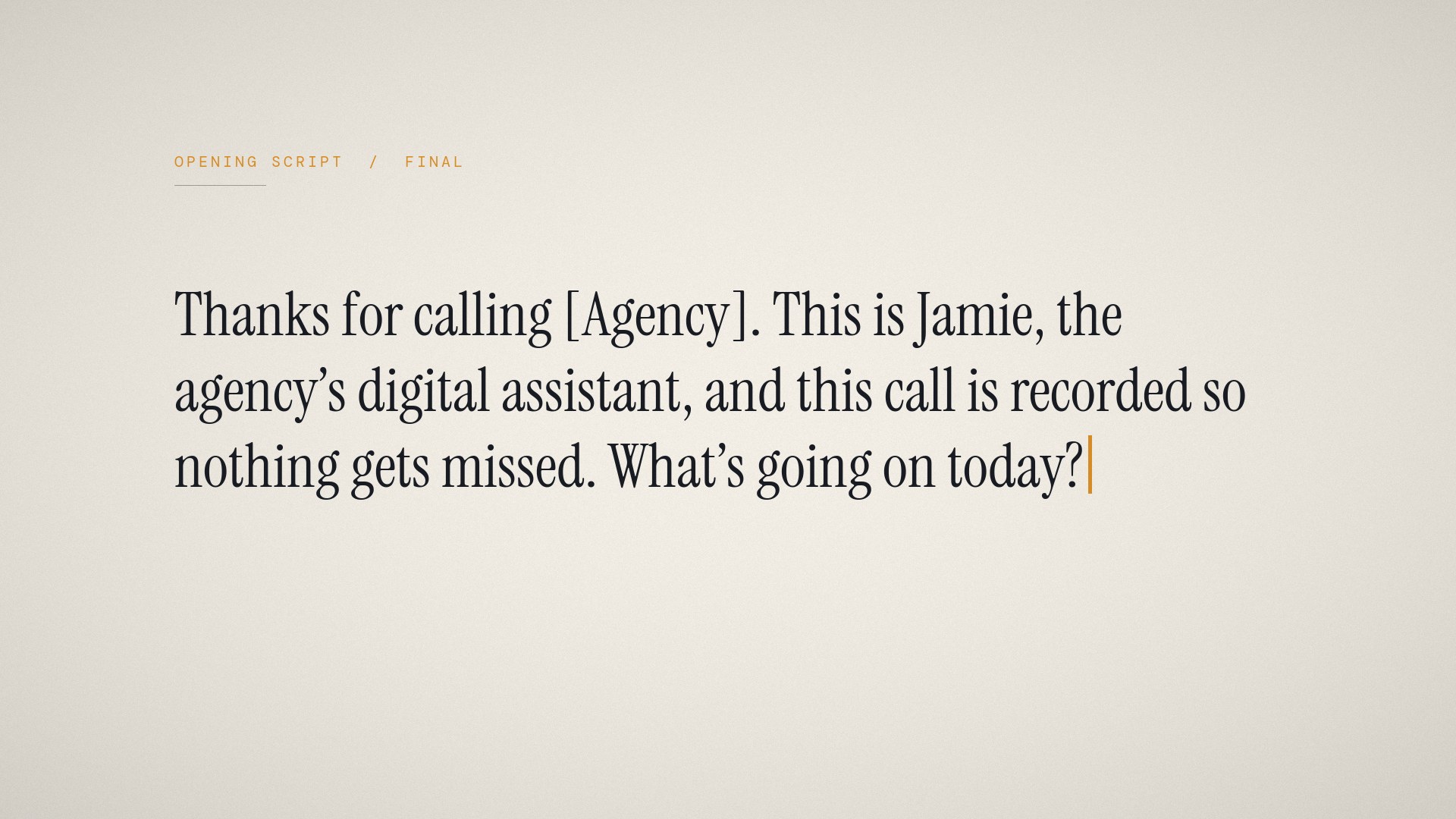
"Thanks for calling [Agency]. This is Jamie, the agency's digital assistant, and this call is recorded so nothing gets missed. What's going on today?"
Audit your own greeting
Call your own number from a phone the office won't recognize, on a busy morning, and record what you hear. Time it from the first ring to the first word, then hold the greeting up against the nine lines above. Most businesses find two or three to fix, and none of the fixes cost anything. The rules are the same whether a person or a voice agent answers your phone.
Back in the driveway, the man in the bathrobe gets an answer on the first try. He hears the agency's name, then a name for whoever picked up, then a plain question about whether everyone's all right. It takes about four seconds. He'll forget every word of it by lunch.
He'll remember, for the next eleven years, that somebody picked up.
Sources. Voice impressions: McAleer, Todorov and Belin, PLOS ONE, 2014; Mileva and Lavan, Journal of Experimental Psychology: General, 2023. Phone history: Mental Floss on "hello"; Morven Museum and AT&T Archives; Ritz-Carlton Basics excerpt. Conversation research: Schegloff, 1979; Heritage et al., Journal of General Internal Medicine, 2007; Stokoe, TED Ideas; British Psychological Society on Stokoe; Stivers et al., PNAS, 2009; Arias, Belin and Aucouturier, Current Biology, 2018; Big Think on Mehrabian. Answer rates: Clio Legal Trends Report, 2024; ServiceTitan booking-rate data, 2022; Revmo State of Restaurant Calls, 2026. Disclosure: Luo et al., Marketing Science, 2019; Upfirst hang-up analysis, 2026; Lavan et al., PLOS ONE, 2025; The Guardian on Google Duplex; Gartner, 2024; Entrepreneur on Klarna; GovTech on New Orleans. Law: FCC proposal; EU AI Act Article 50; Maine LD 1727; Utah AI Policy Act as amended; California AB 3030. The insurance agency and its caller are a composite. Vendor data is identified as such where it appears.
Related Case Studies
Chroma Feralis: The Wild Mirror of Escalation
Chroma Feralis isn't a voice agent, she's a prompt come to life. Born from chaos, built for performance.
The Actress in the Wire: Alex and the Art of Improvised Brand Voice
Alex isn't just a voice agent, she's an actress in the wire. In this demo, she transformed an ordinary call into something memorable.
The Hidden Challenge of True Two-Way Texting
On the surface, inbound and outbound texting looks simple: send a menu link, answer a question, done. The reality is far more complex.