
Case Study
Who Is This?
Every front desk answers the same five questions about a caller, usually in someone's head. Software can answer them too, if it keeps one record of a person instead of four.
By Colin P. Highland
The first thing a receptionist thinks when the phone rings is "who is this?" and the true answer is usually "someone we already know, in a tool I don't have open."
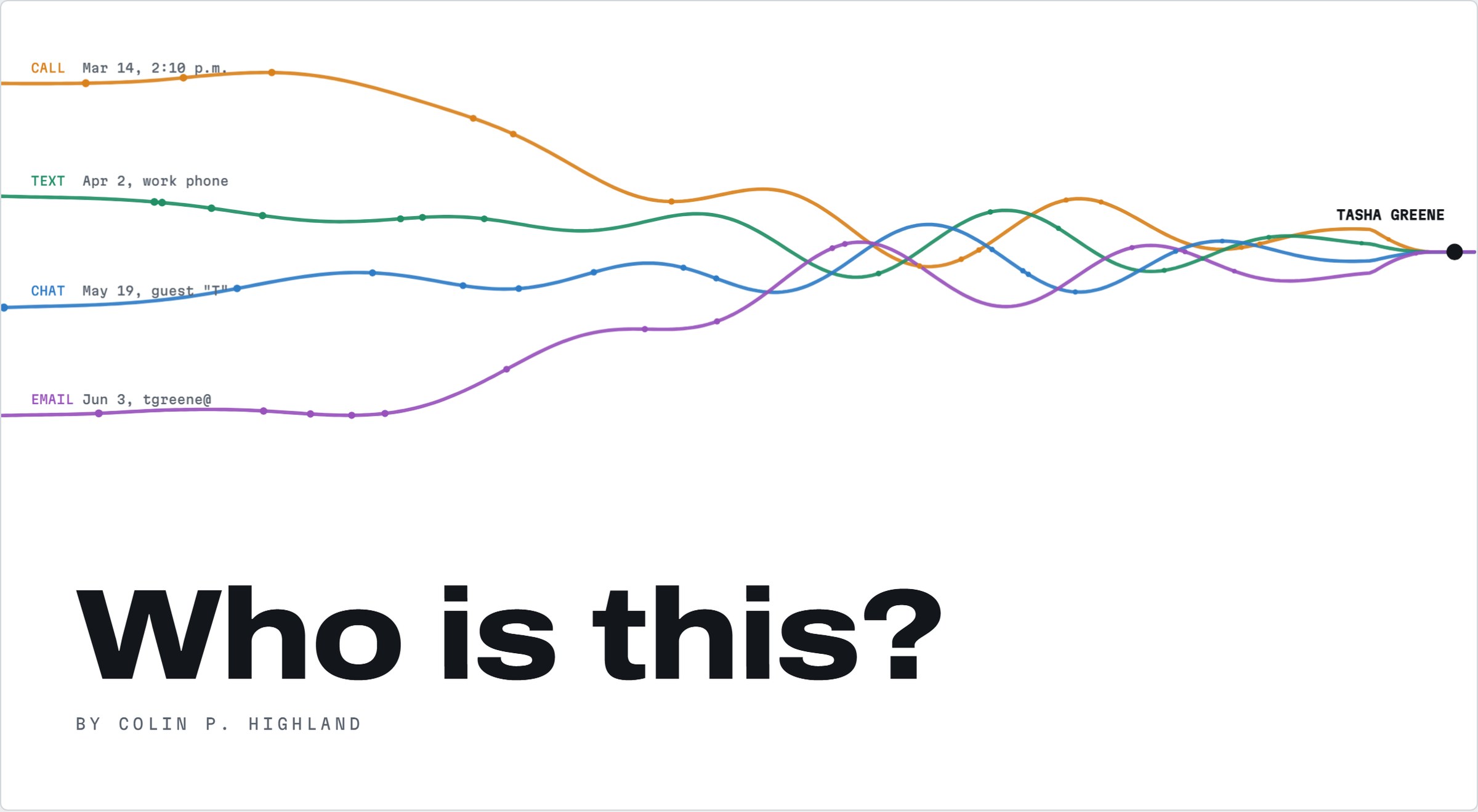
Take Tasha Greene, a regular at a two-location day spa. She booked a massage by phone in March. In April she texted from her work phone to move it. In May she asked the website chat whether gift cards work at both locations, and in June she emailed to say the parking validation machine ate her ticket. Four conversations, four systems, and as far as the software is concerned, four strangers. The only place Tasha exists as one person is in the memory of whoever has worked the desk long enough.
I build the software that answers these calls, so take this with the usual discount. Most of what makes an answering agent feel smart on the phone has nothing to do with the voice. It comes from whether the system can answer five questions a good receptionist runs through without noticing.
Who is this?
A person reaches a business through identities: a phone number, a second phone number, an email address, a chat session that may or may not include a name. The contact list worth having is built from those identities, and one person can own several of them.
The hard part is the moment a new identity appears. When Tasha texts from her work phone and mentions her Saturday massage, the system can see that the message probably belongs to her. It should not simply decide. It proposes the link, shows why it thinks so, and waits for a person on staff to confirm it. Every merge keeps a note of the reasoning and a copy of what the record looked like before, so a wrong merge is one click to reverse rather than an afternoon of untangling.
There is a security reason to be strict here, too. A caller who says "this is Tasha" from an unknown number has claimed an identity. They have not proven one. Until a person confirms the link, the agent doesn't read Tasha's history back to them. That sounds paranoid until you think about who might call a spa pretending to be someone's spouse.
Have we talked before?
Once the identities are joined, everything that happened can sit on one timeline. Calls with their recordings. Texts with their full bodies, each one tied to the call that produced it. Chats. Emails. A receptionist can scan a year of contact with one person in about the time it takes the caller to say hello.
The tether between a text and its call matters more than it looks. When Tasha replies "yes that works" to a confirmation text, the reply only makes sense next to the call where the time was offered. Without the link, a staff member reads a text that says yes to nothing.
What did we promise?
Every conversation with a business leaves something owed. The agent said someone would call back about the gift card. The text promised a confirmation by Friday. A good system treats each of those as an open item with an owner, a status and a next step, and puts the next step on the record where the next person will see it.
This is the question most answering services quietly fail. They are very good at taking messages and much worse at noticing that a message was never acted on.
What happens next?
Most inboxes and call logs are sorted by time, which is the order things happened to arrive in and almost never the order they should be handled. A front desk on Monday morning wants the call backs first, then the confirmations, then the things waiting on the customer, then everything that needs nothing at all.
So the queue groups work by its next action, with search and filters on top. Businesses can also set their own rule for what counts as urgent. A spa might flag any call that mentions a skin reaction, and those calls carry a high priority marker in the queue and on the record, ahead of the gift card questions.
Who else knows them?
Tasha visits both spa locations. The north spa knows about her massage, and the south spa knows she bought a facial there in May. When she calls the south spa to ask about her gift card, should its agent know about the massage?
Only if the owner says so. The owner groups locations into sisters, and inside a group, an agent can see that a caller has history at the other location and pick up the thread. Outside the group nothing crosses, which is the right answer for, say, a franchise location owned by somebody else under the same sign. The agent knows which location a caller meant by the number they dialed, so the same customer can call two lines and be greeted correctly at each.
Writing back to the business's own customer database follows the same caution. A business can turn it on, and when it's on, the agent adds notes and new contacts and leaves existing fields alone, with a log of everything it wrote. If the agent mishears a street name, the worst outcome is a note somebody reads and corrects.
Who doesn't need this
A one-location business with one phone line and a receptionist who has been there nine years already has the best contact record ever built, and it lives in that receptionist's head. Software will not beat that memory at knowing Tasha. It helps when that receptionist is out sick, when the calls come after hours, when there are two locations or three, and when the customer chose the channel nobody was watching.
Try this tonight. Pick a customer you know well and count how many systems hold a piece of them. If the answer is one, you're in better shape than most.
Art generated for this piece. Names, numbers and businesses are illustrative.
Related Case Studies
The Call Is the Easy Part
A voice agent that sounds good on the phone is the minimum now. Whether it actually helps a business gets decided in the hours and days after the caller hangs up.
Is the Pool Open Today? Why Answers With an Expiry Date Break Voice Agents, and How to Keep Them Fresh
Across 63,561 calls over six months, questions that depend on the date were 2.6% of calls but 10.6% of the times a voice agent had no answer. When and why these questions fail, and how fields from transit to emergency alerts keep time-sensitive facts current.
Your Website Is Not a Knowledge Base: What 21,839 Voice Agent Calls Show, and How Large Organizations Curate Knowledge for AI
Voice agents answering from a website crawl told callers they had no answer twice as often, and two in three of those calls went to staff. What residents asked, five ways crawls fail, and how organizations that answer at scale build knowledge for AI.