
Case Study
The Outbound AI Call Compliance Guide
How to place outbound calls with AI voice agents and stay inside FCC, TCPA and state rules, explained with pictures, sample calls, a decision guide, a section for agencies, seven quick scenarios and a printable checklist.
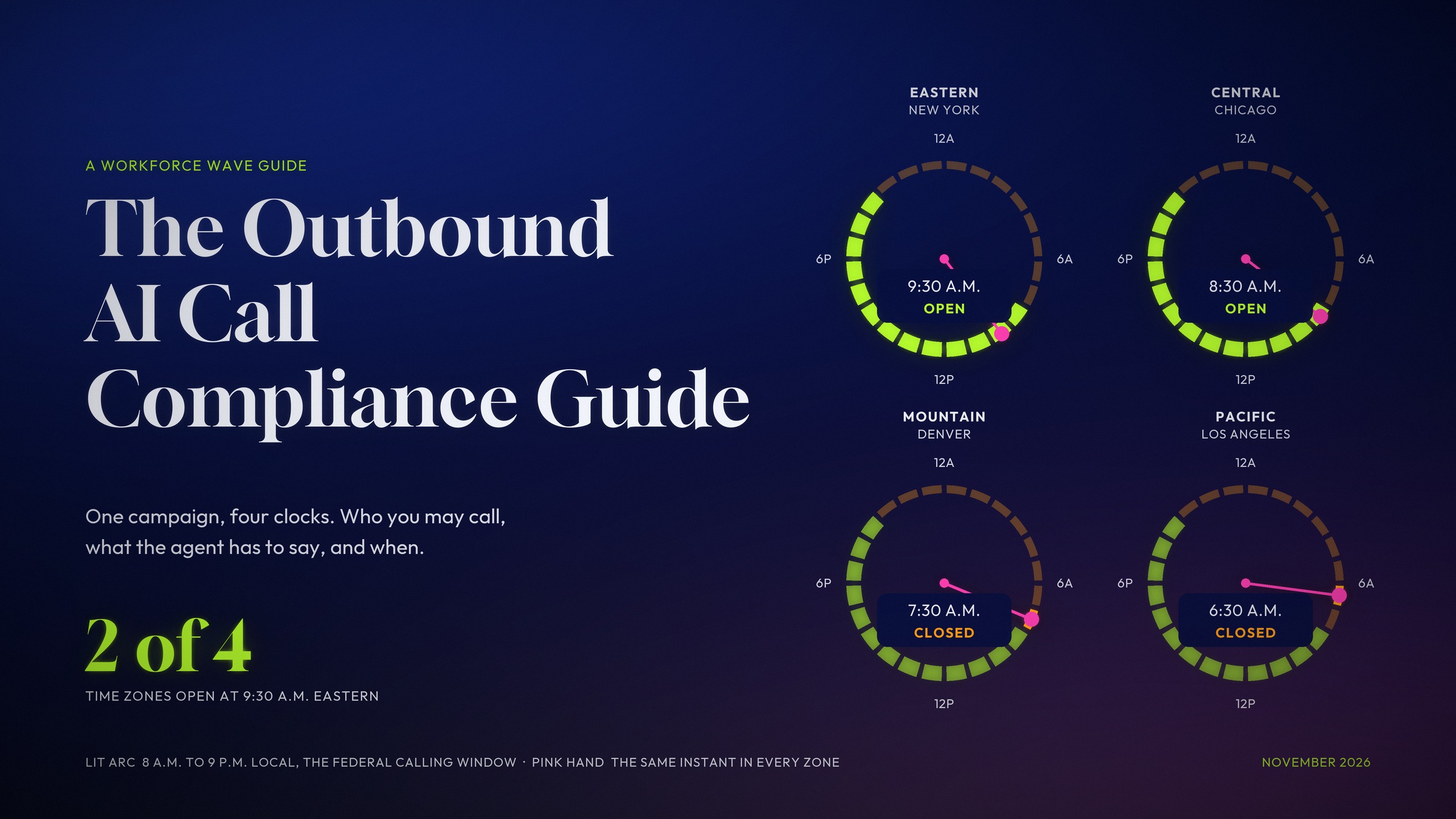
Your brand doesn't just use voice agents—it casts them.
Open the Workshop — Get a CallA Workforce Wave guide, current as of November 10, 2026. A practical summary for business owners and operators, not legal advice.
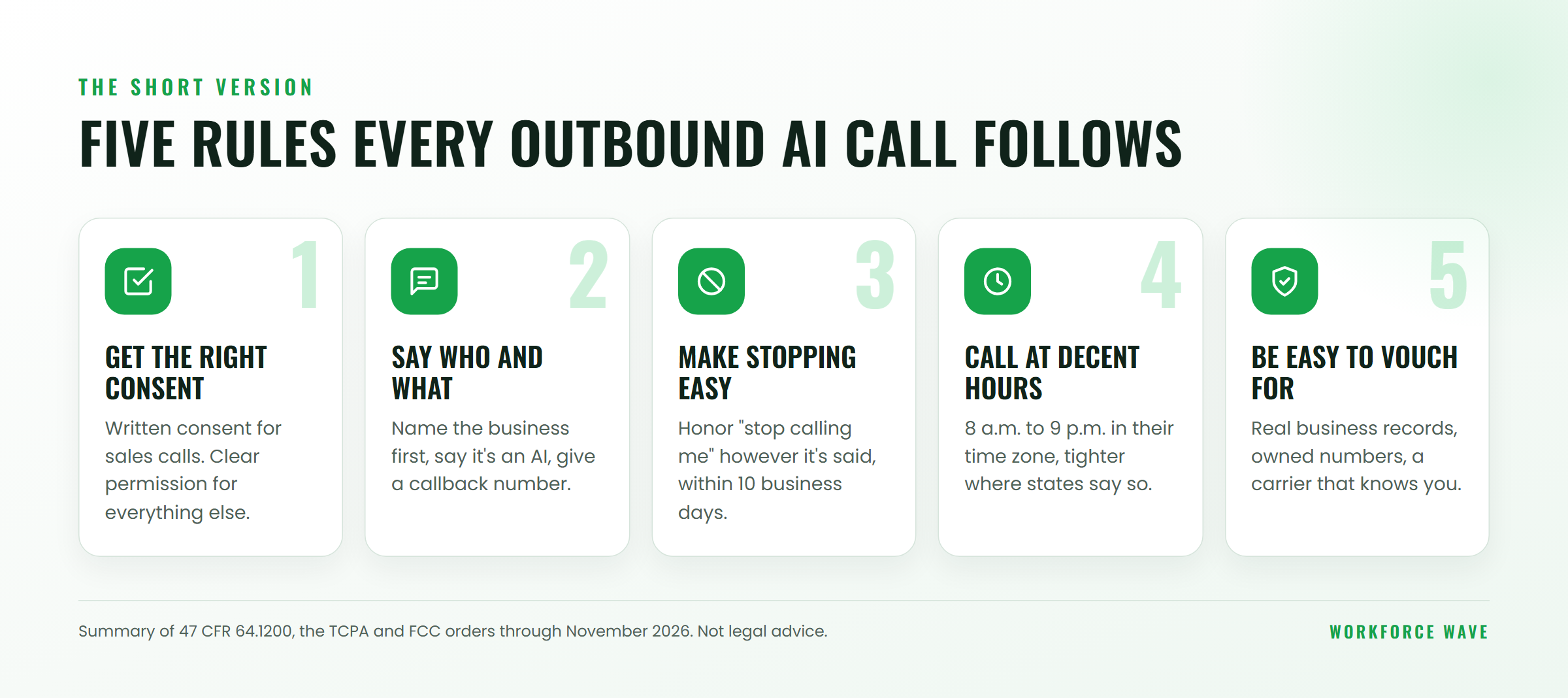
An AI voice agent can place a thousand calls in the time it takes a person to place ten. That speed is why businesses want outbound agents, and it is also why the law watches them closely. Every rule that ever applied to robocalls applies to an AI agent, a few newer rules were written with AI in mind, and the carrier that connects your calls now has to know who you are.
None of it is hard once you see it laid out. This guide walks through the rules in the order you would build a campaign, with pictures, sample calls you can listen to, and a few quick scenarios to test yourself on. If you only have a minute, start with the five rules below.
In this guide
- Why AI calls follow the robocall rules
- Consent: who you may call
- Can my agent make this call? A decision guide
- What the agent has to say (with sample calls)
- When someone says "stop calling me"
- When to call, and who not to call
- Your carrier and your caller ID
- Building it into the agent
- If you run campaigns for clients
- What it costs to get it wrong
- Test yourself: seven scenarios
- Common questions
- The pre-launch checklist (printable)
For the risks behind these rules, and what they mean for agencies that run campaigns for clients, read the companion article, Before You Dial.
1. Why AI calls follow the robocall rules
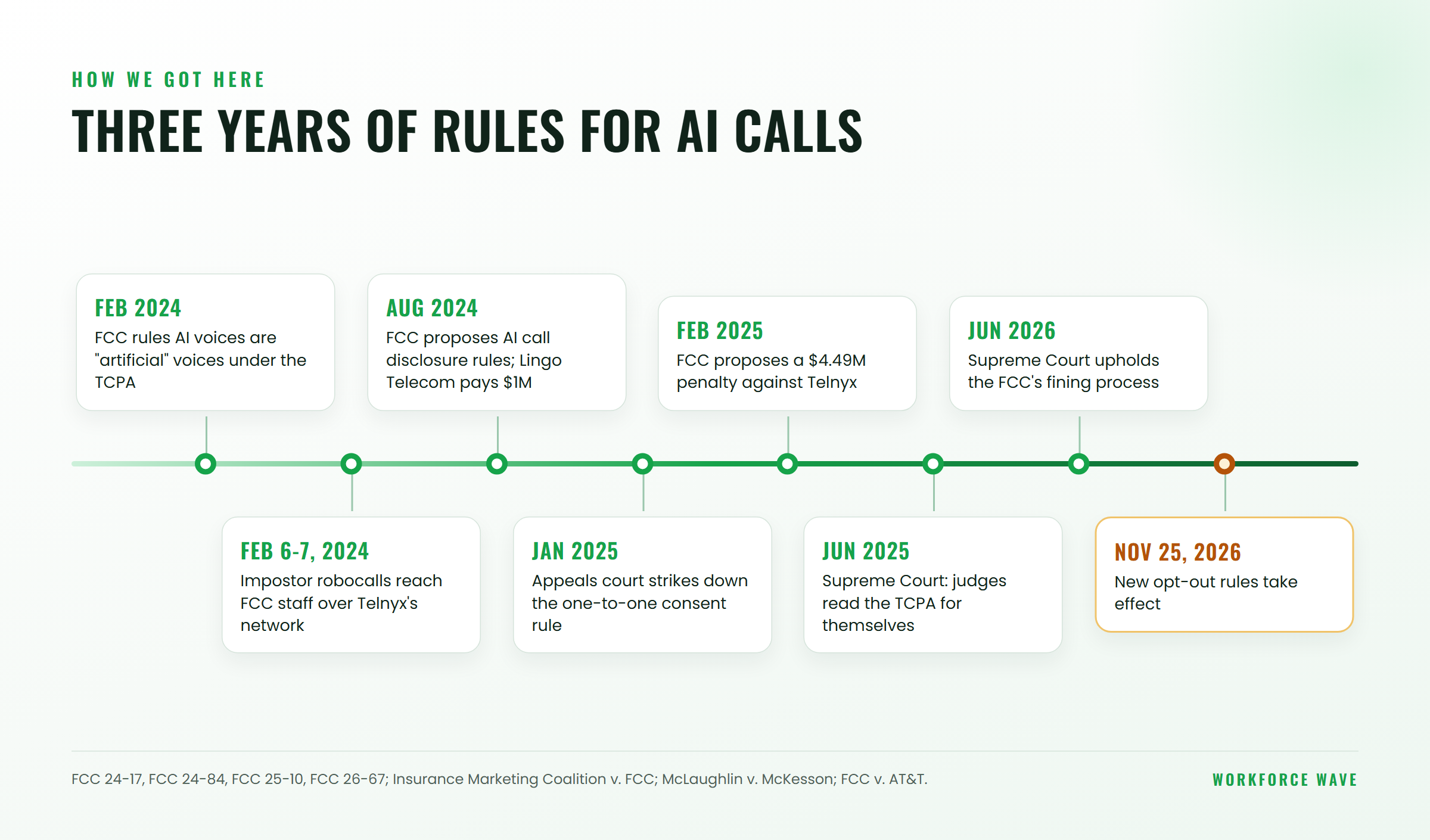
The short answer: in February 2024 the FCC ruled unanimously that a voice generated by AI is an "artificial" voice under the Telephone Consumer Protection Act. An agent can listen, answer questions and sound completely natural, and the law still treats its calls like any prerecorded robocall.
That one ruling pulls every outbound AI agent into a set of rules that have been building for decades, and the last three years have added several more.
Ringless voicemail counts too. The FCC ruled in 2022 that a message dropped straight into a voicemail box is a call, so it needs the same consent a ringing call would.
For the law itself in more depth, see our TCPA compliance overview and the rest of our voice agent compliance library.
The fine print: the four layers of rules
| Layer | What it covers | Main sources |
|---|---|---|
| Federal law and FCC rules | Consent, disclosures, calling hours, Do Not Call, abandoned calls, caller ID | Telephone Consumer Protection Act (47 U.S.C. 227); 47 CFR 64.1200 and 64.1600 |
| FTC rules | Telemarketing conduct, misrepresentation, impersonating a business or agency | Telemarketing Sales Rule (16 CFR 310); Impersonation Rule (16 CFR 461) |
| State law | Tighter calling hours, call limits, state Do Not Call lists, AI and recording disclosures | State telemarketing statutes, recording consent laws, AI disclosure laws |
| Carrier and industry rules | Customer vetting, caller ID attestation, spam labeling | 47 CFR 64.1200(n)(4), STIR/SHAKEN, carrier acceptable use policies |
The fine print: what the 2025 Supreme Court decision changed
In McLaughlin Chiropractic Associates v. McKesson (June 2025), the Supreme Court held that federal judges are not bound by the FCC's reading of the TCPA and must read the statute for themselves. A judge could, in theory, read "artificial voice" differently than the FCC does. No court has done that for AI voices as of this writing. Build to the FCC's reading, which is the stricter one, and treat every call your agent places as an artificial voice call.
2. Consent: who you may call
The short answer: the more a call sells, the more permission it needs. A reminder needs the person's permission to be called at that number. A sales call needs that permission in writing.
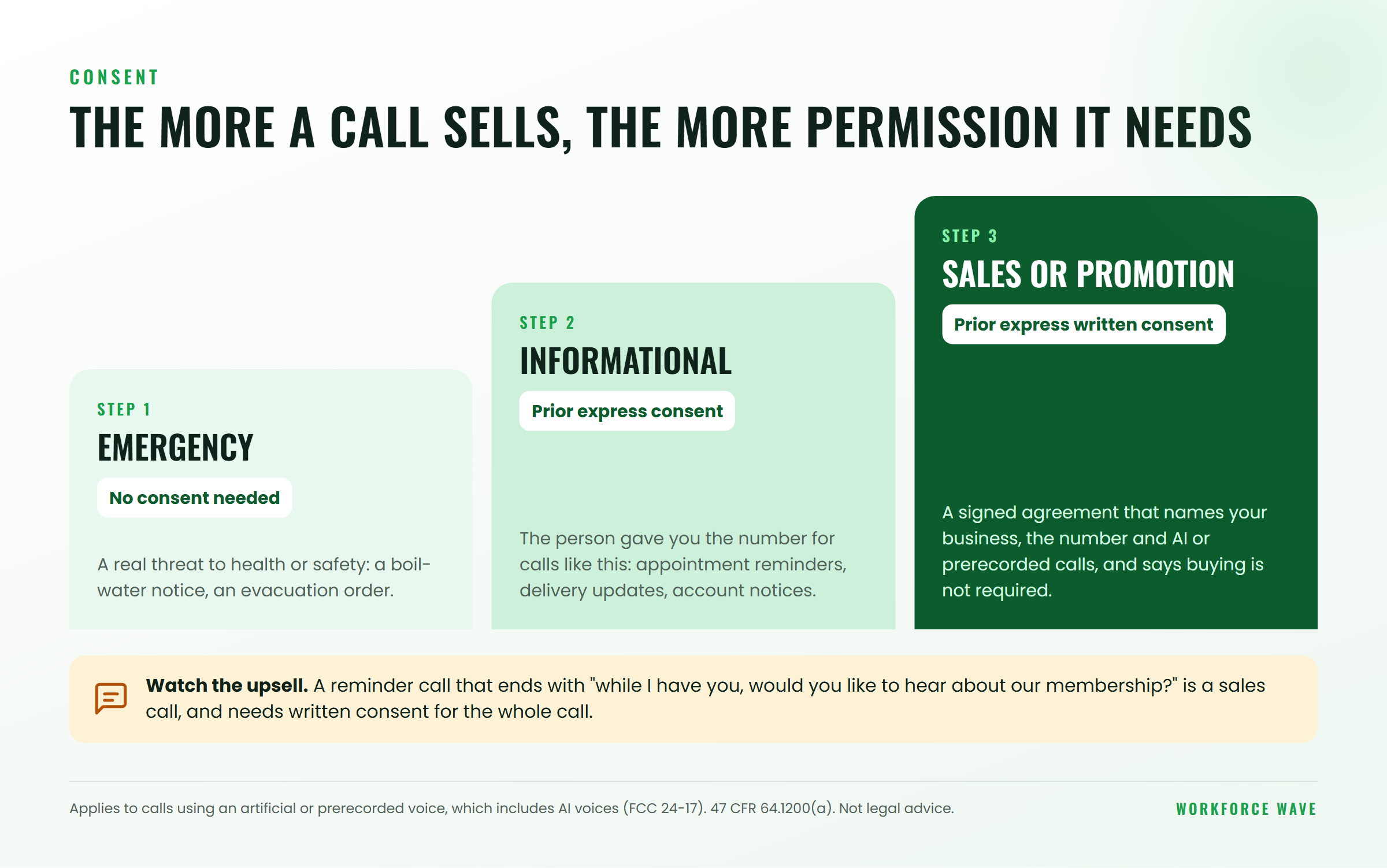
Three things trip up AI campaigns more than anything else:
- The upsell. A reminder that turns into a pitch is a sales call from the first word, and needs written consent.
- Purchased lead lists. If you can't produce the consent record for a number, and show that it covers your business, don't call it.
- Cell phones used for business. The rules for AI calls to cell phones apply whether the phone belongs to a consumer or a contractor who runs a business from it.
The fine print: what written consent has to include
Prior express written consent is a signed agreement (an electronic signature that meets the E-SIGN Act counts) that:
- clearly authorizes your business to make telemarketing calls using an artificial or prerecorded voice;
- names the phone number the person authorized;
- tells the person that signing is not a condition of buying anything.
Keep every record with its date, source, exact wording and number. The federal statute of limitations on TCPA claims is four years.
The fine print: lead generators and the one-to-one rule
The FCC adopted a rule in 2023 that would have required consent to name each seller individually. The Eleventh Circuit struck it down in January 2025 (Insurance Marketing Coalition v. FCC) before it took effect. The underlying duty did not go away: the consent still has to clearly cover your business.
The fine print: health care calls
Certain health care messages from HIPAA-covered entities to cell phones are exempt from the consent requirement, under strict conditions on content, how often you call and how people opt out. It is a narrow exemption. Read the rule, or ask counsel, before relying on it.
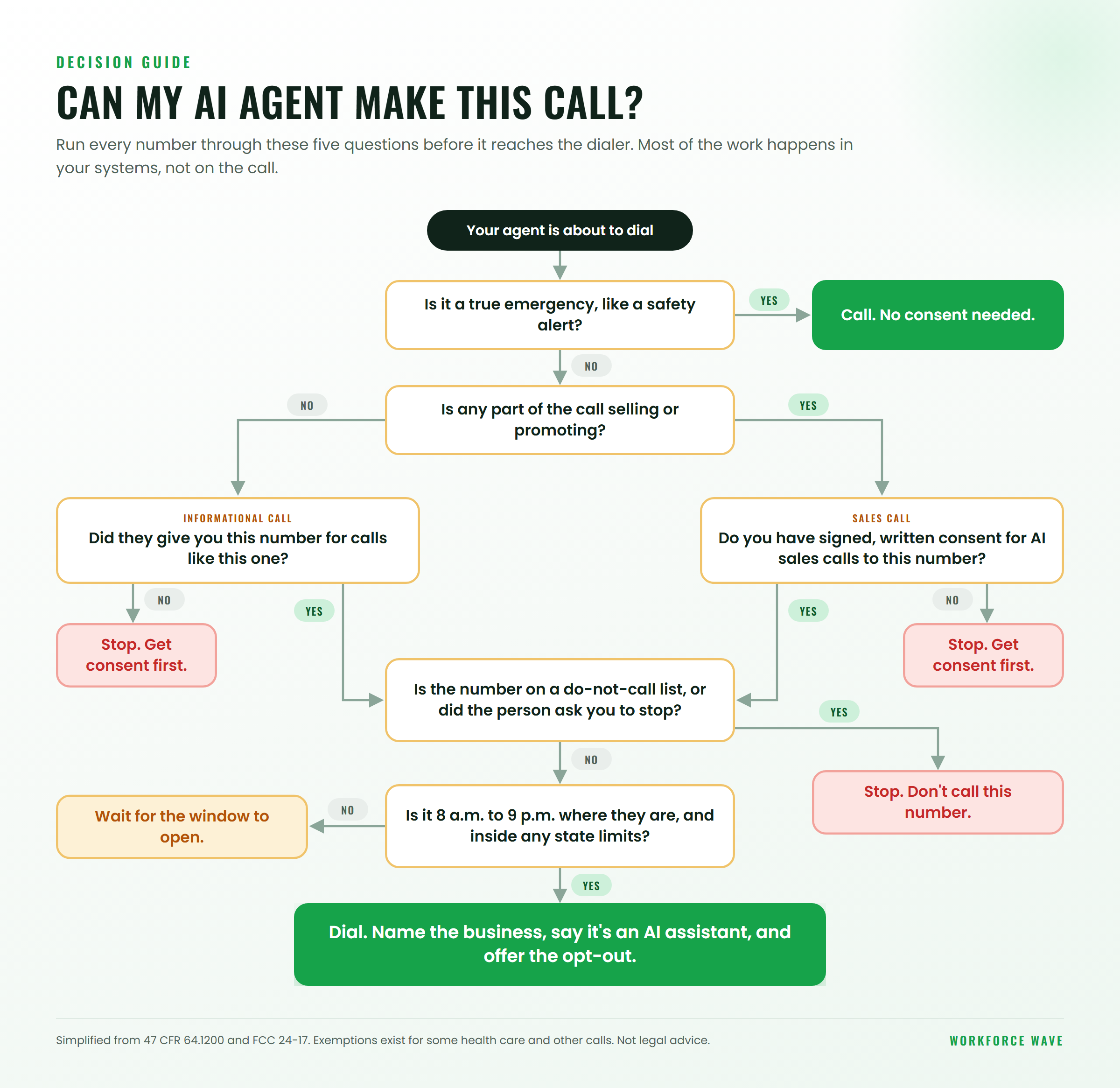
3. Can my agent make this call?
Put the consent rules together with the opt-out and timing rules and you get five questions every number should pass before it reaches the dialer. Most of these checks belong in your systems, before the call. The agent shouldn't be the one deciding.
4. What the agent has to say
The short answer: who is calling, that it's an AI, how to opt out and how to call back. Here is what that sounds like in one breath.
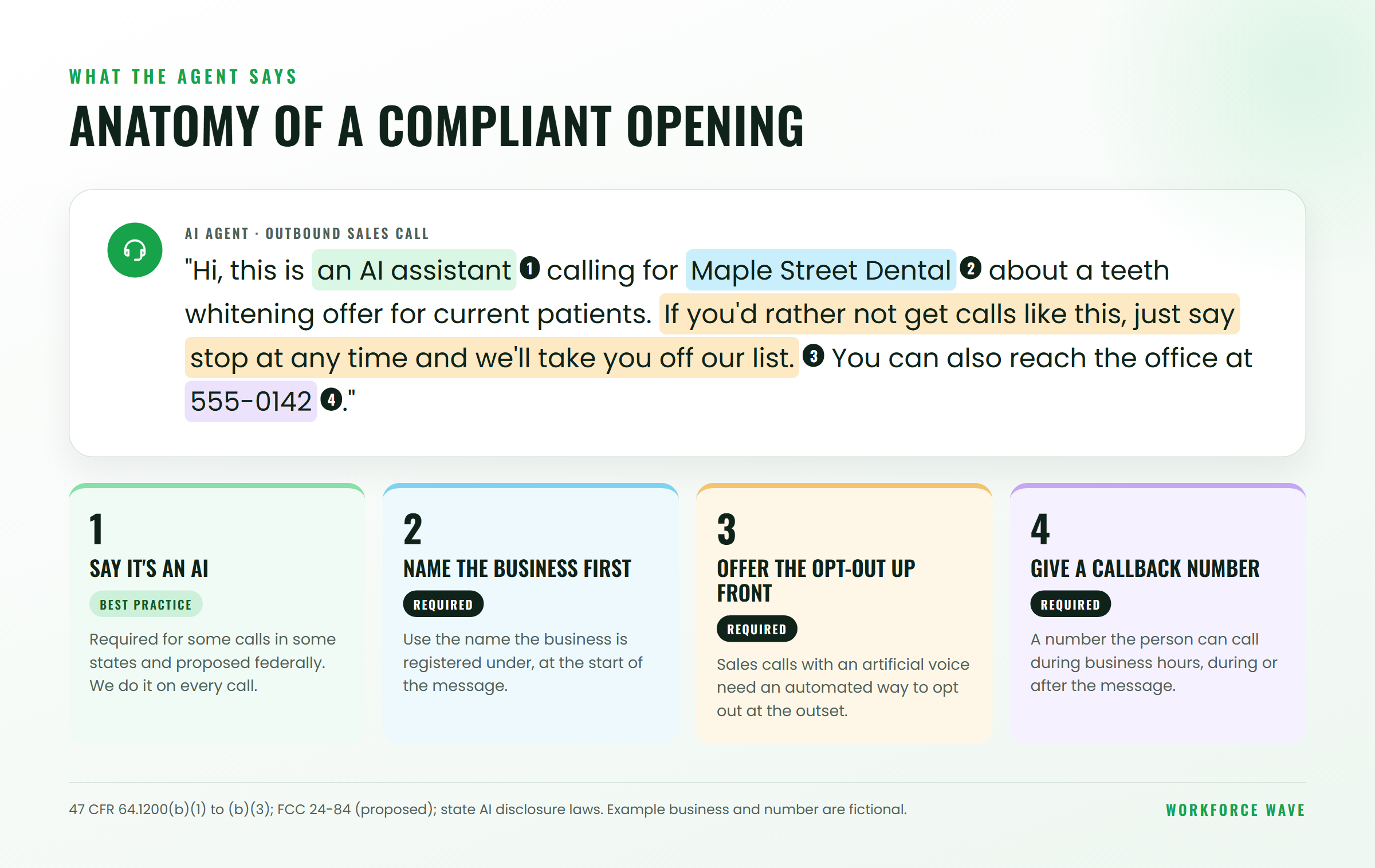
Listen to it. Three short sample calls, voiced with AI, for a fictional dental office.
Never impersonate. The agent may not claim to be a person when asked, and may not suggest it speaks for a government agency, a court, a bank or any business it doesn't represent. The FTC's Impersonation Rule has made that an unfair practice on its own since April 2024, and the FCC's biggest robocall cases involve exactly this.
The fine print: the federal disclosure rules
| Requirement | When | Source |
|---|---|---|
| Name the business responsible for the call, by its registered name | At the beginning of the message | 47 CFR 64.1200(b)(1) |
| Give a phone number the person can call during business hours | During or after the message | 47 CFR 64.1200(b)(2) |
| Offer an automated, interactive opt-out (spoken or key press) | Sales calls, at the start of the message; on voicemail, a toll-free number that reaches the same opt-out | 47 CFR 64.1200(b)(3) |
| Disclose call recording | When recording in all-party consent states such as California | State recording laws |
The fine print: AI disclosure laws
The FCC proposed in 2024 that callers disclose AI use both when they collect consent and at the start of every AI-generated call (FCC 24-84). As of November 2026 the proposal has not been adopted. Several states have acted on their own:
- California requires a disclosure when an automatic dialing-announcing device delivers a message in an artificial voice (Assembly Bill 2905, effective January 1, 2025).
- Maine prohibits using an AI chatbot or similar technology in trade in a way that could mislead a consumer into thinking they're dealing with a person, unless it is disclosed.
- Utah requires disclosure when a person asks, and up front in regulated occupations.
More states have bills moving. Our recommendation is to disclose on every outbound call, in every state, in the first sentence. One rule is easier to follow than fifty, and someone who didn't ask for your call deserves to know what's on the line.
5. When someone says "stop calling me"
The short answer: any reasonable way of saying it counts, and you have ten business days to honor it. Same day is better.
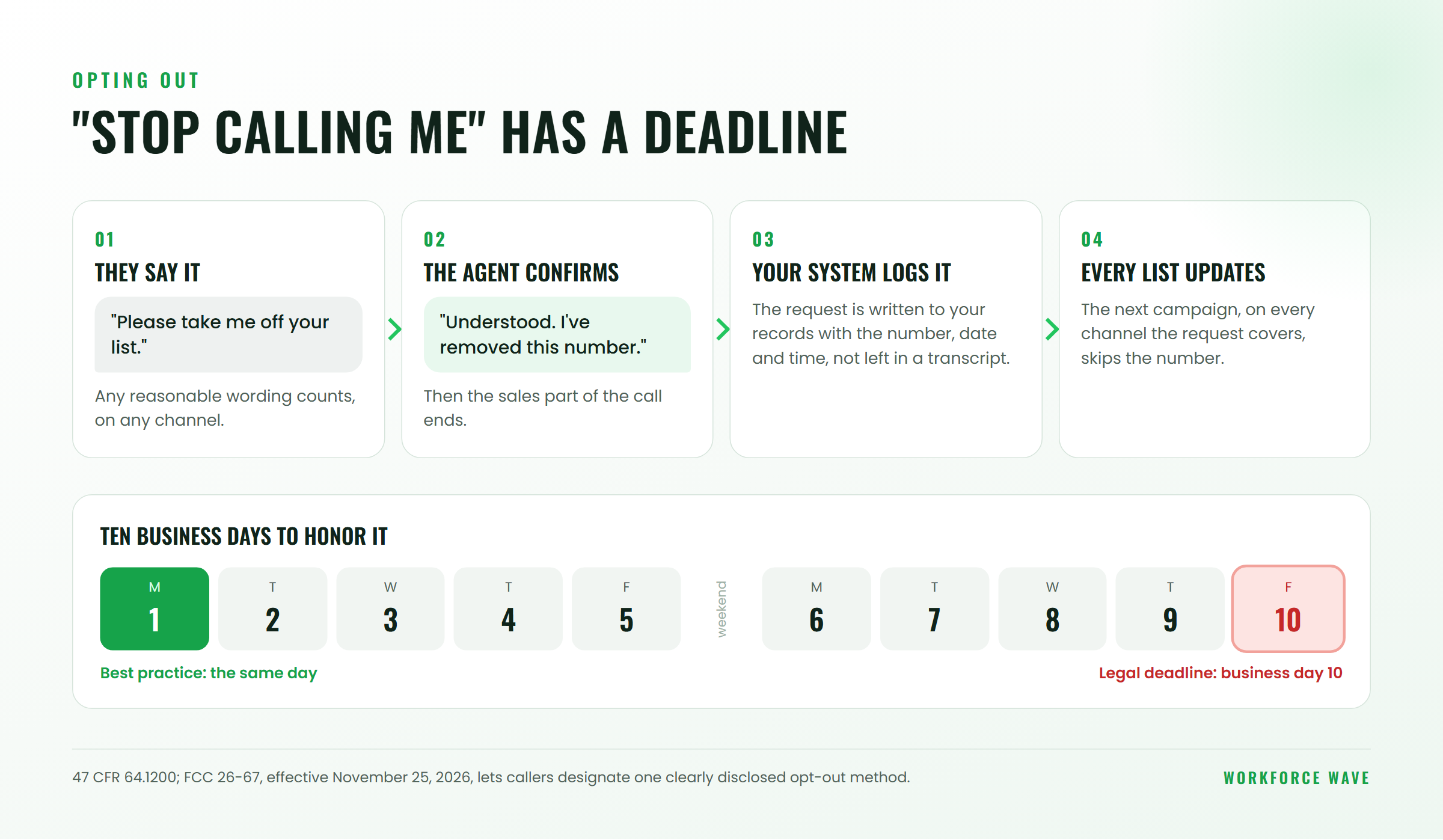
For an AI agent, that means the opt-out has to work inside the conversation. The agent should recognize it however it's phrased ("take me off your list," "don't call this number," "not interested, stop calling"), confirm it briefly, end the sales part of the call, and write it to your system so no future campaign dials that number. An opt-out that lives only in a transcript is one you didn't honor.
The fine print: what changes on November 25, 2026
Under the FCC's September 2026 order (FCC 26-67):
- A caller may designate one exclusive method for opting out, as long as it is clearly disclosed. If you don't designate one, any reasonable method still works.
- Opting out of informational calls applies to that category of message. Opting out of sales calls still covers all of your future sales calls and texts.
- The FCC is taking comment on further changes, including a deadline shorter than ten business days.
6. When to call, and who not to call
The short answer: between 8 a.m. and 9 p.m. in the time zone where the phone rings, never to a number on a do-not-call list without the right consent, and never into silence.
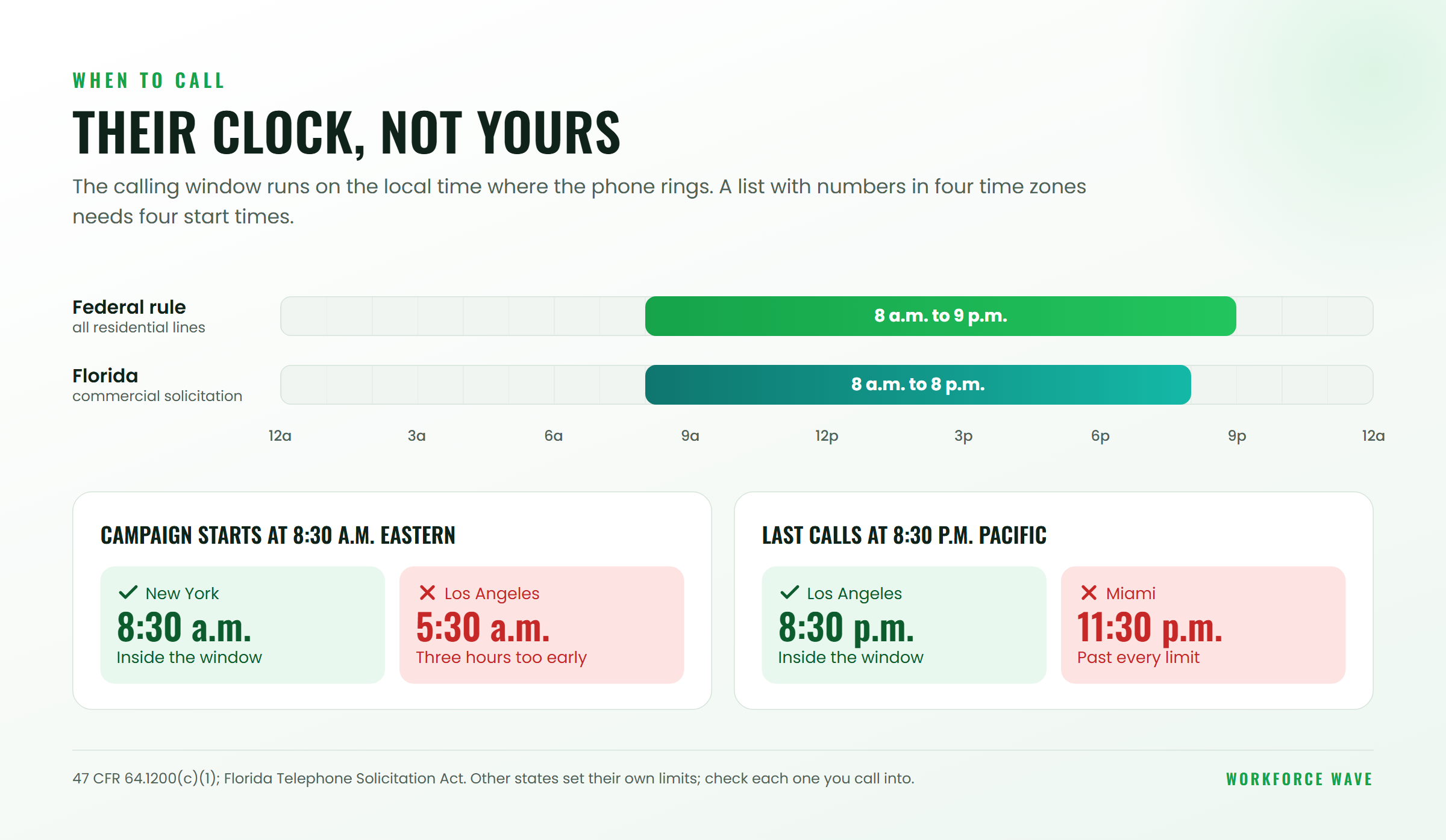
- Calling hours. The federal window is 8 a.m. to 9 p.m., local time for the person you're calling. Apply it to every outbound AI call, reminders included. Several states set narrower windows and daily limits; Florida, for one, limits sales calls to 8 a.m. to 8 p.m. and limits how often you can call the same person about the same thing in a day.
- The National Do Not Call Registry. Sales calls can't go to registered numbers unless you have written consent or an established business relationship that fits the rule. Scrub your list at least every 31 days, and against state lists where they exist. More in our Do Not Call Registry guide.
- Your own do-not-call list. Any business that makes sales calls needs a written do-not-call policy, and has to honor requests within ten business days. Your AI agent follows it like any employee.
- Numbers that changed hands. Checking the FCC's Reassigned Numbers Database before you call gives you a safe harbor if a number now belongs to someone new.
- Dead air. For sales calls placed through a dialer, the agent has to start speaking within two seconds of the person's hello, and no more than three percent of answered calls in a 30-day campaign may be abandoned.
7. Your carrier and your caller ID
The short answer: expect your phone carrier to check who you are before your first call, and make that easy for them.
Carriers have a legal duty to know their customers (47 CFR 64.1200(n)(4)). In February 2025 the FCC proposed a $4,492,500 penalty against one carrier, Telnyx, after two accounts opened under false names placed 1,797 impostor robocalls in one night. Telnyx is contesting it. Carriers across the industry have tightened their checks since.
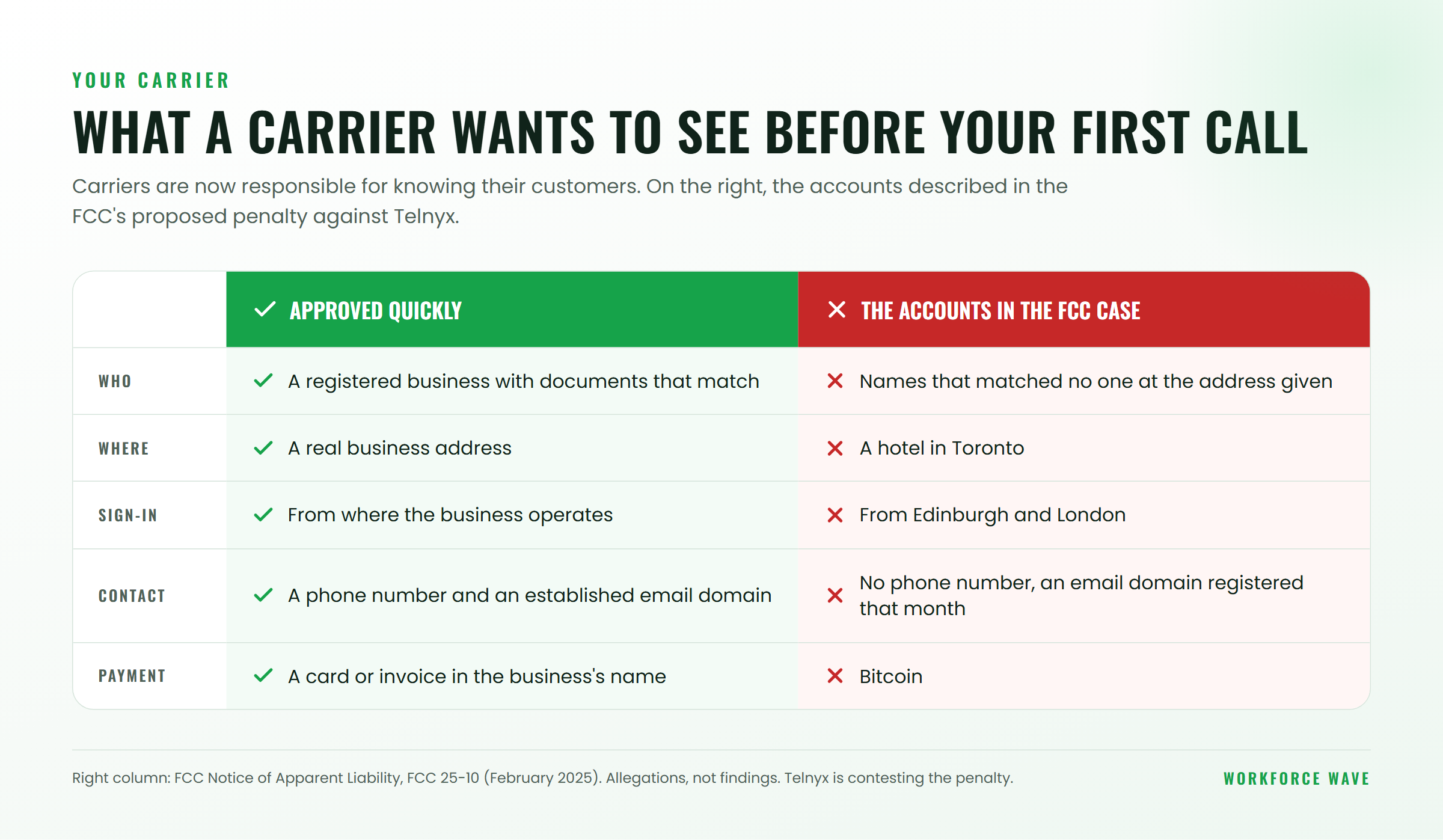
Caller ID. Use numbers you control, assigned through your carrier, so your calls get full ("A-level") STIR/SHAKEN attestation, the network's signal that your carrier knows you and you're entitled to the number. Register your numbers with the major analytics providers through their free registries, and consider branded caller ID so your business name shows on the screen. Don't rotate through big pools of numbers to stay ahead of spam labels. Carriers and regulators read that pattern as a sign of a bad actor.
The fine print: caller ID law
The Truth in Caller ID Act prohibits displaying misleading caller ID with intent to defraud, cause harm or wrongfully obtain anything of value. STIR/SHAKEN rules are at 47 CFR 64.6300 and following.
8. Building it into the agent
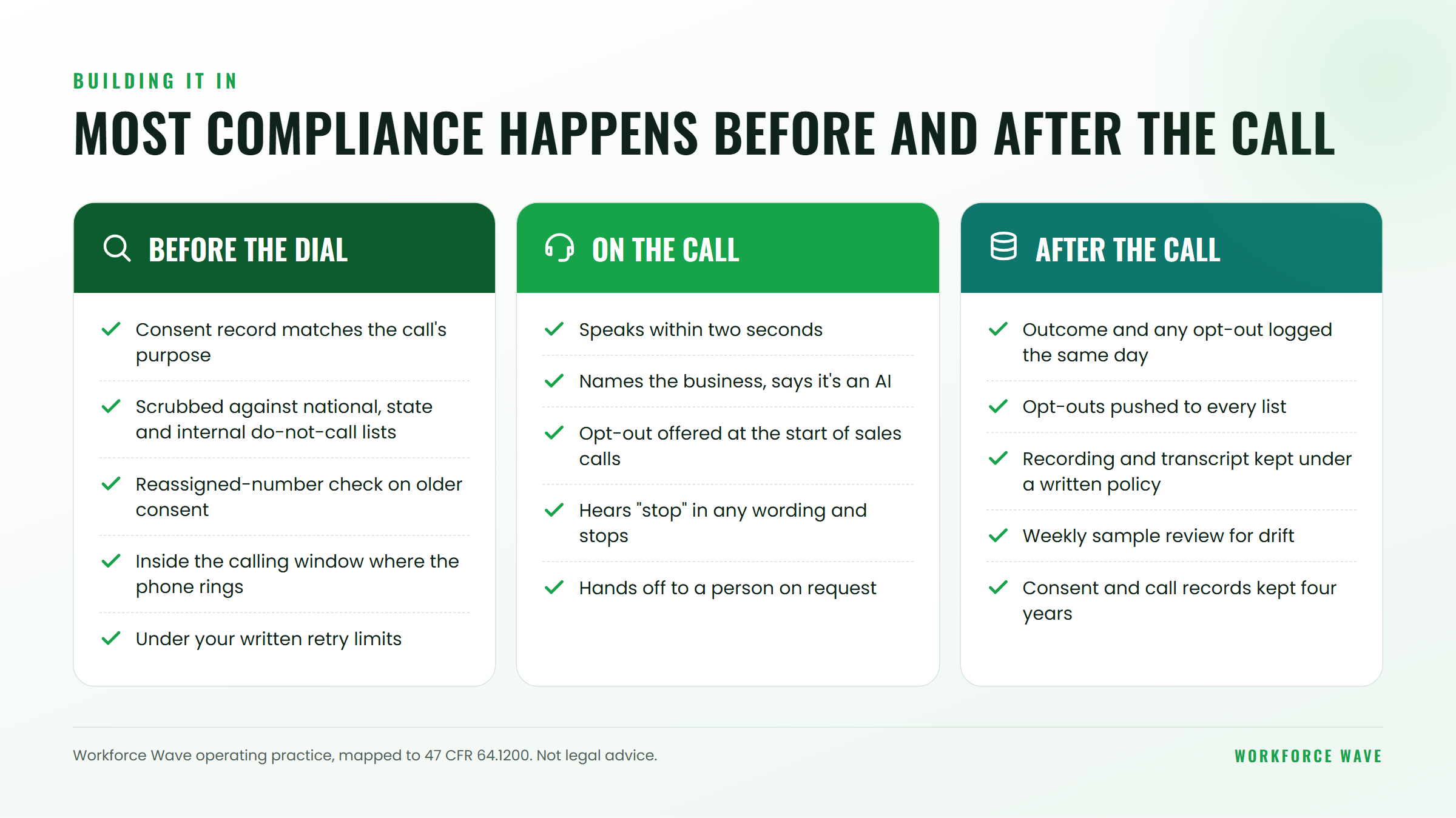
The short answer: most compliance happens in the systems around the agent. The prompt matters, but the checks before the dial and the records after the call do most of the protecting.
9. If you run campaigns for clients
The short answer: agencies and calling platforms carry their own risk. Vet each client the way carriers now vet you, and keep the controls that prevent violations in your own hands.
Agencies often assume the risk sits with the client, because the client owns the list and the relationship. The rules don't work that way. In the case behind the FCC's proposed $4.49 million penalty against Telnyx, the people who placed the calls were never identified, so the FCC pursued the company that let them onto the network. An agency that onboards clients who will dial is in a similar position, one step closer to the call.
Three routes can reach an agency or platform directly:
- Being treated as the caller. The FCC looks at whether a platform is "so involved in the placing of a specific telephone call" that it effectively made the call, and has used that test against a robocall platform. Writing the script, loading the list and launching the campaign is a lot of involvement.
- Assisting a violation. The FTC's Telemarketing Sales Rule makes it a violation to give "substantial assistance" to a seller or telemarketer while knowing, or consciously avoiding knowing, that they are breaking the rule. The FTC has used it against phone service providers.
- Acting for the business. Under the FCC's 2013 DISH Network ruling, a business can be liable for calls placed on its behalf. That pushes careful clients to demand compliance terms from their vendors, which means the agency is the one who has to deliver.
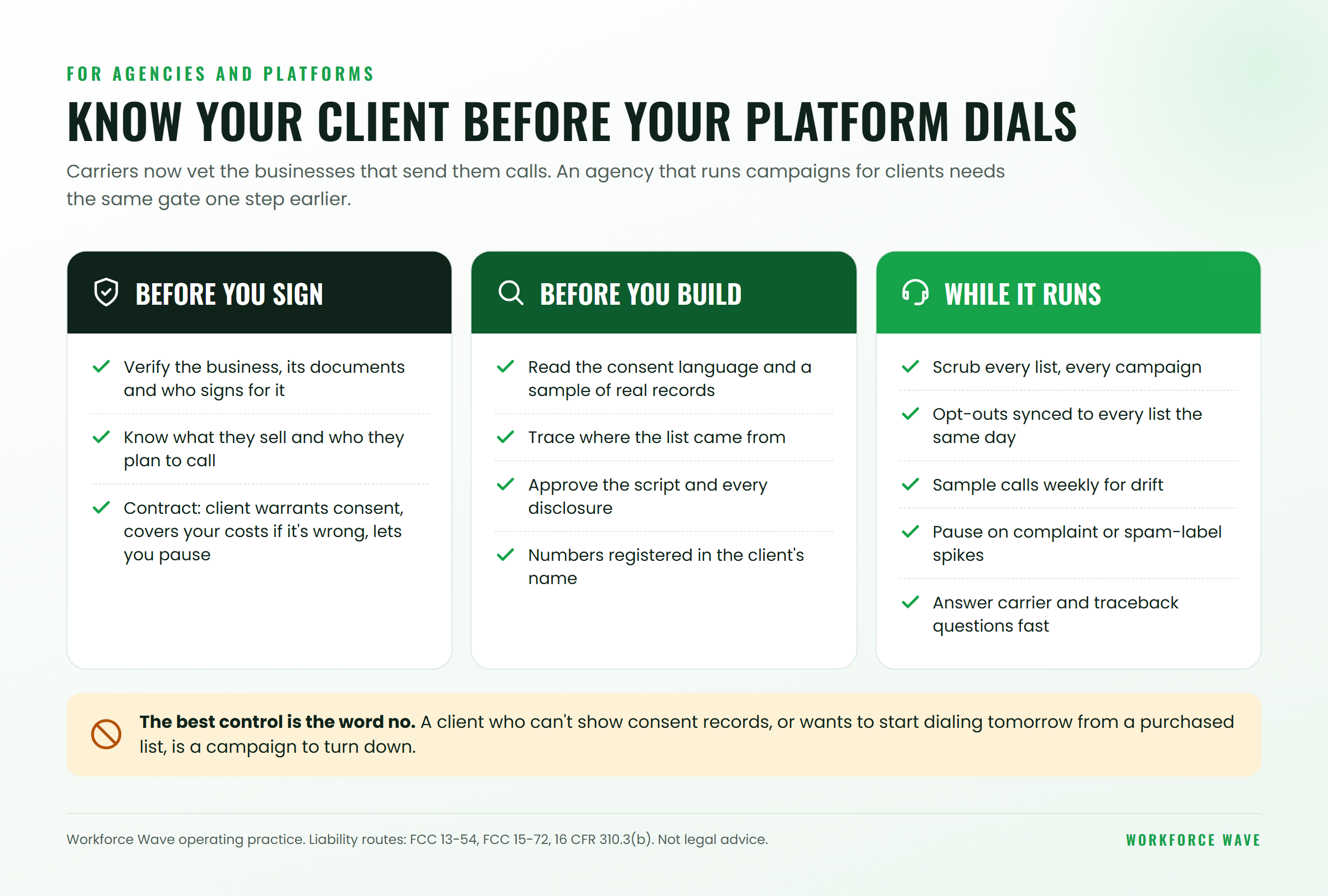
The habits that protect an agency:
- Know your client. Confirm the business is real, who owns it and what it sells. Don't onboard an account you couldn't describe to a regulator.
- See the consent before you see the list. Read the consent language the client used and check a sample of actual records against it. If the client bought the list, ask the seller for the records too.
- Never let a list go straight to the dialer. Scrub every list yourself against the national registry, state lists, the client's own do-not-call list and every opt-out you've captured.
- Own the opt-out plumbing. Opt-outs your agents hear are yours to capture and sync. Don't hand them to the client in a weekly export.
- Own the script. If your team wrote it, you're responsible for what it says. Every outbound script names the business, says it's an AI, offers the opt-out and gives a callback number.
- Keep numbers separate. Run each client on numbers registered in that client's name, so one client's campaign can't damage another's caller ID reputation or tie you to its traffic.
- Put it in the contract. The client warrants it has consent for every number, covers your costs if it doesn't, cooperates with carrier and traceback inquiries, and gives you the right to pause a campaign at any time.
- Watch it run, and keep a kill switch. Sample calls weekly, watch complaint and spam-label rates, and pause first and ask questions second. In the Telnyx case, the FCC credited the company's prompt report of the calls when it declined to raise the penalty.
The fine print: where these rules come from
- Seller liability for third-party calls: FCC Declaratory Ruling in the DISH Network matter, FCC 13-54 (May 2013), applying federal common-law agency principles. The D.C. Circuit later held the ruling isn't binding on courts, but courts still look to it.
- Platform as caller: the FCC's 2015 TCPA Omnibus Declaratory Ruling and Order, FCC 15-72, and the FCC's enforcement action against the robocall platform Dialing Services.
- Assisting and facilitating: FTC Telemarketing Sales Rule, 16 CFR 310.3(b), and FTC actions against VoIP providers that carried illegal robocalls.
10. What it costs to get it wrong
The short answer: the law prices every call separately, so mistakes scale with the campaign.
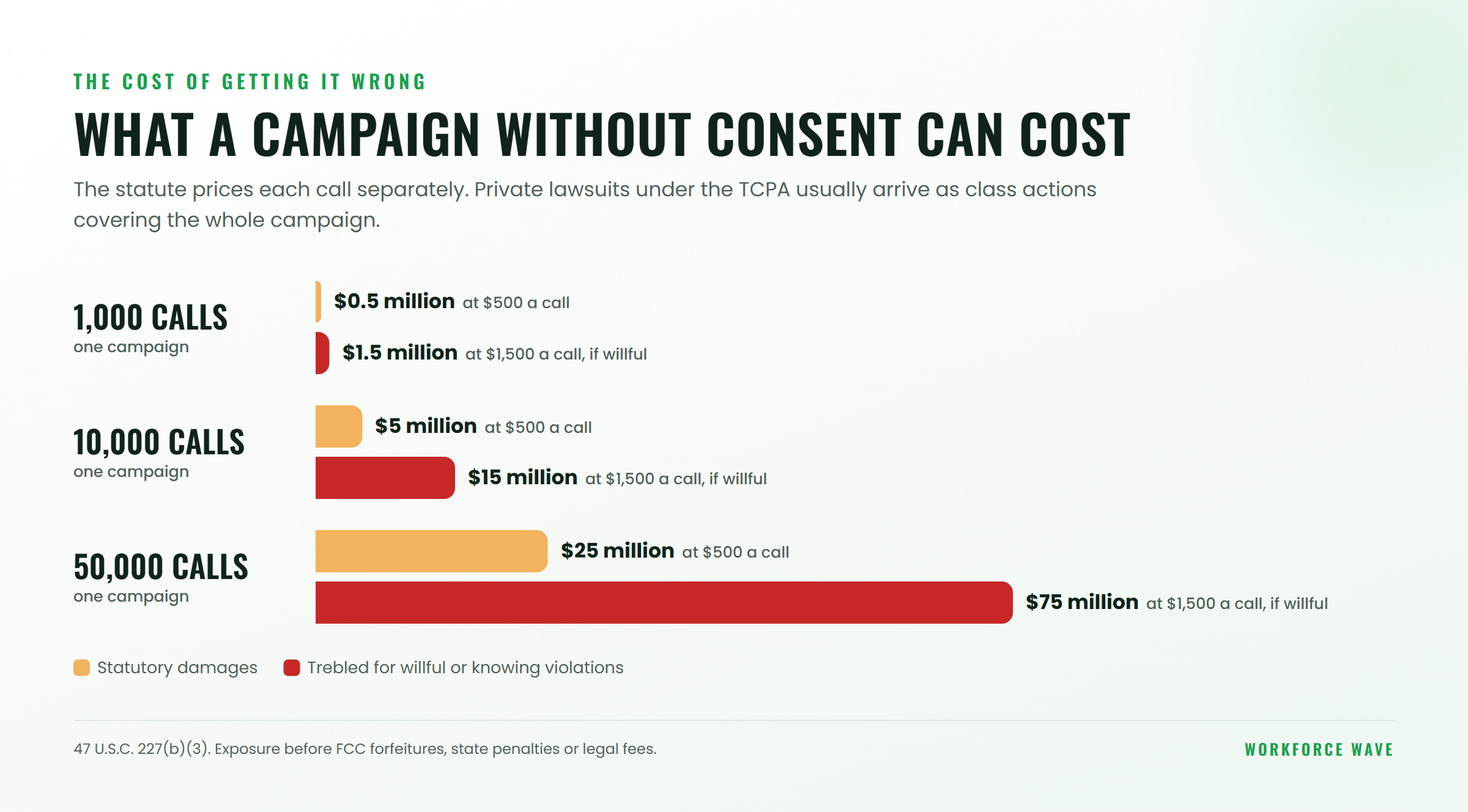
Private lawsuits aren't the only risk. In the Telnyx case the FCC proposed $2,500 per call, and the Supreme Court upheld the FCC's fining process in June 2026 (FCC v. AT&T). The FTC can seek more than $50,000 per violation of its telemarketing rule. In 2024 the FCC proposed a $6 million penalty against the political consultant behind AI calls that imitated President Biden's voice, and the carrier that carried them, Lingo Telecom, paid $1 million to settle. And a carrier that sees trouble can block your calls or close your account without warning.
11. Test yourself: seven scenarios
Make your call on each one, then tap to see the answer.
1. A patient gave your dental office her cell number on the intake form. Can your AI agent call to remind her of tomorrow's cleaning?
Yes. It's an informational call, and giving you the number for her appointments is prior express consent for calls about them. The agent still names the office first, says it's an AI and gives a callback number.
2. Same patient, same call, but at the end the agent mentions a whitening special. Still fine?
No. The pitch makes it a sales call, and a sales call with an AI voice needs her signed, written consent. Keep reminders as reminders, and run promotions only to people who agreed to them in writing.
3. You bought a list of 5,000 "opted-in" homeowners from a lead vendor. Can your agent start calling them about solar panels?
Only if you can produce, for each number, a written consent that covers your business and AI or prerecorded sales calls. "Opted in" on a vendor's word is not a consent record. This is where most TCPA lawsuits start.
4. Your campaign is set to start at 8:15 a.m. Eastern for a list that includes Arizona and California. Problem?
Yes, because it's 5:15 a.m. in California. The calling window runs on the time where the phone rings, so each time zone needs its own start time.
5. Halfway through a call, someone says "ugh, just don't call me again" and keeps talking. What does the agent do?
Treat it as an opt-out. Any reasonable wording counts. The agent confirms it, drops any sales talk, and the request goes to every list the same day. The legal deadline is ten business days.
6. A caller asks, "Is this a real person?" Can the agent say "I'm Jamie from Maple Street Dental" and keep going?
No. A name alone dodges the question. The agent should say plainly that it's an AI assistant and offer a way to reach a person. Pretending to be human is the fastest way to lose a caller's trust, and in some states it breaks the law.
7. You're an agency. A new client wants an outbound campaign live tomorrow from a list they bought, and says consent is "their responsibility." Do you build it?
Not yet. Ask for the consent language and a sample of records first, and scrub the list yourself. If you write the script, load the list and press start, you are close enough to the calls to share the risk, whatever the contract says. A client who can't produce consent records is a campaign to turn down.
12. Common questions
We only provide the software. Are we covered?
Less than you might think. A platform that knowingly lets clients use it for illegal calls, or that is closely involved in placing them, can be held responsible. The more your team does (writing scripts, loading lists, launching campaigns), the more the calls look like yours. See If you run campaigns for clients.
Do these rules apply to calls to other businesses?
Many do. The consent rules for AI calls to cell phones apply no matter who owns the phone, and the disclosure, caller ID and impersonation rules apply to every call. Calls to business landlines get more room under the Do Not Call rules, but not under the artificial voice rules.
Do they apply when customers call us?
Mostly not. The TCPA rules in this guide govern calls you place. Inbound calls have their own considerations, mainly recording disclosures and a few state AI disclosure laws. We cover greetings for inbound calls in Thank You for Calling.
What about text messages?
The FCC treats texts as calls under the TCPA, so the consent and opt-out rules apply to them too, along with carrier registration for business texting (10DLC). That deserves its own guide.
Can the agent leave a voicemail?
Yes, with the same consent the call needed. The message should name the business, give a callback number, and for sales calls give a toll-free number that reaches the opt-out.
Does a better-sounding voice change anything?
No. The law cares whether the voice is artificial, not how good it is. A voice cloned from a real person adds risk, especially if the person hasn't agreed to it.
Is this legal advice?
No. It's a practical summary from a company that builds and runs voice agents. Rules change and states differ, so have counsel review any campaign before it launches.
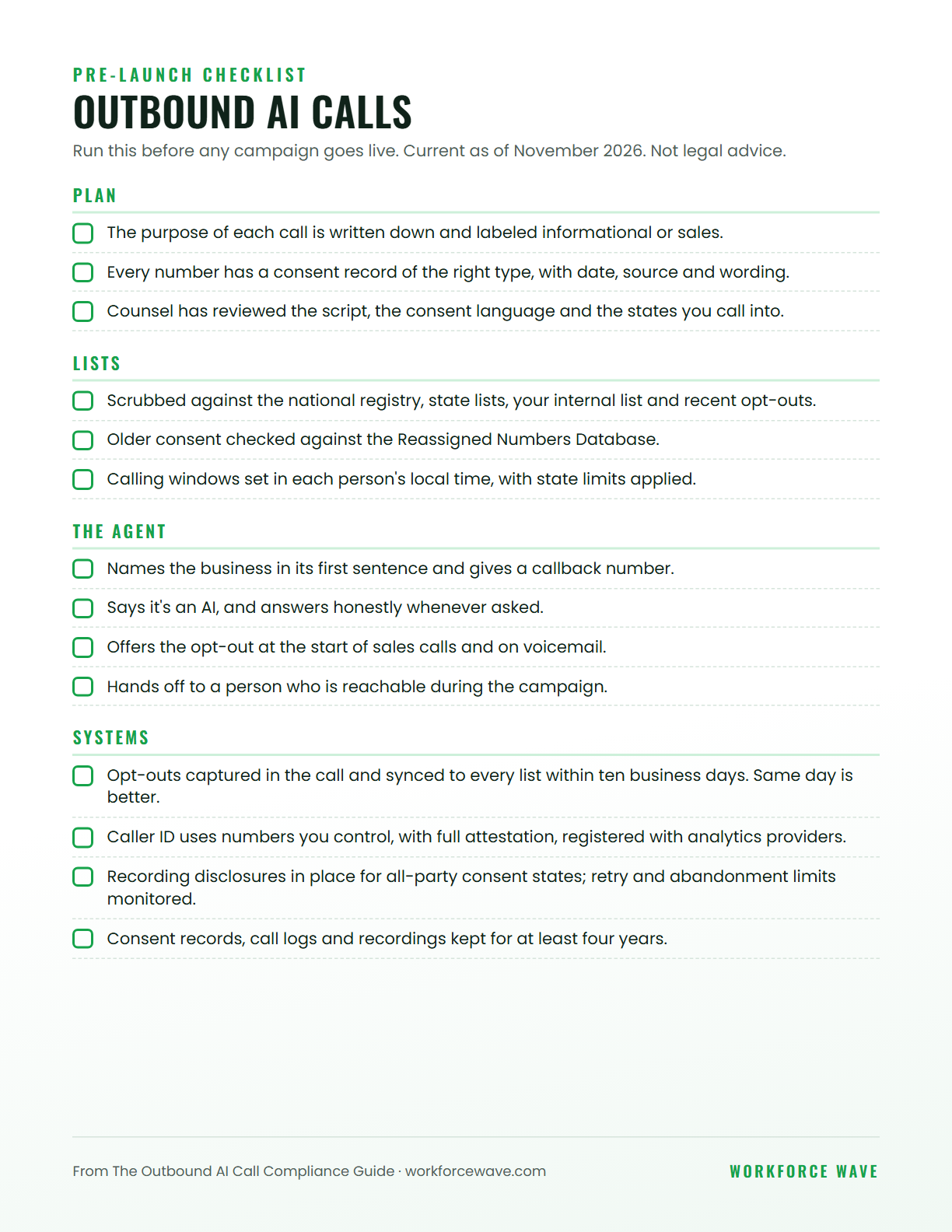
13. The pre-launch checklist
Print it, hand it to whoever runs the campaign, and don't launch until every box is checked. Download the one-page checklist (PDF).
Planning an outbound program and want a second set of eyes? See how we run outbound campaigns, then talk to our team. We'll review your consent flow and your agent's opening before anything dials.
Sources and citations
- Telephone Consumer Protection Act, 47 U.S.C. 227; FCC rules at 47 CFR 64.1200.
- FCC Declaratory Ruling on AI-generated voices, FCC 24-17 (February 8, 2024).
- FCC Notice of Proposed Rulemaking on AI-generated calls and texts, FCC 24-84 (August 2024).
- FCC Report and Order on consent revocation, FCC 26-67 (adopted September 30, 2026; effective November 25, 2026).
- Eleventh Circuit decision in Insurance Marketing Coalition v. FCC, case number 24-10277, decided January 24, 2025.
- Supreme Court decision in McLaughlin Chiropractic Associates v. McKesson Corp., decided June 2025.
- Supreme Court decision in FCC v. AT&T, Inc., case number 25-406, decided June 4, 2026.
- In re Telnyx LLC, Notice of Apparent Liability for Forfeiture, FCC 25-10 (February 4, 2025).
- FTC Telemarketing Sales Rule, 16 CFR 310; FTC Rule on Impersonation of Government and Businesses, 16 CFR 461.
- California Assembly Bill 2905 (2024); Maine LD 1727 (2025); Utah Artificial Intelligence Policy Act and 2025 amendments.
Sample calls are voiced with AI for a fictional business. Rules in this area change often; check each source for amendments before relying on it.
Related Case Studies
Before You Dial: The Cautions of Outbound Voice AI Campaigns
Outbound AI calling is the fastest way to reach customers, and the fastest way to get sued, blocked or named in an FCC notice. Six cautions for businesses and voice AI agencies, told partly through the night 1,797 impostor robocalls put a carrier in front of the FCC.
The Pause: Voice AI Latency After a Year of Production Calls, and the Price of Full Duplex
Voice agents got much faster in a year, and their slowest turns improved most. What production data shows about latency today, and what an agent would give up to talk while it listens.
Around the World in 80 Languages
One voice speaks 80 languages following the sunrise. Then two agents chase it again, switching between Hindi, Russian and Japanese every three words.