
Case Study
Before You Dial: The Cautions of Outbound Voice AI Campaigns
Outbound AI calling is the fastest way to reach customers, and the fastest way to get sued, blocked or named in an FCC notice. Six cautions for businesses and voice AI agencies, told partly through the night 1,797 impostor robocalls put a carrier in front of the FCC.
Your brand doesn't just use voice agents—it casts them.
Open the Workshop — Get a CallOutbound calling is the part of voice AI that sells itself. An agent that can work through a list of a thousand patients, policyholders or past customers before lunch, sound warm doing it and never lose its place is an easy thing to want. Businesses ask for it, and agencies are happy to build it.
It is also the part of voice AI most likely to end in a lawsuit, a blocked phone number or a federal enforcement notice. The rules that govern it are older than most of the companies selling it, they price every mistake by the call, and they reach further up the chain than most people expect.
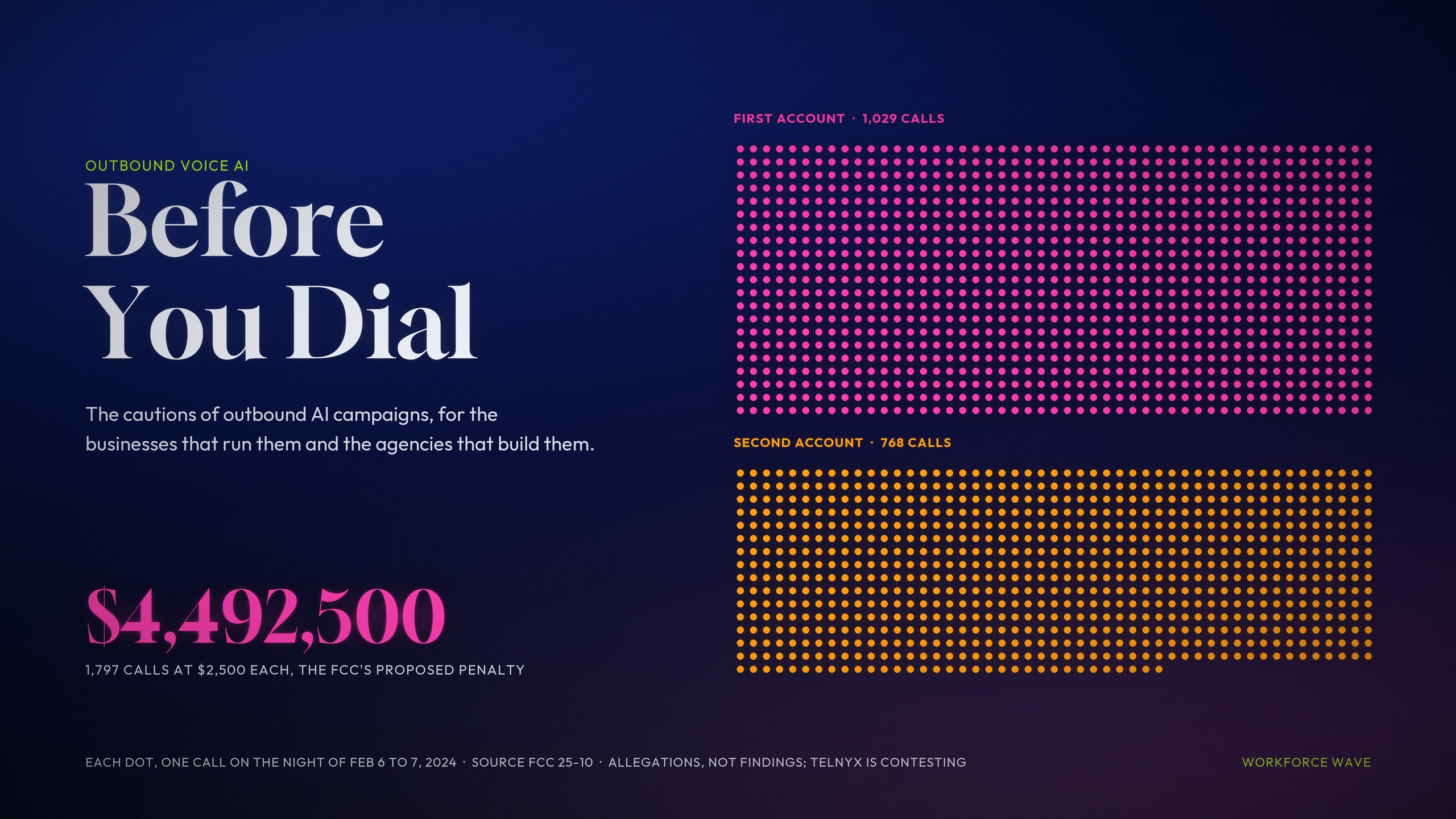
The clearest recent illustration is one night in February 2024, when 1,797 recorded calls went out over a single carrier's network pretending to be the FCC. The callers were never found. The carrier, a company called Telnyx, ended up facing a proposed $4.49 million penalty. We'll come back to that night throughout this piece, because nearly every caution below shows up in it somewhere. This is written for two readers: the business thinking about an outbound AI campaign, and the voice AI agency thinking about running one for a client.
Caution 1: The law hears a robocall
However natural it sounds, an AI voice agent is a robocall in the eyes of the law. In February 2024 the FCC ruled unanimously that a voice generated by artificial intelligence counts as an "artificial" voice under the Telephone Consumer Protection Act. That single ruling places every outbound AI call under the same rules as a prerecorded message: permission before dialing, the caller's name at the start, an easy way to opt out, and limits on when you call.
The impostor calls that night used the same basic machinery a legitimate campaign uses. According to the FCC's notice, recipients heard an automated voice address them by first name, announce a call from the FCC's "Fraud Prevention Team," and invite them to press one to talk now or two to schedule a call back. A person who pressed through was told to pay $1,000 in Google gift cards to avoid jail. Strip out the fraud and the call flow is ordinary: automated voice, personalized greeting, a choice to connect to a person. That is why the law draws no line between a clever AI agent and a recording. The technology is the same from the network's point of view, and so are the rules.
If you're the business: assume every call your agent places is regulated like a robocall, including reminders and follow-ups.
If you're the agency: never describe an outbound agent to a client as "not a robocall because it's conversational." The FCC has already said otherwise.
Caution 2: Consent is the whole game
Almost every expensive outbound mistake comes back to consent. A reminder or account notice needs the person's permission to be called at that number. A sales or promotional call with an artificial voice needs that permission in writing, signed, naming your business, the number and the kind of call. The difference catches people constantly. A reminder that ends with "while I have you, can I tell you about our membership?" is a sales call from the first word.
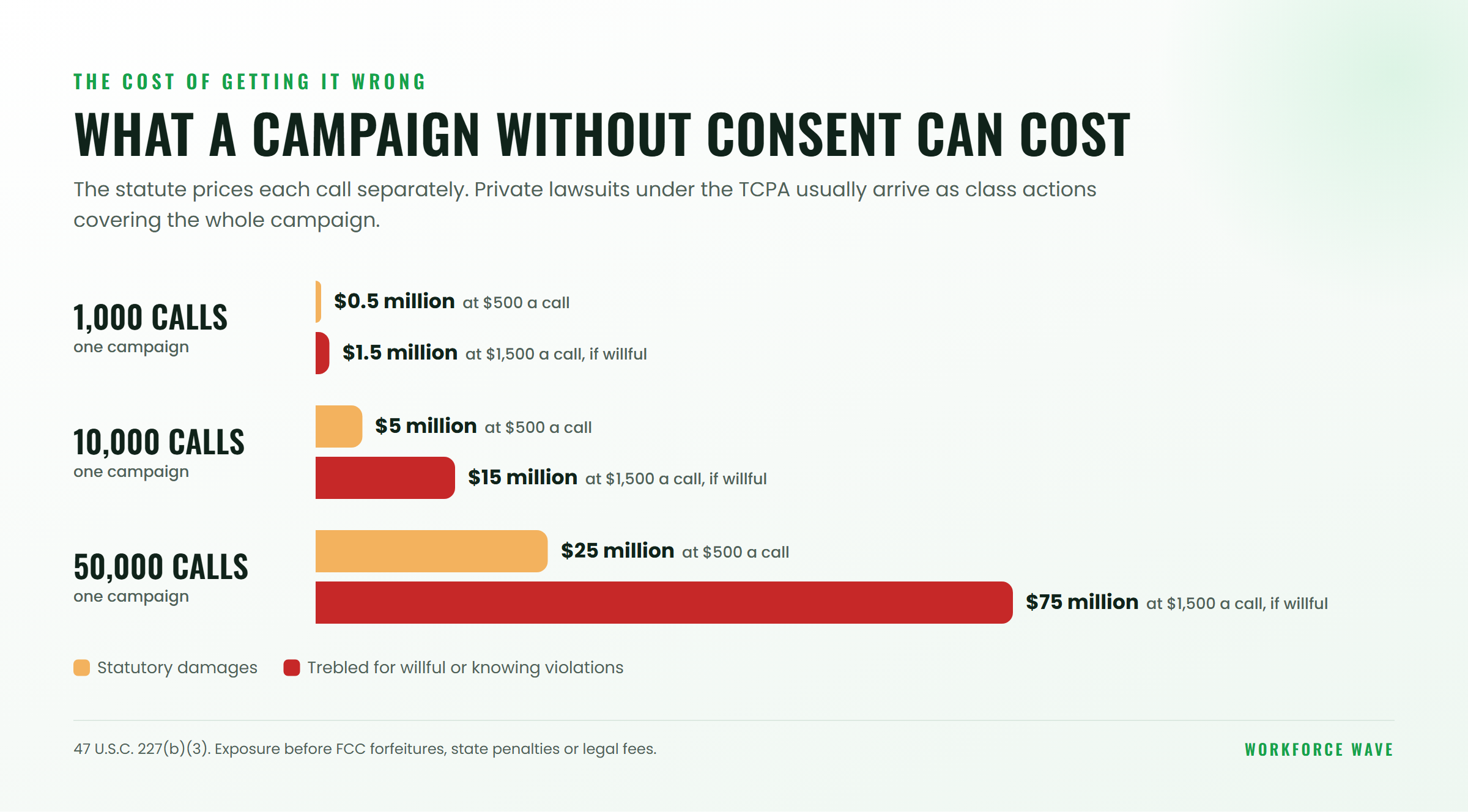
The law also prices consent failures per call. A private lawsuit under the TCPA carries $500 for each call made without proper consent, up to $1,500 if the violation was willful, and these cases usually arrive as class actions that cover the entire campaign.
The FCC priced its case against Telnyx the same way. It took the 1,797 calls, applied $2,500 to each, and arrived at $4,492,500. It considered raising the amount because the calls impersonated a government agency and declined to, citing Telnyx's prompt report of the calls. The arithmetic is the lesson. Nobody has to prove a campaign hurt anyone in particular. They count the calls.
If you're the business: if you can't produce a consent record for a number, of the right type, with its date and wording, don't call it. "The lead vendor said they opted in" is not a record.
If you're the agency: ask to see the consent language and a sample of records before you build anything. A list you didn't vet becomes your problem the moment your platform dials it.
Caution 3: Responsibility runs up the chain
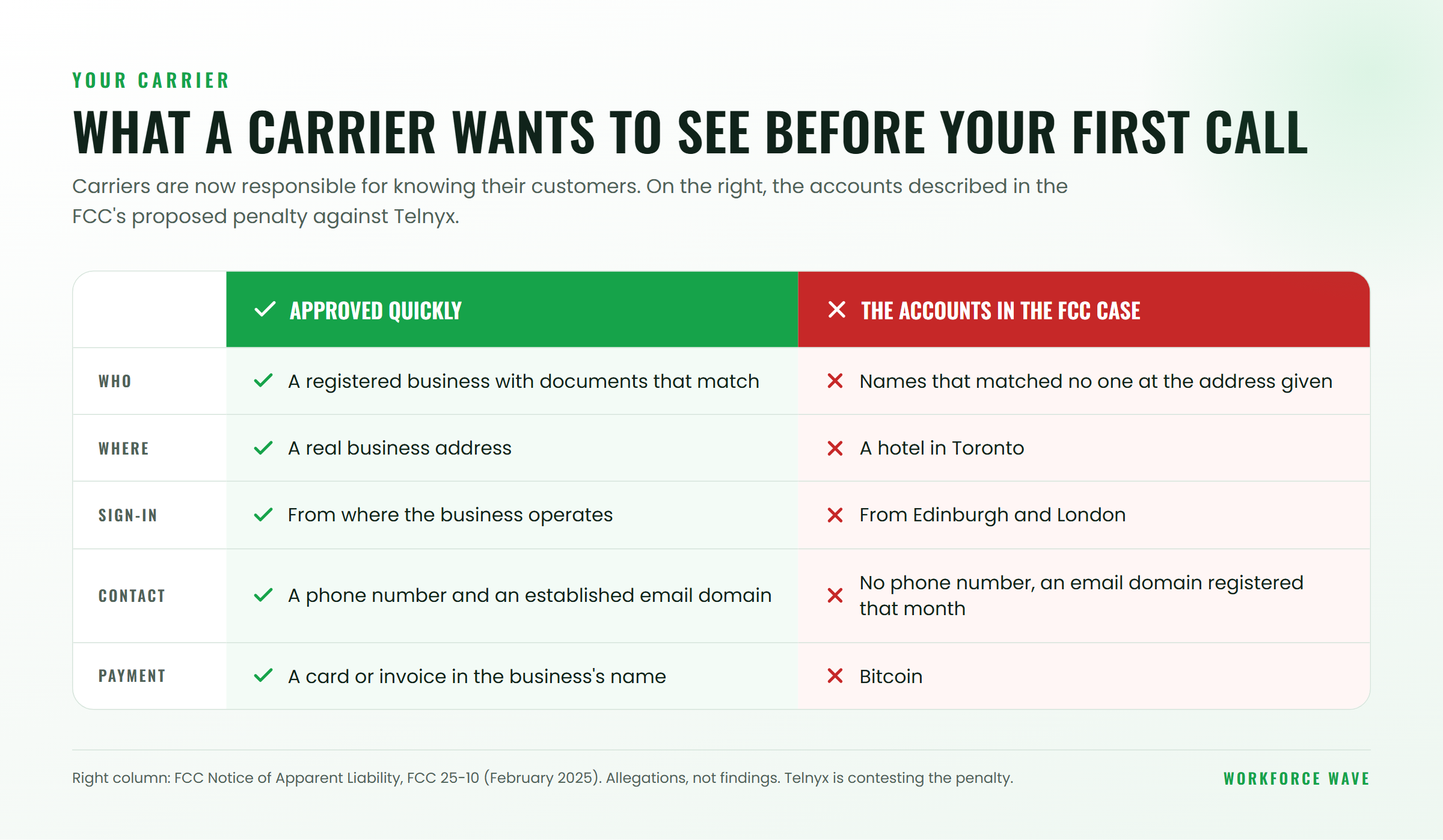
The most striking thing about the Telnyx case is who the FCC went after. The people who placed the calls signed up under false names, from IP addresses in Edinburgh and London, and paid in Bitcoin. The FCC could not identify them. So it proposed a penalty against the company whose network the calls started on, for failing to know its customers well enough to stop them.
That pattern is not limited to carriers. Liability for an illegal outbound call can land on everyone who helped place it:
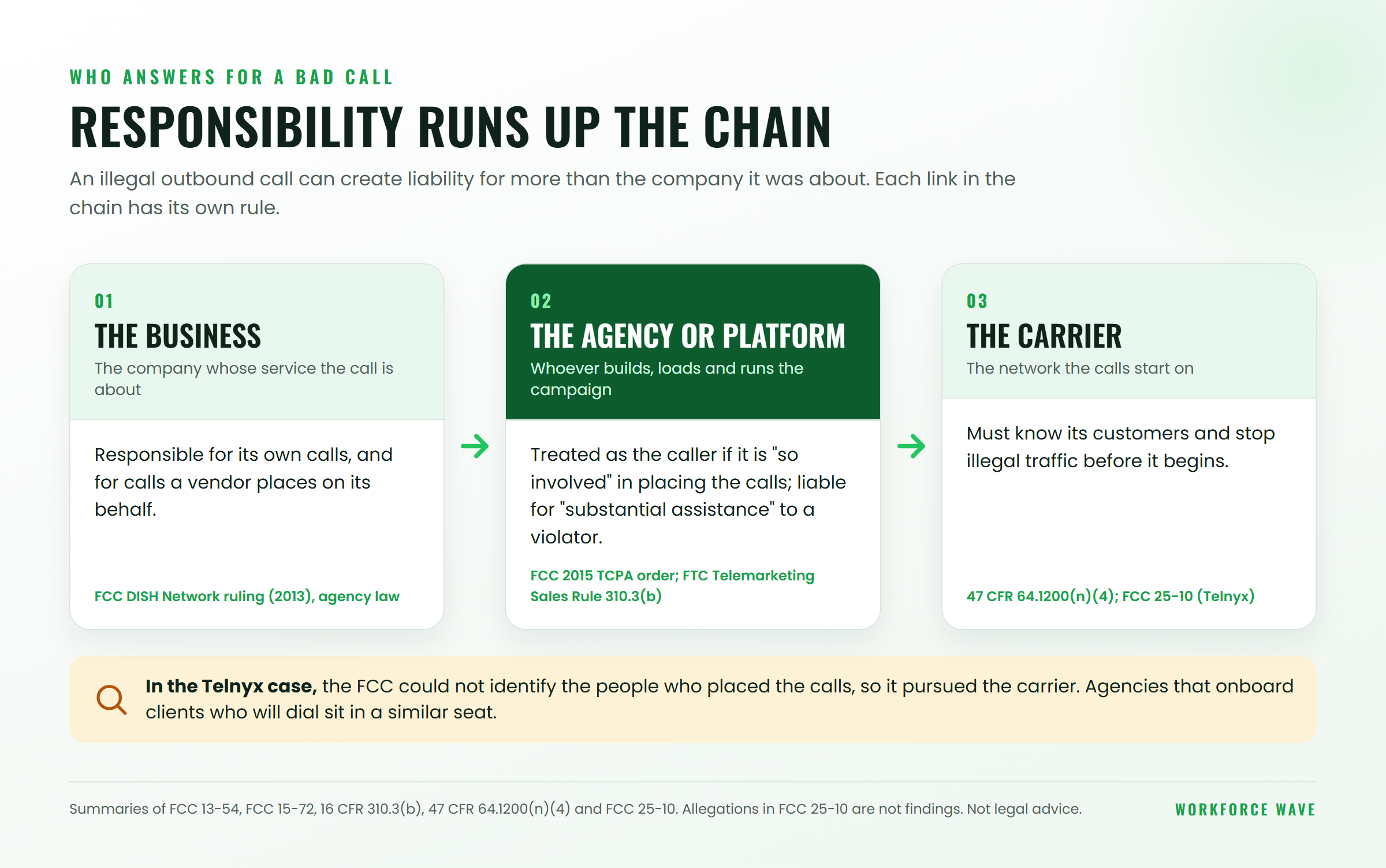
- The business whose products are promoted is responsible for its own calls, and can be held responsible for calls a vendor makes on its behalf. The FCC said so in a 2013 ruling involving DISH Network, applying ordinary principles of agency law.
- The agency or platform that runs the campaign can be treated as the caller itself if it is "so involved in the placing of a specific telephone call" that it effectively made it, the standard the FCC set out in 2015 and has used against a robocall platform. Under the FTC's Telemarketing Sales Rule, anyone who gives "substantial assistance" to a telemarketer while knowing, or consciously avoiding knowing, that the telemarketer is breaking the rule can be liable too.
- The carrier has its own duty to know its customers and stop illegal traffic, which is the duty the Telnyx notice says was missed.
If you're the business: hiring an agency doesn't move the risk off your books. Ask the agency how they check consent, honor opt-outs and keep records, and get it in the contract.
If you're the agency: you sit in the same seat Telnyx sat in, onboarding customers who will dial. Know who your client is, what they're calling about and where their list came from, before the first campaign. "We just provide the software" is a weak defense when your team wrote the script, loaded the list and pressed start.
Caution 4: The network can't tell you from a scammer
Look at a new outbound campaign from the phone network's side. An account opened recently starts placing hundreds of calls an hour with a synthetic voice that asks people to press one. That describes the impostor scam. It also describes a perfectly legitimate AI campaign on its first night. What separates the two is entirely paperwork and configuration, and none of it is visible on the wire.
Carriers have responded the only way they can, by asking for that paperwork up front. Telnyx's online reviews are mostly positive, but one complaint keeps coming up: strict identity checks, verification that takes days, and accounts locked until the owner submits a government ID. Read alongside the FCC's notice, that friction makes sense, and it is spreading across the industry.
Even approved campaigns can run into the network's defenses. Analytics engines label numbers as "spam likely" based on call patterns, and once a number is labeled, answer rates collapse. Rotating through pools of fresh numbers to stay ahead of the labels, a practice the industry calls snowshoeing, is exactly what bad actors do, and carriers treat it that way.
If you're the business: expect a week, not a day, to get outbound calling approved, and have your business documents, use case, sample scripts and consent method ready.
If you're the agency: don't run one client's campaign on numbers registered to you or to another client. Use numbers the client controls, registered with full caller ID attestation and with the analytics providers, so one campaign's reputation never bleeds into another's.
Caution 5: "Stop" has a deadline
People can withdraw permission any reasonable way they like, and "please stop calling me" said to an AI agent counts. The business then has ten business days to honor it everywhere, on top of the Do Not Call rules that already apply to sales calls. New FCC rules taking effect November 25, 2026 let a caller designate one clearly disclosed method for opting out, and narrow how far an opt-out from informational calls reaches. They don't relax the basic duty.
For AI campaigns, this is where things quietly go wrong. The agent hears the request, says something polite, and the request ends up in a transcript nobody reads. The next campaign dials the same number. Each of those calls is a fresh violation.
If you're the business: ask to see exactly where an in-call opt-out goes, and how fast it reaches every list you call from.
If you're the agency: make opt-out capture part of the build, not the prompt. Log it as data, sync it the same day, and test it before launch the way you'd test a booking.
Caution 6: The rules are still moving
Outbound AI calling is regulated by rules that changed several times in the last three years and are still changing. An FCC proposal to require AI disclosure at the start of every AI-generated call has been pending since 2024. A federal appeals court struck down a major consent rule for lead generators in January 2025. In June 2025 the Supreme Court told federal judges they don't have to follow the FCC's reading of the TCPA, which makes the outcome of private lawsuits harder to predict. A growing list of states, California, Maine and Utah among them, have their own AI disclosure rules.
The Telnyx case sits in the middle of that movement. Telnyx is contesting the penalty, and one of its arguments was that the FCC can't impose fines this way without a jury trial. In June 2026 the Supreme Court rejected that argument in a separate case, FCC v. AT&T, ruling 8 to 1 that the FCC's process stands because a company can still contest a fine in federal court. As of this writing we found no final order in the Telnyx matter. What the ruling does settle is that FCC fines over calls remain a live risk.
If you're the business: treat any outbound program as something to review at least yearly, and whenever you add a state.
If you're the agency: build to the strictest version of the rules, not the most current one. Disclosing AI on every call in every state is easier to run than fifty different scripts, and it's where the law is heading.
What Telnyx says
The account of that night above comes from the FCC's Notice of Apparent Liability (FCC 25-10), which is a proposal and a set of allegations, not a finding. In its February 2025 response, Telnyx said it uses industry best practices against bad actors and often goes beyond what the law requires, that a sophisticated scammer slipping briefly past its controls does not mean it broke the rule, and that the rule asks for effective measures, not perfection. The FCC itself credited Telnyx for disclosing the calls promptly, and one commissioner dissented from the proposal on constitutional grounds.
A note on our interest. Telnyx sells voice AI agents, and so do we. We name it here because the FCC did, in a public enforcement action that is now the leading example of what these rules mean in practice. Nothing here goes beyond what the FCC alleged and what Telnyx said in its own defense.
Where we stand
We place outbound calls for clients, and we run ringless voicemail campaigns, which the FCC also treats as calls. Every caution in this piece applies to us.
Here is the part that costs us business. Most companies that ask us for an outbound AI agent should not start with one. If you can't produce a consent record for each number on your list, an outbound campaign is the most expensive thing you can buy. The better first project is usually an agent that answers your phone, with outbound follow-up only to people who have asked to hear from you. When we do run outbound, the agent names the business and says it's an AI assistant in its first sentence, in every state, whether or not that state requires it yet. We check the consent and the list before we build, and we turn work down when the paperwork isn't there.
The guide
Everything above, turned into a working reference: the consent levels, what the agent has to say (with sample calls you can play), opt-out rules, calling hours, carrier vetting, how to build compliance into the agent, a section for agencies that run campaigns for clients, seven scenarios to test yourself on and a printable checklist.
Read The Outbound AI Call Compliance Guide.
This article describes a pending enforcement matter based on the FCC's public notice and Telnyx's public response. Allegations in a Notice of Apparent Liability are not findings of a violation. Nothing here is legal advice.
Related Case Studies
The Outbound AI Call Compliance Guide
How to place outbound calls with AI voice agents and stay inside FCC, TCPA and state rules, explained with pictures, sample calls, a decision guide, a section for agencies, seven quick scenarios and a printable checklist.
The Pause: Voice AI Latency After a Year of Production Calls, and the Price of Full Duplex
Voice agents got much faster in a year, and their slowest turns improved most. What production data shows about latency today, and what an agent would give up to talk while it listens.
Around the World in 80 Languages
One voice speaks 80 languages following the sunrise. Then two agents chase it again, switching between Hindi, Russian and Japanese every three words.