
Case Study
The Pause: Voice AI Latency After a Year of Production Calls, and the Price of Full Duplex
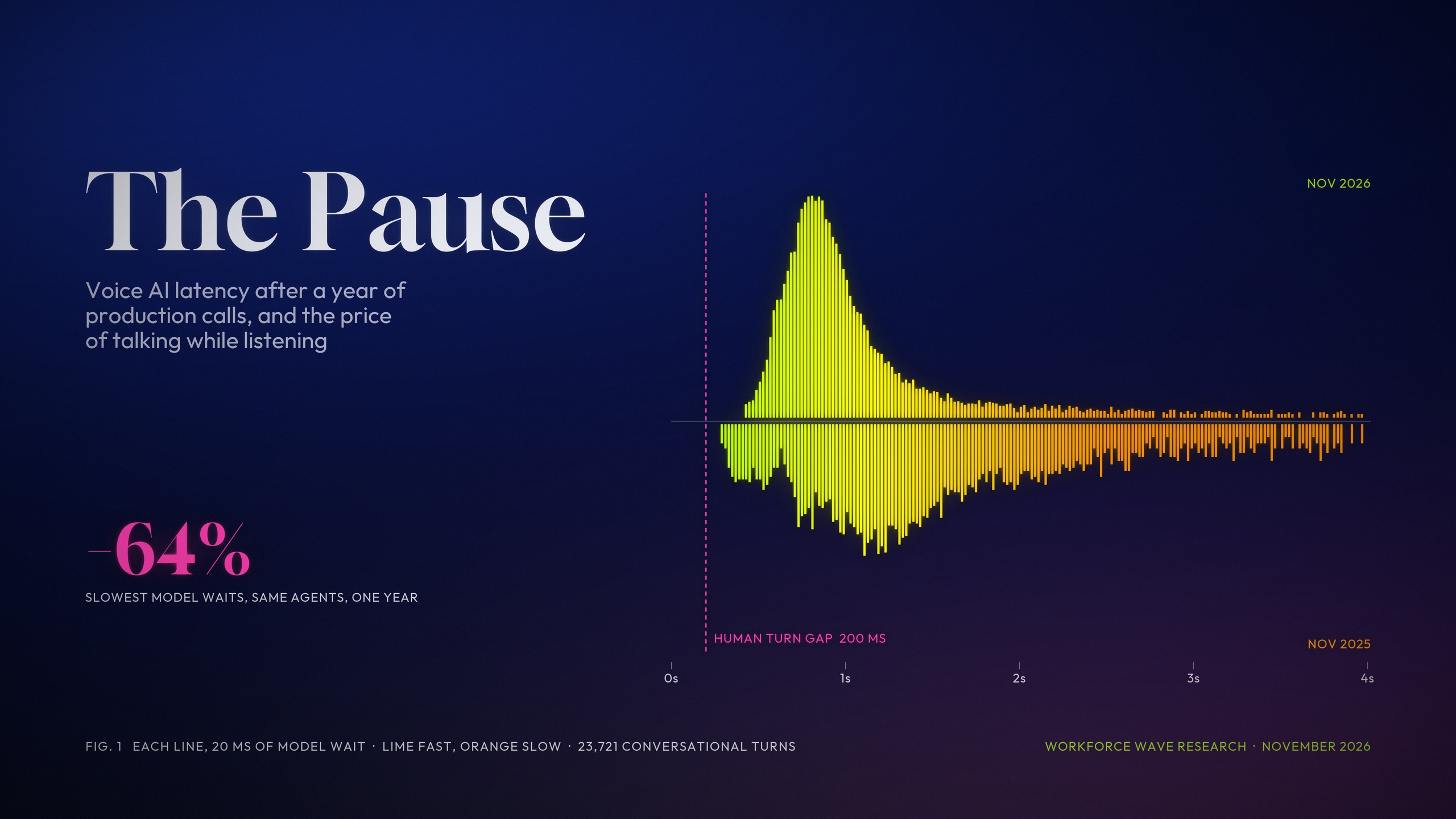
Voice agents got much faster in a year, and their slowest turns improved most. What production data shows about latency today, and what an agent would give up to talk while it listens.
Your brand doesn't just use voice agents—it casts them.
Open the Workshop — Get a CallAbstract
Background. In November 2026 Nuance Labs released Emma, an AI video persona built on a full-duplex model that listens and speaks at the same time. Launch coverage argued that timing, more than realism, is what holds voice AI back. Public discussion of voice agent latency mixes vendor component figures with caller experience, and almost no production data has been published.
Methods. We compared per-turn timing logged by a commercial voice platform for production AI voice agents during November 1 to 9, 2025 and November 1 to 9, 2026, alongside a monthly series from June 2025. We analyzed conversational turns only, excluding the opening greeting and any turn that called a tool. The primary comparison used the 12 agents active in both windows. We then reviewed public benchmarks and 2026 research on full-duplex speech models.
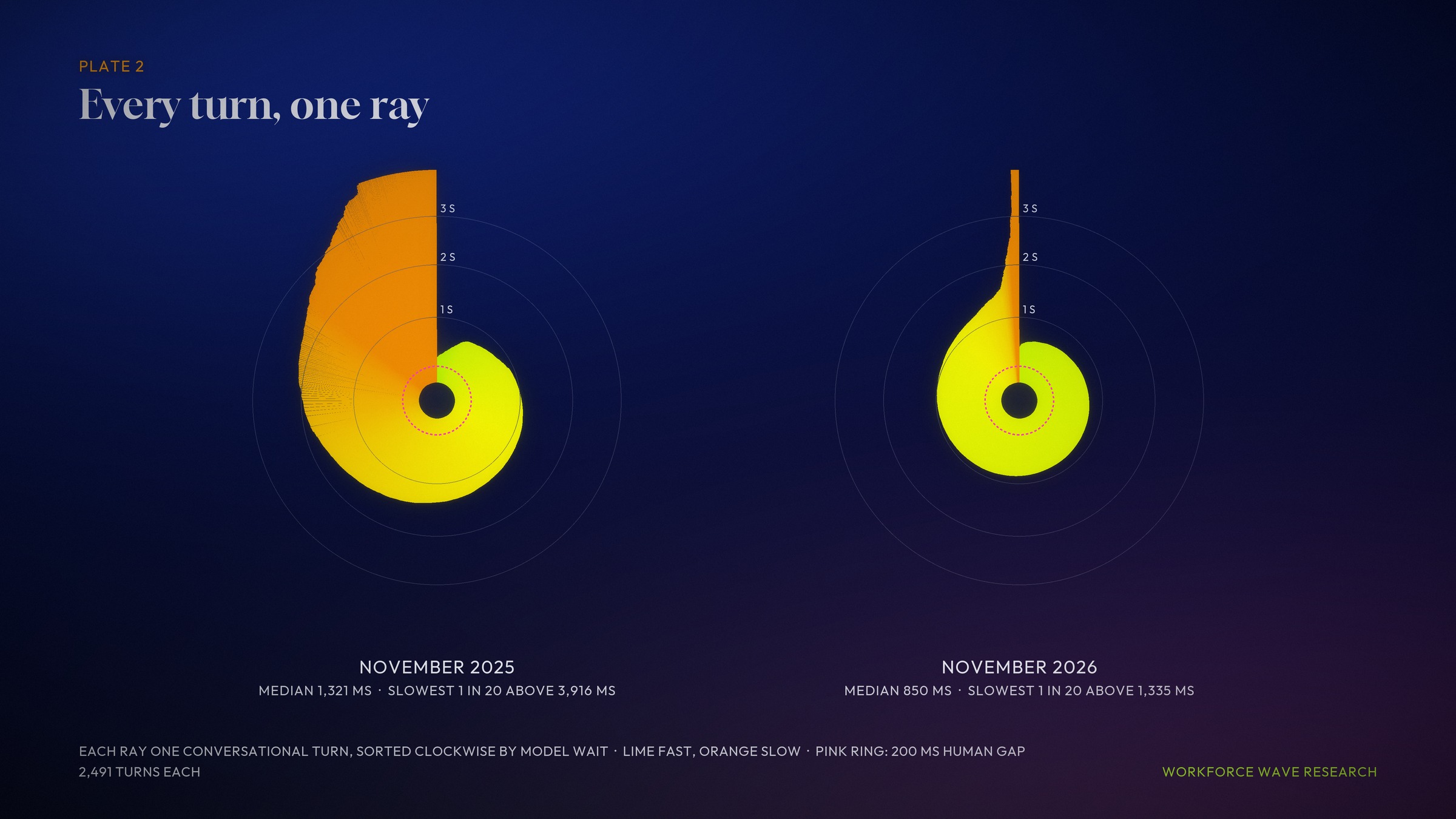
Results. For the same 12 agents, median language-model wait fell from 1,277 ms to 856 ms (33%), and the 95th percentile fell from 3,819 ms to 1,383 ms (64%). Median speech-synthesis wait fell from 255 ms to 99 ms. Across the fleet in 2026, the platform waited a median of 320 ms of silence before deciding a caller had finished. Turns with longer model waits were not followed by more hang-ups, and the share of turns the caller talked over did not rise with wait time. Independent phone-call benchmarks still place the full wait a caller hears at 1.3 to 1.8 seconds, against a human norm near 200 ms.
Conclusions. Voice agents got much faster in a year, and the largest gain was in the slowest turns. The remaining gap to human timing sits in turn detection, the language model and the network, and closing it with full-duplex models currently costs reasoning depth, reliable tool use, script adherence and auditability. Over the next one to two years we expect hybrid systems that pair a duplex front end with a conventional reasoning back end.
1. Introduction
Nuance Labs, a company founded by former Apple researchers and reported to have raised more than $50 million, introduced Emma in November 2026 [1, 2]. Emma is a video persona that nods, reacts and starts answering while the other person is still talking. The company reports that on 1,785 questions drawn from its own recordings of real conversations, Emma's reply timing overlapped the original human speaker's 89% of the time, against 35% for the next closest system [1]. A widely shared post about the launch summed up the reaction: the demo looks real, and realism was never the bottleneck, timing was.
That claim invites three questions for anyone who runs voice agents in production. How slow are voice agents today, measured where the caller sits? How much faster did they get over the past year, and why? And what would a production agent give up if it tried to work the way Emma does?
This paper answers the first two with a year of production data from a fleet of AI voice agents that answer telephone calls for businesses and public agencies, set against independent benchmarks. It answers the third from the 2026 research literature on full-duplex speech models and from the limits Nuance Labs itself publishes.
2. Two clocks
2.1 The human benchmark
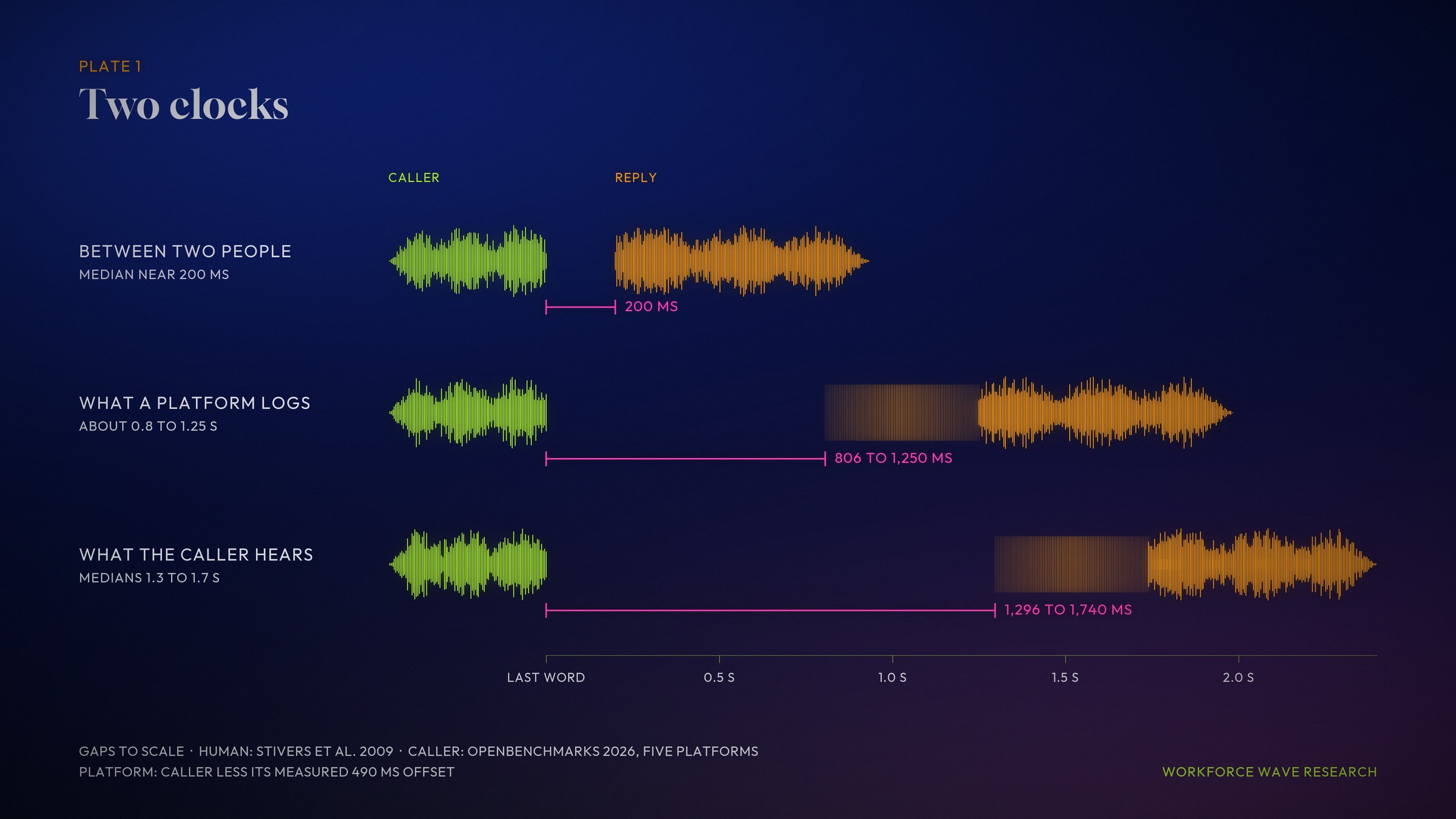
People take turns in conversation remarkably fast. A study of ten languages on five continents found median gaps between a question and its answer of 0 to 300 ms, with most languages near 200 ms [3]. Corpus studies of Dutch, English and Swedish put the median gap between speakers at 110 to 130 ms [4]. Because producing even a short reply takes longer than that, listeners must plan their answer while the other person is still talking. A gap of 200 ms is therefore the result of overlapping listening and planning, and a system that waits for silence before it starts thinking cannot reach it.
2.2 What a voice agent turn is made of
Most production voice agents run a cascade. The system listens until it decides the caller has finished (endpointing), converts speech to text, sends the text and conversation history to a language model, and streams the model's first sentence into a speech synthesizer. Each step adds time, and so do the network legs between the caller's phone, the telephony provider and the voice platform.
2.3 The vendor's clock and the caller's ear
Headline latency figures usually describe one component. One speech-synthesis vendor reports a median time to first speech near 150 ms for its newest fast model [5], and speech-to-speech APIs launched in 2026 report 570 to 620 ms to first audio [6]. These are real measurements of a part of the system, with the network removed.
The only independent benchmark we found that measures the whole wait, from the caller's last word to the first sound the caller hears over a real phone call, reported medians of 1,296 ms to 1,740 ms across five commercial voice agent platforms, with 95th percentiles of 1,768 ms to 2,259 ms [7]. The same benchmark found that the latency a platform reports for itself runs about 490 ms below what the caller hears, because the platform starts its clock after it has detected the end of speech and stops it when audio leaves its servers. Neither figure is wrong. They answer different questions, and only one of them describes the caller's experience.
3. Methods
3.1 Data source
Workforce Wave builds and operates AI voice agents that answer inbound telephone calls. All agents in this study run on one commercial voice platform that logs timing for each agent turn: the time to the language model's first token, the time to its first complete sentence and the time to the synthesizer's first audio. From June 2026 the platform also logged how long it waited in silence before starting a turn and how long final speech recognition took.
3.2 Windows and inclusion
We compared two matched windows, November 1 to 9 of 2025 and of 2026, so that day-of-week and seasonal patterns were the same. The 2025 window contained 476 calls to 23 agents and the 2026 window 3,814 calls to 63 agents. We kept agent turns that followed a caller turn and excluded each call's opening greeting. We also excluded every turn in which the agent called a tool, such as a scheduling or record lookup, because those turns include waiting on an outside system. The analysis set contained 2,491 conversational turns in 2025 and 21,230 in 2026.
3.3 Same-agent cohort
The fleet grew between the two windows and its mix of business types changed. Our primary comparison therefore uses the 12 agents that took calls in both windows: 1,968 turns in 2025 and 8,486 in 2026. Fleet-wide figures are reported alongside.
3.4 Measures
We report the median and the 95th percentile of each timing measure. The 95th percentile is the wait on the slowest one turn in twenty, which a caller in a five-minute call will usually meet at least once. We also report the share of agent turns the platform marked as interrupted, meaning the caller began speaking while the agent was talking, and the share of agent turns after which the caller left the call without the agent having said goodbye.
3.5 Privacy
Only timing fields and turn metadata were analyzed. No caller numbers, identities or recordings were used, and no client organization is named.
4. Results
4.1 One year, the same agents
For the 12 agents active in both windows, every measured stage got faster (Table 1). The median wait for the language model's first token fell by a third. The 95th percentile fell by almost two-thirds, from 3.8 seconds to 1.4 seconds. Speech synthesis, already fast in 2025, fell to a median of 99 ms, below the 200 ms human turn gap. The share of turns the caller talked over fell from 16.2% to 11.6%.
| Measure | 2025 | 2026 | Change |
|---|---|---|---|
| Model first token, median | 1,277 ms | 856 ms | −33% |
| Model first token, 95th percentile | 3,819 ms | 1,383 ms | −64% |
| Model first sentence, median | 1,312 ms | 1,015 ms | −23% |
| Speech synthesis first audio, median | 255 ms | 99 ms | −61% |
| Speech synthesis first audio, 95th percentile | 447 ms | 205 ms | −54% |
| Turns the caller talked over | 16.2% | 11.6% | −4.6 points |
| Conversational turns | 1,968 | 8,486 |
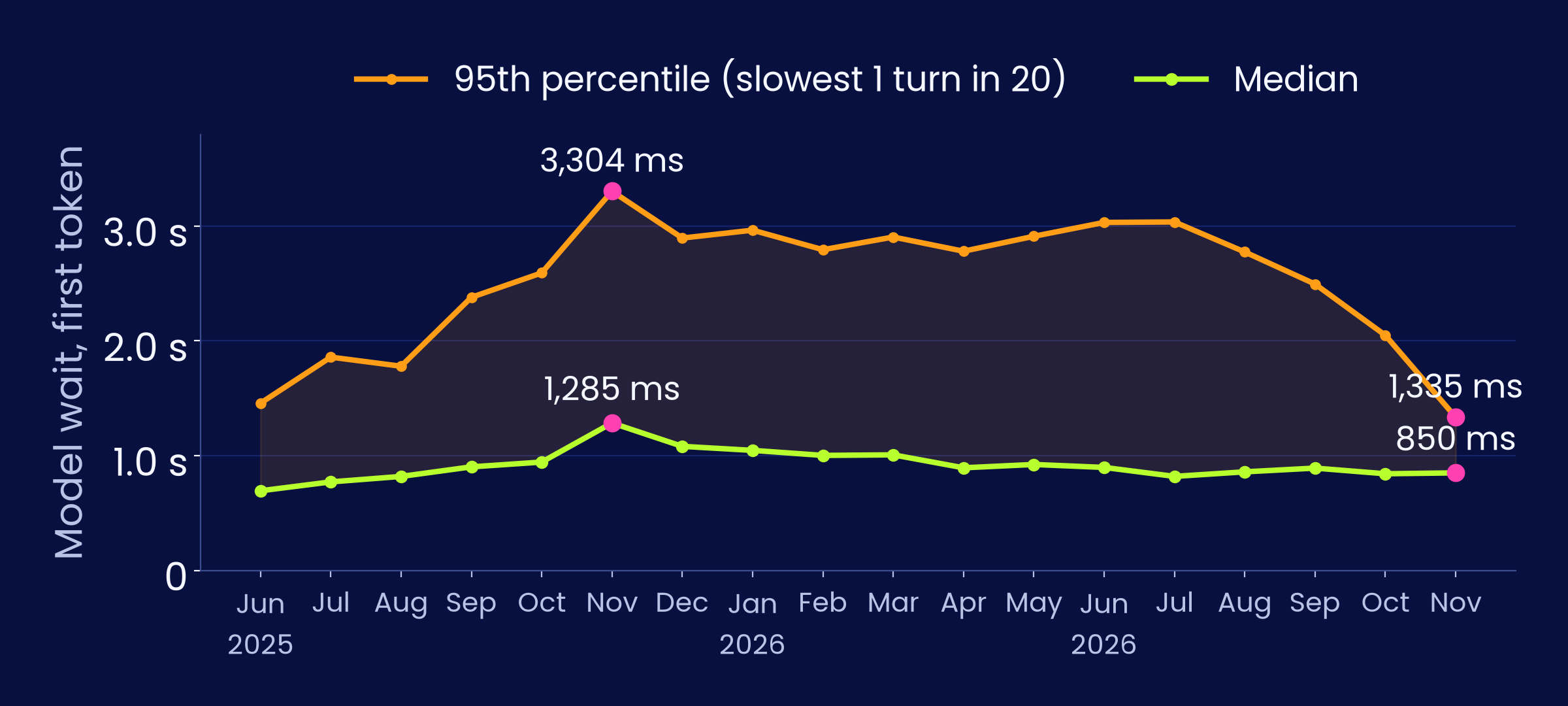
The whole fleet moved the same way. Median model wait fell from 1,321 ms to 850 ms and the 95th percentile from 3,916 ms to 1,335 ms, across 23 agents in 2025 and 63 in 2026.
4.2 The path between the two Novembers
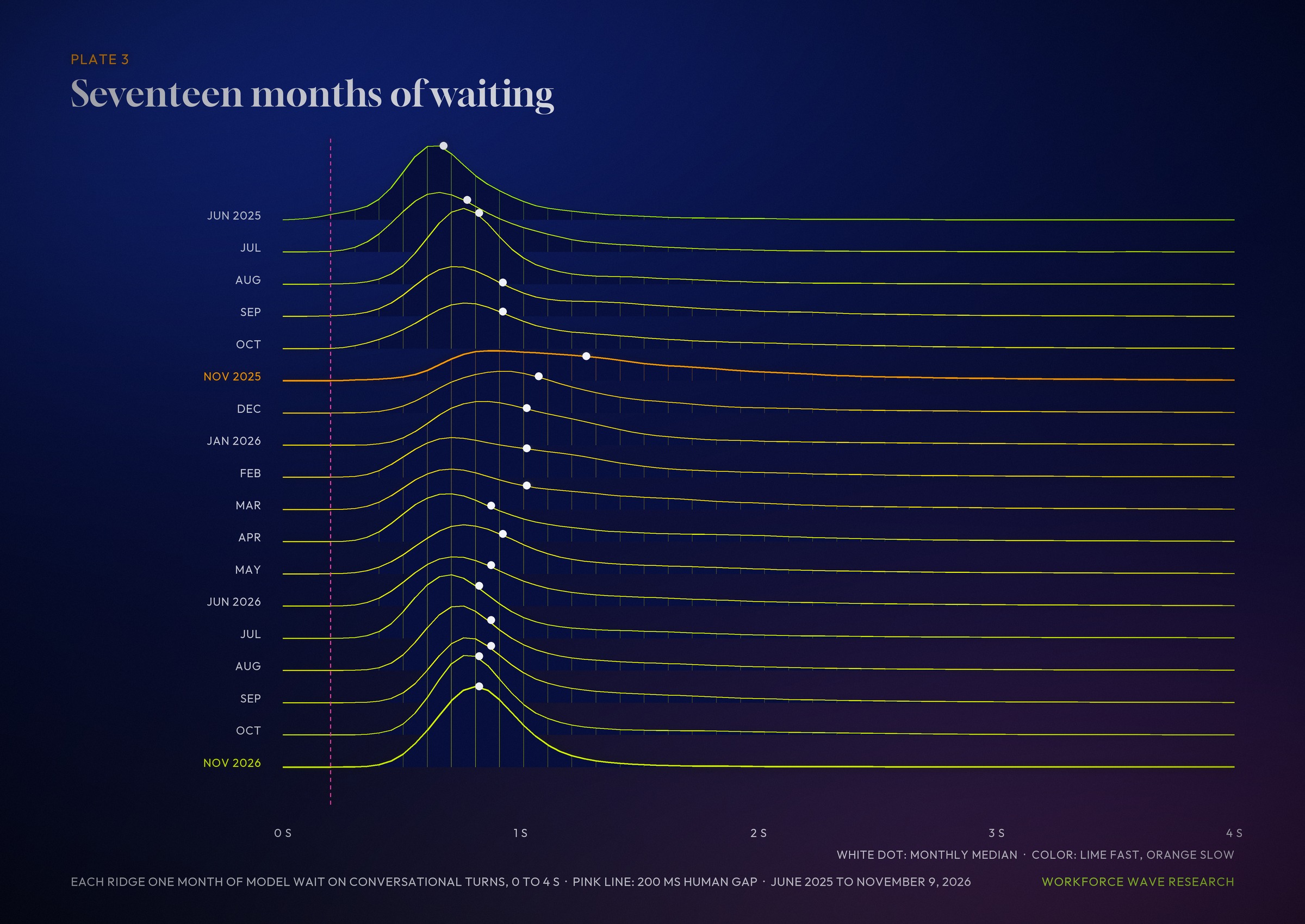
The improvement was not a steady slope (Figure 1). Median model wait was lower in mid-2025 than in November 2025. It rose through the autumn of 2025 as many agents in the fleet moved to a new generation of reasoning-tier models that were more capable and slower to start, and it fell through 2026 as faster versions of those models arrived and agents were moved back to fast models where the extra reasoning was not needed. In the November 2025 window, agents running GPT-5 waited a median of 1.80 seconds for a first token, while agents running Claude 3.7 Sonnet waited 0.84 seconds and Gemini 2.5 Flash-Lite 0.51 seconds (all agent turns). The choice of model moved latency more than any change in the platform did.
The slow tail followed a different path from the median. The 95th percentile peaked at 3.3 seconds in November 2025, held between 2.5 and 3.0 seconds for most of 2026, and then fell to 2.0 seconds in October and 1.3 seconds in the first nine days of November. Most of the improvement in the slowest turns is therefore recent, and a longer window will show whether it holds.
4.3 Where the time goes now
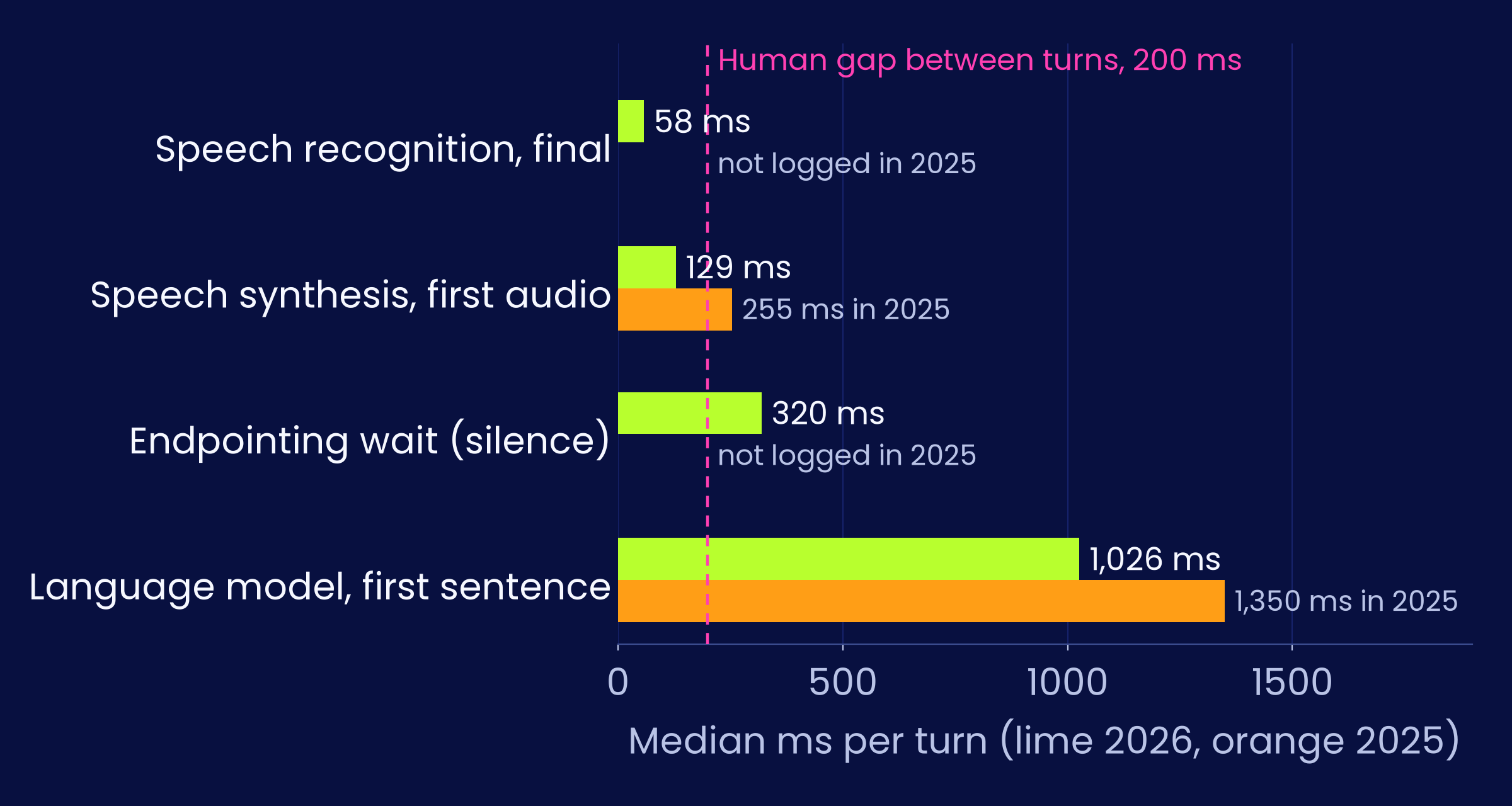
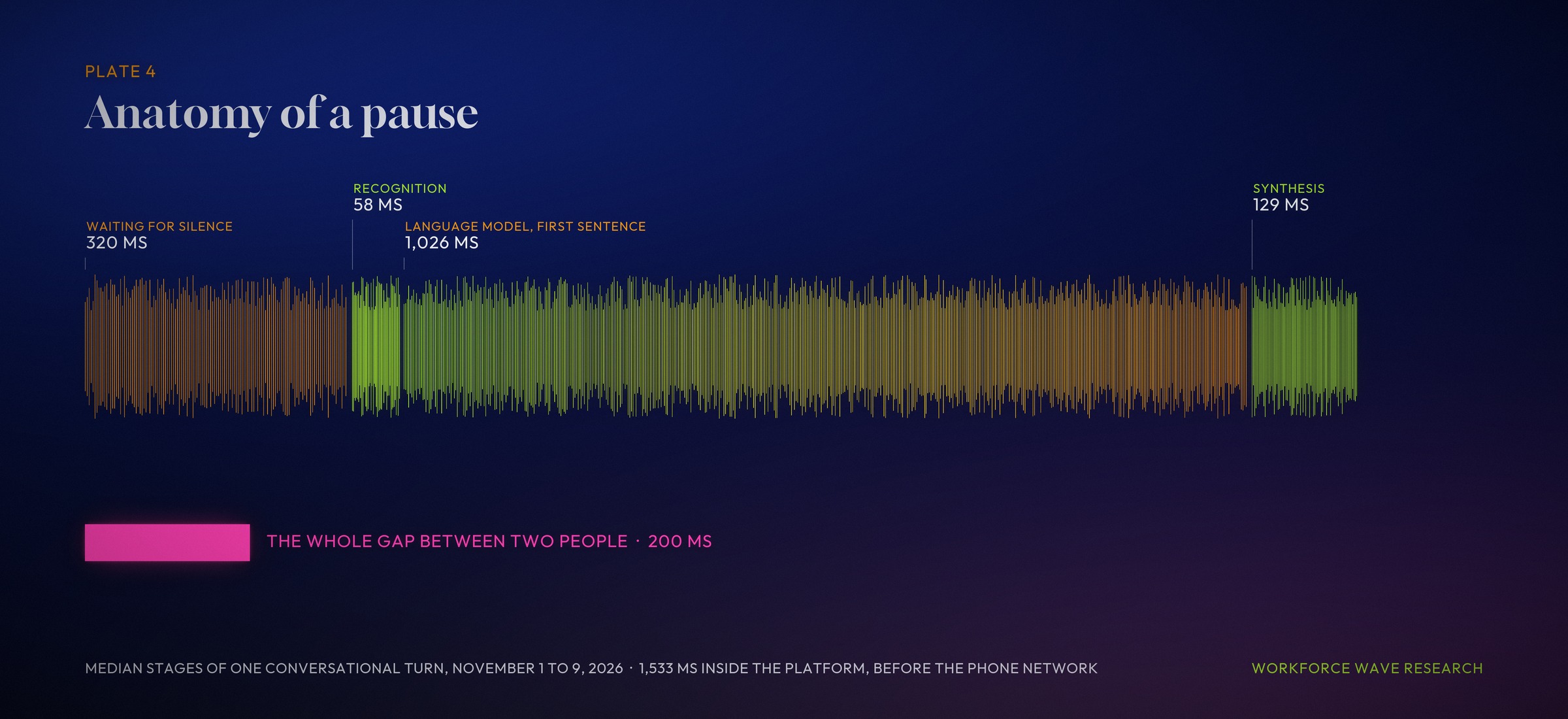
In 2026 the fleet logged each stage of a turn, which shows where the remaining wait sits (Figure 2). Final speech recognition took a median of 58 ms and speech synthesis 129 ms. The platform waited a median of 320 ms of silence before treating the caller as finished, and on the slowest one turn in twenty it waited more than two seconds, often because the caller paused mid-thought. The language model's first sentence took a median of just over one second and remains the largest single stage. Speech synthesis is no longer the constraint it was. Endpointing and the language model are.
4.4 Does waiting drive callers away?
The launch commentary that prompted this paper asked where callers drop off. We grouped 433,875 conversational turns from July 1 to November 9, 2026 by how long the language model took to respond (Figure 3). Callers left without a goodbye after 3.9% of turns with a model wait under one second and after 3.3% of turns with a wait over three seconds. Callers saying only "hello?" or "are you there?" after the agent spoke was rare in every group, at 0.1% to 0.4% of turns.
The share of turns the caller talked over moved the other way from what a pure latency story predicts. It was highest, 14.1%, when the model answered in under a second, and 6.4% to 7.4% when it took two seconds or more. Grouping turns by the endpointing wait instead showed no trend, with talk-over between 10.0% and 14.6% across every range. Much of this overlap is ordinary conversation: callers adding a detail, correcting themselves or saying "okay" while the agent is speaking. A cascade treats each of those as an interruption.
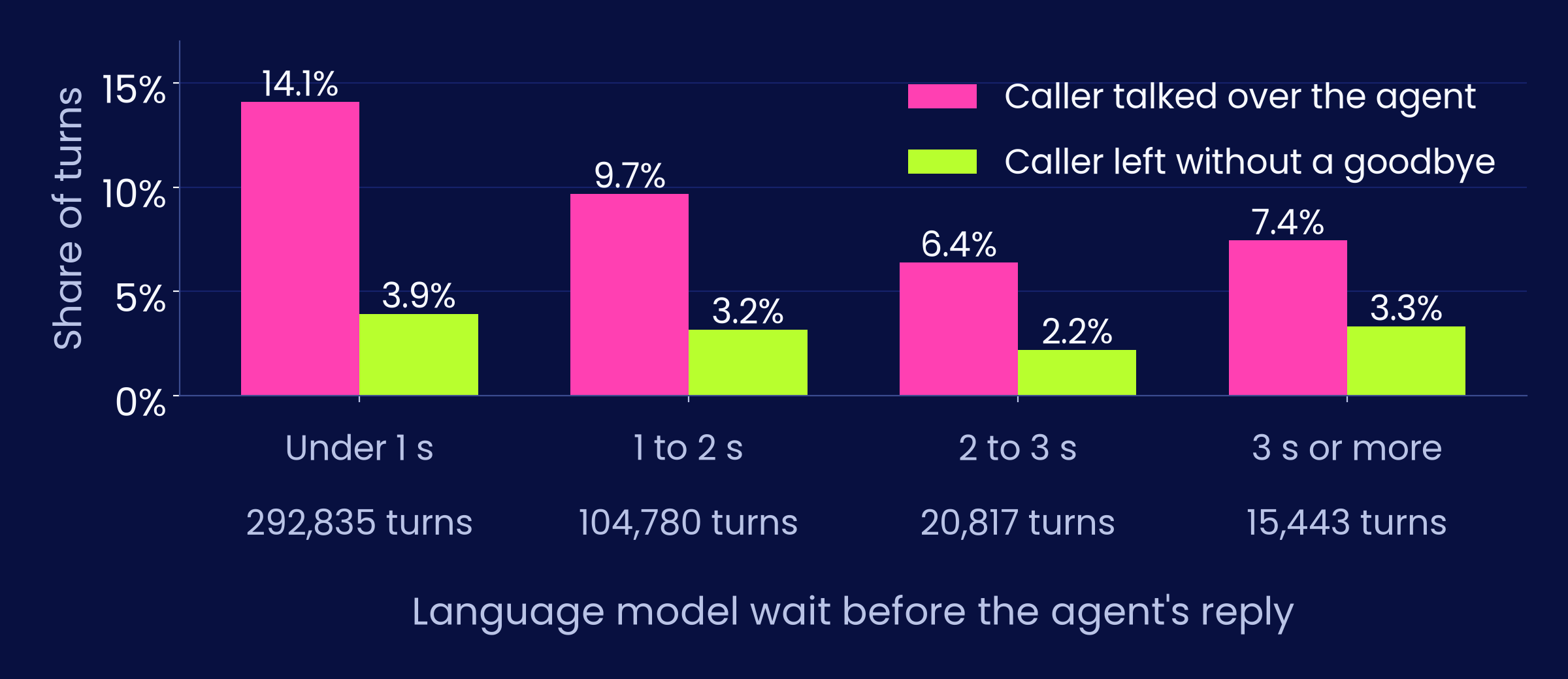
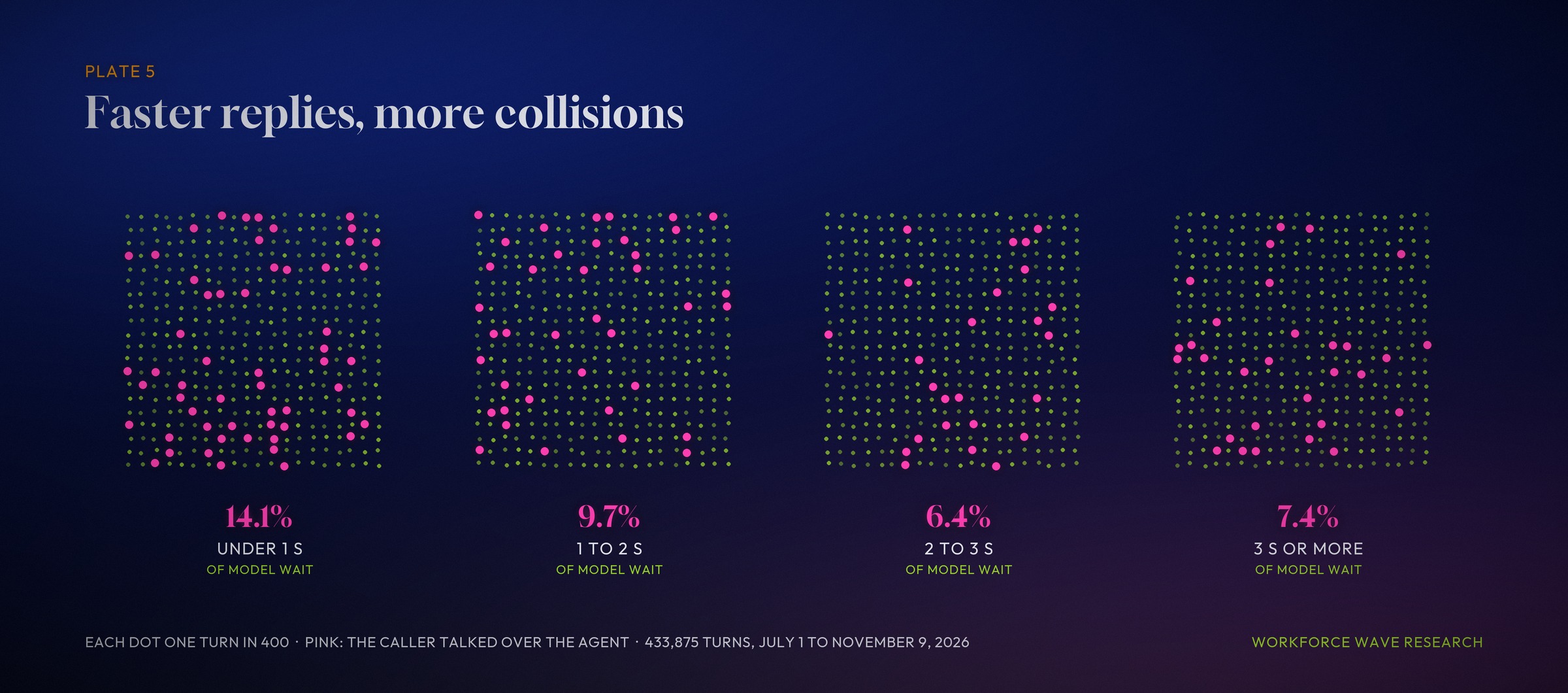
These are associations, and faster turns differ from slower ones in other ways. Within the range this fleet now operates in, they suggest that further cuts to raw speed will do less for callers than better handling of overlap, which is the problem full-duplex models are built to solve.
5. The price of talking while listening
A full-duplex model processes the caller's audio and its own speech as continuous parallel streams, so it can backchannel, yield when interrupted and start answering before the caller has finished [8]. Kyutai's Moshi introduced the design in 2024, NVIDIA's PersonaPlex added control over role and voice in January 2026, and NVIDIA's VoiceChat added native tool calling in September 2026 [8, 9, 10]. Nuplex, the model behind Emma, belongs to this family. The 2026 literature and Nuance Labs' own published limits point to seven costs that a production voice agent would carry if it adopted the design today.
5.1 Reasoning depth
Open duplex models are built on language models of about 7 billion parameters, far smaller than the models production agents now use for reasoning [9]. Nuance Labs states plainly that Emma's reasoning comes from a language model and that she can make confident mistakes [1].
5.2 Knowledge and context
Audio-native models spend context on sound. Moshi-family models tokenize audio at 12.5 frames per second, so background knowledge, account details and conversation history compete with the audio itself for the same context window [11]. A cascade passes text to a model with a context window of 128,000 tokens or more.
5.3 Tool use in the moment
When a duplex agent needs to check a calendar or look up a record, it hands the task off and keeps talking. Nuplex works this way, letting a persona pass longer tasks to the developer's tools in the background [1], and a 2026 architecture paper proposes the same delegation for open models [12]. The agent therefore speaks before it knows the answer. For booking, billing or eligibility lines, that is a meaningful change in what the caller hears and when.
5.4 Speaking up for the right reason
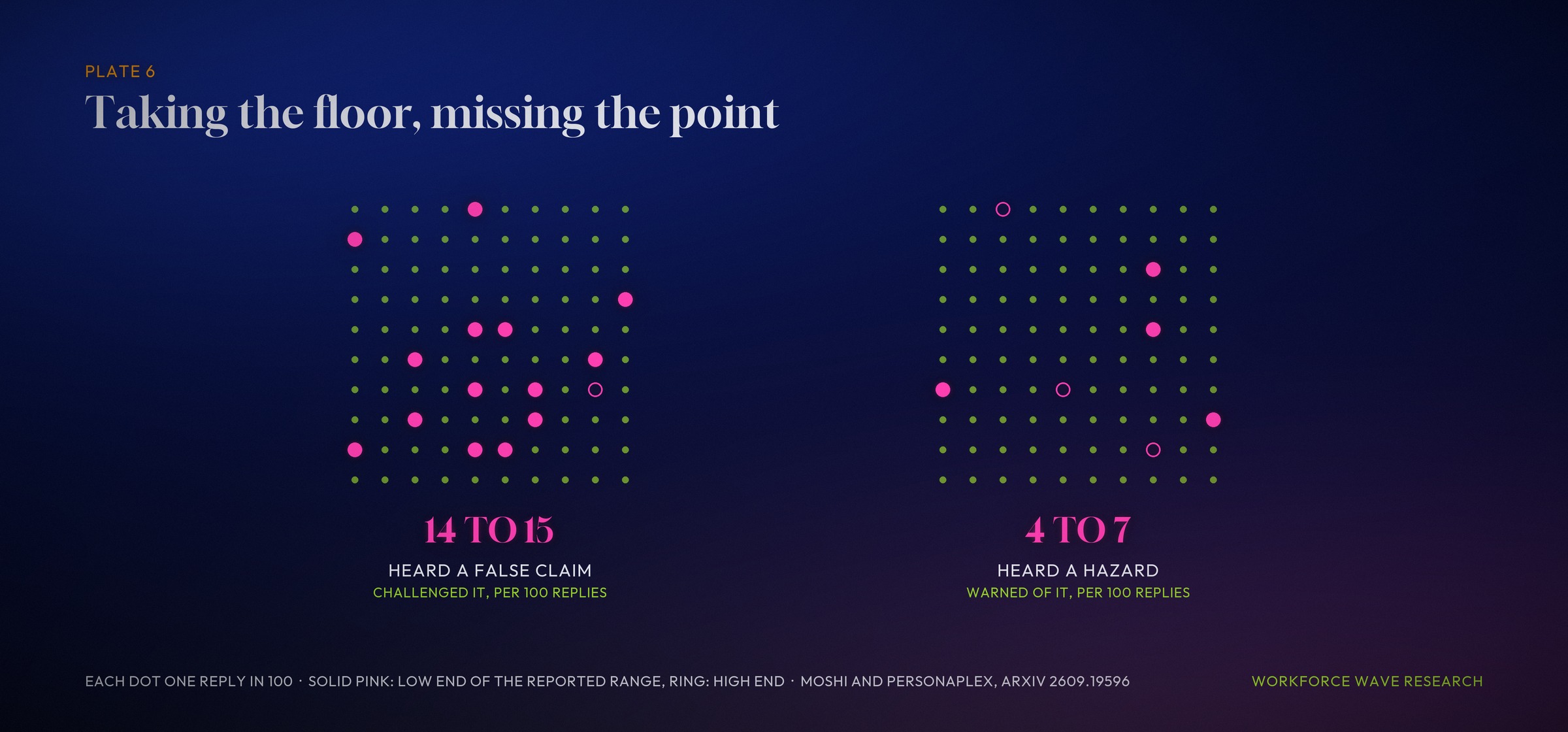
A September 2026 study tested whether duplex models take the floor when they should. Across five model families, being addressed and a pause in speech were far more reliable triggers than hearing something false or dangerous. Given the floor, Moshi and PersonaPlex answered most direct questions, but only 14% to 15% of replies to a false claim challenged it, and only 4% to 7% of replies to a described hazard warned of it [13]. Timing that feels human does not yet come with judgment about content.
5.5 Script and procedure
Many business lines must say specific things in a specific order: a recording disclosure, a consent question, every field of an intake. On an assistant benchmark, Moshi scored 1.26 of 5 for task adherence. PersonaPlex reports 4.34, a large improvement, on single-scenario tests published by its developer [9]. Multi-turn procedure, such as a complete intake over fifteen turns, has not yet been benchmarked for these models.
5.6 Noise and the telephone network
Nuance Labs reports that background voices, a television, speakerphone or a weak microphone make Emma's turn-taking worse, and that long mid-sentence pauses are its hardest case [1]. Telephone audio is narrower and noisier than a laptop microphone, so we expect duplex turn-taking to degrade further on phone lines, though no published study has measured it yet.
5.7 Auditability and regulated use
A cascade produces a text record of every turn that can be reviewed, searched and analyzed after the call, and each component can be tested and replaced on its own. Audio-native systems blur those seams. Nuance Labs has kept healthcare and anything involving minors out of its beta, and its service is unavailable in four US states [1]. Those are reasonable choices for a new technology, and they mark the territory where most production voice agents work today.
6. Outlook
The research community has largely converged on a hybrid design: an audio-native front end that handles timing, backchannel and interruption, connected to a text-domain back end that handles reasoning, retrieval, tools and rules [11, 12]. Two techniques make the combination practical. Semantic endpointing uses a model to judge whether a pause ends a thought, rather than waiting for a fixed silence. Speculative retrieval starts looking up likely answers from a live transcript while the caller is still speaking.
Our expectations for the next one to two years, stated as judgments, are these.
- Component latency will keep falling, and cascades on well-chosen models will settle near one second at the caller's ear.
- Duplex systems will reach production first where conversation is the product: companionship, coaching, language practice and entertainment.
- Transactional and regulated lines will adopt duplex behavior through hybrids, with a duplex layer managing the floor and a conventional agent deciding what to say and do.
- Buyers will start asking for caller-side latency at the 95th percentile, and for talk-over and recovery rates, alongside median component figures.
7. Limitations
This is an observational study of one operator's fleet on one voice platform. Timing comes from the platform's own logs, which measure from inside the platform and exclude the telephone network, so they understate the wait a caller hears. The fleet's composition and models changed between the two windows. The same-agent cohort reduces that problem but includes agents whose models and prompts were changed during the year, which is part of what the comparison measures. The 2026 window covers nine days, and most of the drop in the slowest turns arrived in the two months before it. The interruption flag counts any caller speech during an agent turn, including brief acknowledgments. The analysis of caller behavior shows associations, not causes. Section 5 relies largely on research published by model developers, much of it not yet independently reproduced, and on Nuance Labs' own description of Emma.
8. Practical implications
- Measure at the caller's ear. Ask vendors for the time from the caller's last word to the first sound the caller hears on a real phone call, and expect it to run about half a second above the platform's own figure.
- Manage the slow tail. Report the 95th percentile beside the median. In this fleet the tail improved twice as much as the median, and the tail is what a caller remembers.
- Choose the model for the line. Reserve slower reasoning-tier models for agents that need them. Model choice moved latency more than any other single factor in our data.
- Tune turn detection. Endpointing now costs more time than speech recognition and synthesis together, and a fixed silence threshold cannot tell a finished thought from a pause.
- Adopt duplex where conversation is the product. For booking, intake, billing and public-service lines, wait for hybrid systems that keep tool use, scripts and records intact.
Authors
Colin P. Highland and the Workforce Wave research team. November 2026.
Data availability
Aggregate tables and the analysis code are available from the authors on request. Turn-level data are not shared, to protect clients and callers.
Conflict of interest
The authors work for Workforce Wave, which builds and operates cascade-architecture AI voice agents and could be affected by a shift to full-duplex systems. The authors have no relationship with Nuance Labs. No external funding was received.
Suggested citation
Highland CP, Workforce Wave Research. The Pause: Voice AI Latency After a Year of Production Calls, and the Price of Full Duplex. Workforce Wave, November 2026.
References
- Nuance Labs. Meet Emma, the first Nuplex persona. November 2026. nuancelabs.ai
- Unite.AI. Ex-Apple researchers' Nuance Labs lands $50M Series A backed by Nvidia. unite.ai
- Stivers T, Enfield NJ, Brown P, et al. Universals and cultural variation in turn-taking in conversation. PNAS 106(26):10587-10592, 2009. EMCA wiki
- Heldner M, Edlund J. Pauses, gaps and overlaps in conversations. Journal of Phonetics 38(4):555-568, 2010. Summarized in Levinson SC, Torreira F. Timing in turn-taking and its implications for processing models of language. Frontiers in Psychology 6:731, 2015. frontiersin.org
- Tech Times. Eleven v4 shifts voice AI from reading to acting, Turbo hits sub-150ms latency. September 30, 2026. techtimes.com
- ExplainX. Eleven Realtime v1 Mini vs Max. October 2026. explainx.ai
- Openbenchmarks. Voice agent end-to-end latency, turn by turn. 2026. openbenchmarks.com
- Défossez A, et al. Moshi: a speech-text foundation model for real-time dialogue. arXiv:2410.00037, 2024. arxiv.org
- Roy R, et al. PersonaPlex: voice and role control for full duplex conversational speech models. NVIDIA, January 2026. research.nvidia.com
- NemotronLabs VoiceChat: an open full-duplex speech-to-speech model with tool calling capabilities. arXiv:2609.21967, 2026. arxiv.org
- Sopyła K. Speech-to-speech models in 2026: three architectural bets and what each actually gives you. 2026. ai.ksopyla.com
- A frontend-backend architecture for tool calls in full-duplex speech models. arXiv:2609.19334, 2026. arxiv.org
- Full-duplex speech models take the floor when asked, not when needed. arXiv:2609.19596, 2026. arxiv.org
Related Case Studies
Before You Dial: The Cautions of Outbound Voice AI Campaigns
Outbound AI calling is the fastest way to reach customers, and the fastest way to get sued, blocked or named in an FCC notice. Six cautions for businesses and voice AI agencies, told partly through the night 1,797 impostor robocalls put a carrier in front of the FCC.
The Outbound AI Call Compliance Guide
How to place outbound calls with AI voice agents and stay inside FCC, TCPA and state rules, explained with pictures, sample calls, a decision guide, a section for agencies, seven quick scenarios and a printable checklist.
Around the World in 80 Languages
One voice speaks 80 languages following the sunrise. Then two agents chase it again, switching between Hindi, Russian and Japanese every three words.