
Case Study
The Opening Line: A 72,798-Call Study of Business Phone Greetings
Which phone greetings make callers hang up before they speak? An analysis of 72,798 calls to 89 AI voice agents across seven business types.
Your brand doesn't just use voice agents—it casts them.
Open the Workshop — Get a CallAbstract
Background. Business phone greetings are governed by conventions (answer quickly, name the business, end on a question, avoid small talk) that are widely taught and rarely measured. As AI voice agents take over front-desk answering, operators also face a new question: whether the greeting should say that an AI is answering. Published evidence on inbound business calls is limited to one vendor dataset.
Methods. We analyzed 72,798 inbound calls answered by 89 production AI voice agents across seven business types between April 1 and October 9, 2026. The primary outcome was a silent hang-up, a call in which the caller disconnected without speaking, validated against 300 manually checked transcripts. The greeting heard on each call was established from transcripts sampled for every agent in every week. We coded nine greeting features and estimated adjusted odds ratios with logistic regression, holding business type constant and clustering standard errors by agent, then tested the results with three sensitivity analyses.
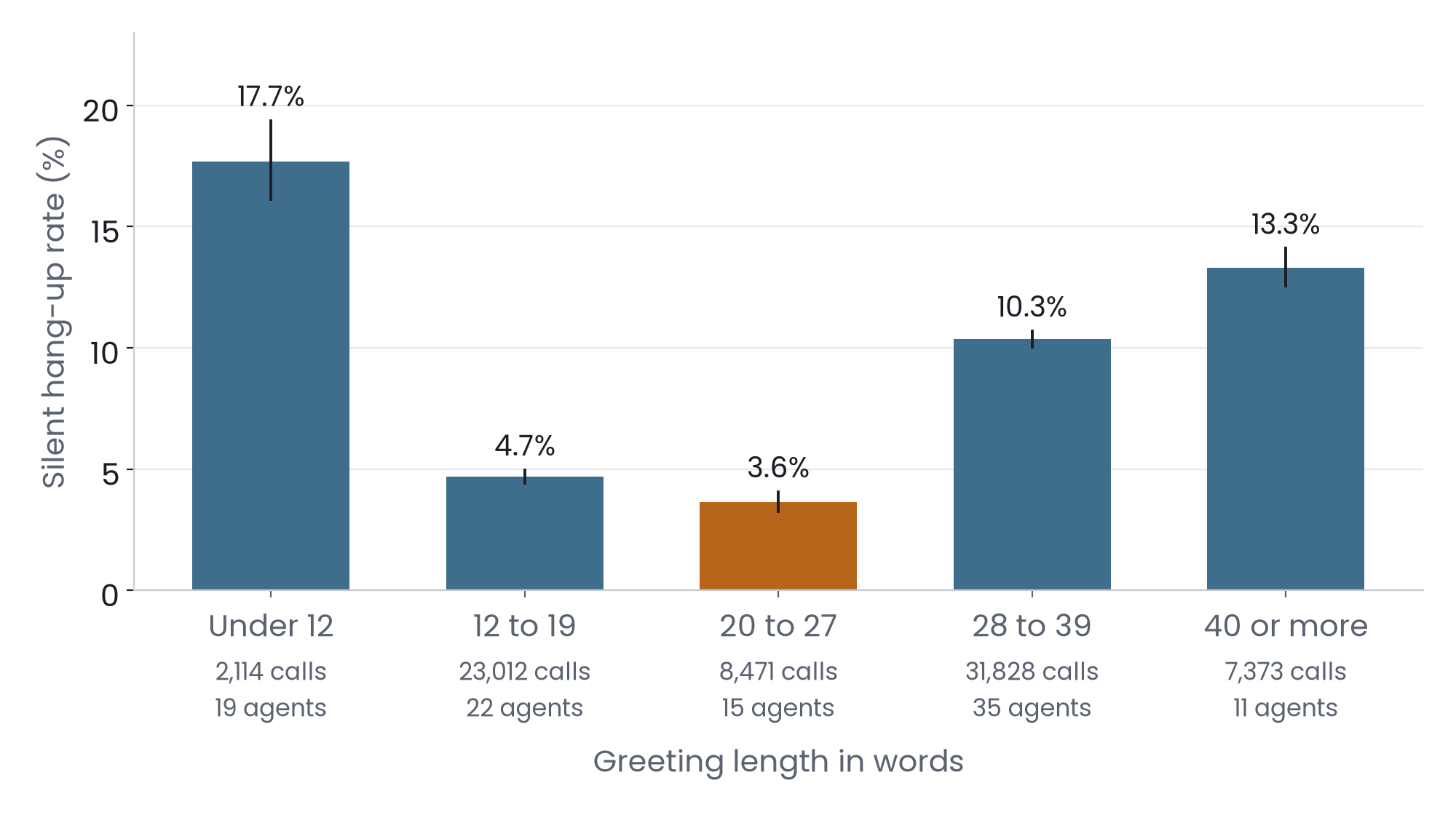
Results. Silent hang-ups occurred on 8.3% of calls. Greetings that opened with an apology or an absence ("our team is with clients right now") were associated with sharply higher odds of a silent hang-up (adjusted odds ratio 4.57, 95% CI 2.24 to 9.34), and the association held in every sensitivity analysis. Greetings of 20 to 27 words had lower odds than greetings of 12 to 19 words (0.23, 0.07 to 0.74), although this did not hold in every specification. Stating that the agent is AI was not associated with more silent hang-ups (0.62, 0.27 to 1.44) and was associated with fewer calls ending inside ten seconds (0.26, 0.15 to 0.45). Several conventions with large unadjusted differences, including ending the greeting on a question and mentioning call recording, showed no measurable effect once business type and agent were accounted for.
Conclusions. In this fleet, one greeting choice was clearly harmful, honest disclosure carried no measurable penalty, and most popular greeting rules did not measurably change whether callers stayed on the line. Raw comparisons across businesses overstated the importance of greeting wording, because the type of business explained much of the difference.
1. Introduction
Every business that answers a phone uses an opening script, and most inherited theirs. The conventions behind those scripts come from hospitality brand standards, call-center training and conversation research, and a companion essay, Thank You for Calling, reviews where each one comes from and how much evidence supports it. Several of the best-known rules, including answering within three rings, have no published study behind them.
The question has become more practical as AI voice agents answer a growing share of business calls. An agent delivers the same greeting on every call, which makes greeting choices easy to change and, in principle, easy to measure. It also raises a question human receptionists never faced: whether to tell the caller that an AI is answering. The only large published analysis of inbound AI greetings, a 2026 study of 450,702 calls by the AI receptionist company Upfirst, found that disclosing AI, mentioning recording and ending on a question were associated with fewer hang-ups, and that opening with the owner's absence was associated with more. That analysis did not adjust for the type of business.
This study asks which greeting features are associated with callers hanging up before they speak, once differences between businesses are taken into account.
2. Methods
2.1 Data source
Workforce Wave operates AI voice agents that answer inbound calls for businesses and public agencies. Call records were drawn from the voice platform's conversation logs for April 1 through October 9, 2026. Each record includes the agent, the start time, the call duration, the number of conversational turns and the transcript. The extract contained 73,735 inbound calls handled by 114 agents.
2.2 Inclusion
We excluded agents used for testing, demonstrations or internal purposes (identified by their configuration names), calls with no recorded duration, and calls for which the greeting could not be established. The analysis set contained 72,798 calls answered by 89 agents using 121 distinct greetings.
2.3 Outcomes
The primary outcome was a silent hang-up: the caller disconnected without saying anything. We identified silent hang-ups from the number of conversational turns recorded for the call, and validated that measure against 300 transcripts drawn evenly from calls with zero to four recorded turns. Every call with one turn or fewer (120 of 120) had no caller speech, and every call with two or more turns (180 of 180) had at least one caller utterance, so the measure agreed with manual review in all 300 cases. The secondary outcome was a call lasting under ten seconds.
2.4 Establishing the greeting each call heard
Greetings changed during the study window for some agents. For every agent in every calendar week, we retrieved one full transcript and took the agent's first utterance as that week's greeting, then assigned it to every call the agent answered that week (1,140 agent-weeks). When a caller speaks over a greeting, the transcript records only the part that was spoken, so greetings that were an exact prefix of a longer greeting from the same agent were merged into the longer version.
2.5 Greeting features
Each greeting was coded for nine features using fixed text rules:
| Feature | Definition |
|---|---|
| Apology or absence | States that staff are unavailable, busy or with other customers |
| Says it is AI | Contains "AI", "A.I." or "artificial intelligence" |
| Digital label | Describes the agent as a digital concierge, agent, assistant, receptionist or host (without "AI") |
| Virtual label | Describes the agent as a virtual assistant, receptionist, agent or concierge (without "AI") |
| Mentions recording | Contains any form of "record" |
| Ends on a question | The final character is a question mark |
| Small talk | Contains "how are you" |
| Length | Word count, grouped as under 12, 12 to 19 (reference), 20 to 27, 28 to 39, and 40 or more |
2.6 Business type
Each agent was assigned to one of seven business types from its configuration name: municipal and public agency, home services, restaurant, hospitality, health and care, spa and beauty, and other.
2.7 Statistical analysis
The primary model was a logistic regression of silent hang-up on all greeting features, with business type as a fixed effect and standard errors clustered by agent, so that calls to the same agent are not treated as independent observations. We report adjusted odds ratios with 95% confidence intervals. Three sensitivity analyses tested the results: generalized estimating equations with an exchangeable correlation structure within agents, the primary model refit without the agent that answered the most calls (17,885 calls), and the primary model with the secondary outcome. Where an agent's greeting gained or lost a feature during the window and at least 30 calls fell on each side, we also compared that agent with itself.
2.8 Privacy
Only call metadata, agent greetings and the presence or absence of caller speech were used. No caller speech, telephone numbers or identities were extracted or stored, and no client business is named in this report.
3. Results
3.1 Sample
Of 72,798 calls, 8.3% ended in a silent hang-up and 5.2% lasted under ten seconds. Silent hang-up rates varied widely by business type, from 3.4% on home-services lines to 15.9% on spa and beauty lines.
| Business type | Calls | Agents | Silent hang-up rate |
|---|---|---|---|
| Municipal and public agency | 26,234 | 20 | 9.2% |
| Home services | 17,906 | 2 | 3.4% |
| Restaurant | 7,370 | 4 | 11.4% |
| Other | 7,164 | 38 | 11.2% |
| Hospitality | 5,688 | 4 | 6.7% |
| Health and care | 4,329 | 4 | 8.0% |
| Spa and beauty | 4,107 | 17 | 15.9% |
| All | 72,798 | 89 | 8.3% |
3.2 Unadjusted comparisons
Before adjustment, several features showed large differences in silent hang-up rates (Table 2). Agent counts can exceed the total because some agents used more than one greeting during the window.
| Feature | With the feature | Without the feature |
|---|---|---|
| Apology or absence | 30.9% (110 calls, 2 agents) | 8.3% (72,688 calls, 88 agents) |
| Small talk | 20.3% (74 calls, 4 agents) | 8.3% (72,724 calls, 86 agents) |
| Ends on a statement | 16.0% (1,696 calls, 19 agents) | 8.1% (71,102 calls, 77 agents) |
| Mentions recording | 9.4% (45,526 calls, 44 agents) | 6.4% (27,272 calls, 51 agents) |
| Virtual label | 17.5% (4,290 calls, 6 agents) | No label: 8.1% (17,152 calls, 52 agents) |
| Digital label | 7.5% (50,160 calls, 33 agents) | No label: 8.1% |
| Says it is AI | 9.5% (1,196 calls, 8 agents) | No label: 8.1% |
3.3 Adjusted associations
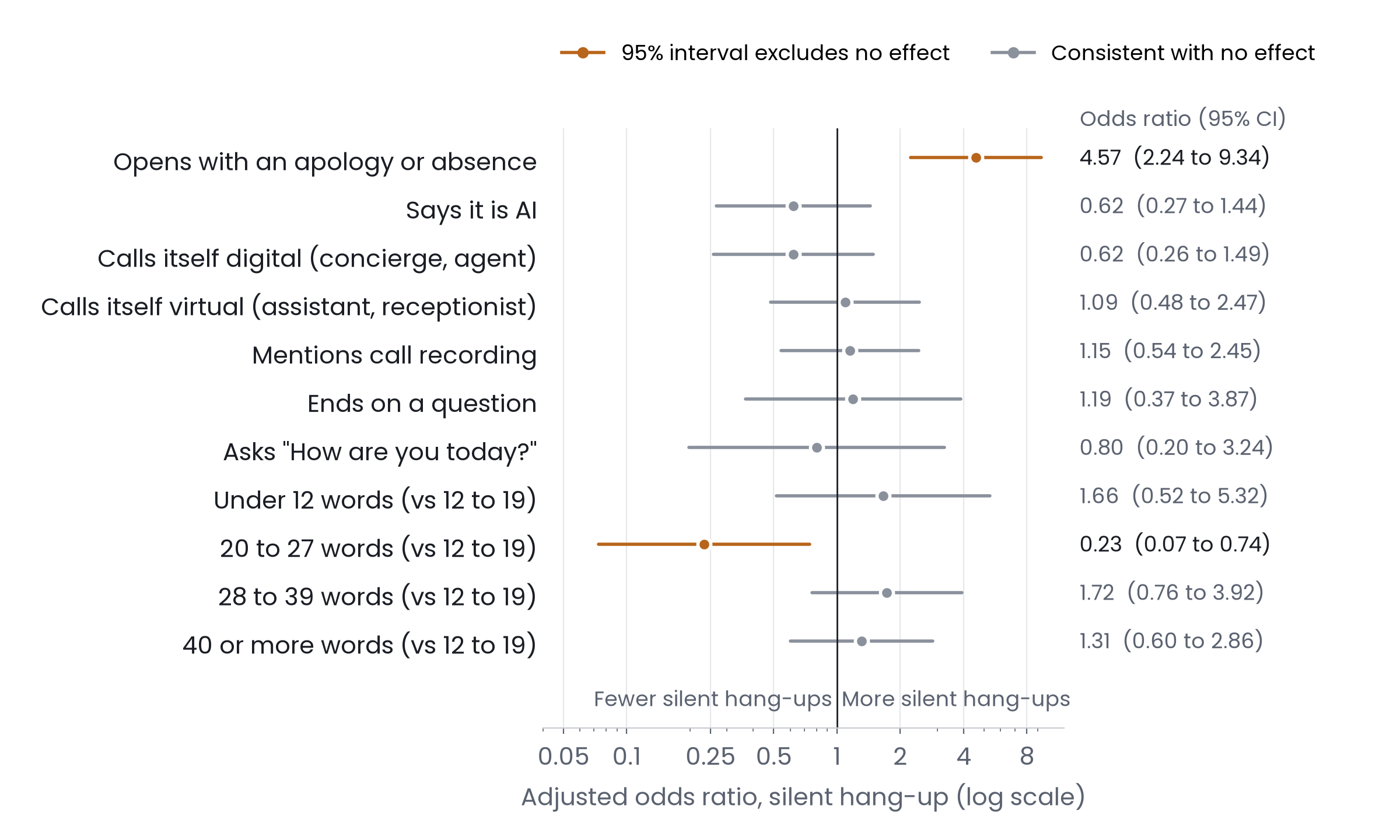
After adjustment for business type and clustering by agent, most of these differences were no longer distinguishable from no effect (Figure 1, Table 3). Two features remained.
Apology or absence. Opening with an apology or a statement that staff were unavailable was associated with 4.57 times the odds of a silent hang-up (95% CI 2.24 to 9.34). The association held under generalized estimating equations (2.40, 1.49 to 3.87), without the largest agent (4.58, 2.24 to 9.38) and for calls under ten seconds (3.24, 1.44 to 7.28).
Length. Greetings of 20 to 27 words had lower odds of a silent hang-up than greetings of 12 to 19 words (0.23, 0.07 to 0.74) and of a call under ten seconds (0.14, 0.05 to 0.36). The generalized estimating equations estimate pointed the same way but its interval included no effect (0.41, 0.13 to 1.29).
| Feature | Primary model | Generalized estimating equations |
|---|---|---|
| Apology or absence | 4.57 (2.24 to 9.34) | 2.40 (1.49 to 3.87) |
| Says it is AI | 0.62 (0.27 to 1.44) | 0.73 (0.41 to 1.30) |
| Digital label | 0.62 (0.26 to 1.49) | 0.68 (0.36 to 1.26) |
| Virtual label | 1.09 (0.48 to 2.47) | 1.02 (0.55 to 1.88) |
| Mentions recording | 1.15 (0.54 to 2.45) | 1.04 (0.52 to 2.11) |
| Ends on a question | 1.19 (0.37 to 3.87) | 1.31 (0.58 to 2.97) |
| Small talk | 0.80 (0.20 to 3.24) | 0.49 (0.15 to 1.61) |
| Under 12 words | 1.66 (0.52 to 5.32) | 1.37 (0.59 to 3.18) |
| 20 to 27 words | 0.23 (0.07 to 0.74) | 0.41 (0.13 to 1.29) |
| 28 to 39 words | 1.72 (0.76 to 3.92) | 1.55 (0.81 to 2.98) |
| 40 or more words | 1.31 (0.60 to 2.86) | 1.57 (0.80 to 3.10) |
Length categories are compared with 12 to 19 words; label categories are compared with greetings that carry no label. Bold marks intervals that exclude no effect.
3.4 Disclosure of AI
Greetings that stated the agent was AI showed no increase in silent hang-ups in either model, and were associated with substantially fewer calls ending inside ten seconds (adjusted odds ratio 0.26, 0.15 to 0.45). Four agents changed between greetings with and without the word "AI" during the window. In three, the period with the word had a lower silent hang-up rate (6.2% vs 15.4%, 2.5% vs 21.8%, 5.7% vs 15.7%); in the fourth the rates were similar (9.8% vs 8.8%). The periods with the word were short in three of the four agents (32 to 40 calls), so these comparisons are illustrative.
3.5 Within-agent comparison for absence openers
One agent used an absence opener for part of the window and a greeting without it for the rest. Its silent hang-up rate was 32.6% with the absence opener (95 calls) and 21.3% without it (174 calls).
4. Discussion
Across nearly 73,000 inbound calls, one greeting choice stood out. Telling callers that staff are busy or away, before offering help, was associated with roughly two and a half to four and a half times the odds that the caller would hang up without a word, and the finding held in every specification and in a within-agent comparison. It matches the direction and rough size of the Upfirst finding that leading with the owner's absence raised the odds of a hang-up by about half. A greeting that opens by explaining who is not available gives the caller a reason to try later.
Disclosure of AI carried no measurable penalty. Callers who heard the word "AI" were no more likely to hang up silently and were less likely to end the call within ten seconds. This agrees with the Upfirst inbound data and stands in contrast to the outbound sales experiment by Luo and colleagues, in which disclosure before the conversation reduced purchases by 79.7%. The difference is plausibly the direction of the call: a person who chose to call a business has already decided to have the conversation.
The most instructive result is what disappeared. Ending the greeting on a statement, mentioning recording and the choice of label all showed sizable raw differences, and none survived adjustment. Different kinds of businesses write different greetings and also receive different callers. Spa and beauty lines in this fleet had nearly five times the silent hang-up rate of home-services lines regardless of wording, and comparing greetings across those lines mostly measures the lines. Any greeting statistic that does not account for the type of business should be read with that in mind, including the vendor statistics most often quoted on the subject.
The length result is suggestive rather than settled. Greetings of about 20 to 27 words, enough for a business name, a named agent and an offer of help, outperformed shorter ones in the primary model and on the secondary outcome, but not under every specification.
5. Limitations
This is an observational study of one company's agents; greetings were not randomly assigned, and unmeasured differences between agents may remain. The apology finding rests on two agents and 110 calls, and its consistency with an independent dataset is part of the case for it. Silent hang-ups include spam, misdials and pocket dials, which add noise but are unlikely to depend on greeting wording. Greetings were established from one transcript per agent per week, so a change made partway through a week was attributed to the whole week. Business types were assigned from agent names and are approximate. Several features were rare, which leaves wide confidence intervals; an absence of evidence for those features should not be read as evidence of no effect.
6. Practical implications
- Remove any apology or absence from the opening line. If staff availability matters, say it after the caller has explained why they called.
- Disclosing that an AI is answering appears safe on inbound lines. We found no penalty and some evidence of benefit.
- Aim for a greeting of about 20 to 27 words: the business name, who is answering, and an offer of help.
- Measure your own line before changing your greeting, and compare it with itself over time rather than with other businesses.
Authors
Colin P. Highland and the Workforce Wave research team. October 2026.
Data availability
Aggregate tables and the analysis code are available from the authors on request. Call-level data are not shared, to protect clients and callers.
Conflict of interest
The authors work for Workforce Wave, which builds and operates AI voice agents. No external funding was received.
Suggested citation
Highland CP, Workforce Wave Research. The Opening Line: A 72,798-Call Study of Business Phone Greetings. Workforce Wave; October 2026.
References
- Upfirst. What makes people hang up on AI receptionists? We analyzed 450,000 calls. 2026. upfirst.ai
- Luo X, Tong S, Fang Z, Qu Z. Frontiers: Machines vs. humans: the impact of artificial intelligence chatbot disclosure on customer purchases. Marketing Science 38(6):937-947, 2019. RePEc
- Highland CP. Thank You for Calling: The Science of the Phone Answering Script. Workforce Wave, October 2026. workforcewave.com
Related Case Studies
Thank You for Calling: The Science of the Phone Answering Script
What the research says about phone answering scripts, which greeting rules still work when an AI voice agent picks up, and a gold-standard script to copy.
Chroma Feralis: The Wild Mirror of Escalation
Chroma Feralis isn't a voice agent, she's a prompt come to life. Born from chaos, built for performance.
The Actress in the Wire: Alex and the Art of Improvised Brand Voice
Alex isn't just a voice agent, she's an actress in the wire. In this demo, she transformed an ordinary call into something memorable.